Reasons to Work with a Business Coach When Launching Your Tech Startup

Launching your first tech startup can be exciting, but the work often puts product, hiring, finance, and go-to-market decisions on the same crowded calendar. Limited resources and a small team can make it difficult to test your thinking before a choice becomes expensive.
A qualified business coach can provide structured questions, accountability, and an outside perspective as you launch your tech startup. Coaching does not replace legal, accounting, technical, or mental-health expertise, but the right engagement can help you work through priorities, stay focused on your goals, and make better use of specialist advice.
How Can a Business Coach Help During a Tech Startup Launch?
A business coach can be a useful partner when the engagement has a clear scope and the coach understands the demands of an early-stage company. The five reasons below preserve the practical sequence founders need most: build confidence, maintain motivation, stick to goals, use a sounding board, and keep current without chasing every new trend.
Boosting Your Confidence
Launching your first tech startup can feel like taking one step forward and two steps backward. For every goal you accomplish, two new problems may appear. When you are starting on your own, you may also have to take on unfamiliar roles in sales, recruiting, customer research, budgeting, and operations.
Research can help you learn the right steps, practices, and strategies, but information alone does not test whether you are applying them to the right problem. A coach can ask you to explain the evidence behind a choice, separate an assumption from a fact, and identify the next decision. That process can build confidence without pretending that every decision is certain.
Taking on different roles and responsibilities can be challenging, especially when you have never done some tasks before. Researching the processes involved can help you perform them correctly and become more confident. A trained and experienced executive coach can share guidance, help you capitalize on your strengths, and build your belief in the plan, but the founder must still verify the advice and own the decision.
An experienced coach may also help you recognize strengths, blind spots, and common business startup pitfalls. The useful outcome is not confidence for its own sake. It is enough clarity to make a decision, document why you made it, and learn from the result.
Keeping You Motivated
Confidence can help you begin, while motivation helps you continue when launch work becomes repetitive or uncertain. Obstacles such as estimating startup costs, recruiting the right people, or revising a product plan can discourage a founder even when the underlying idea remains sound.
Regular conversations with a business coach create a place to name what is difficult, examine what changed, and choose the next manageable commitment. A coach can be a collaborator and co-strategist without becoming the decision-maker. The founder still owns the plan, the tradeoffs, and the result.
Throughout your entrepreneurial journey, you will face various obstacles. Encountering them can leave you feeling low, discouraged, or frustrated enough to consider abandoning a plan too early. Conversing with your coach can give you a useful push and help you stay determined to fulfill the next goal, provided the coach does not minimize a real warning sign.

Helping You Stick to Your Goals
Setting clear, realistic goals is an important part of a successful tech startup launch. Reaching them is different. Customer feedback, a missed hire, a delayed feature, or a cash constraint can force you to change the route without abandoning the destination.
Meeting a business coach on a regular schedule gives you a repeatable accountability loop. Review the goal, bring evidence of what happened, identify the blocker, make the decision, and commit to the next action. This process keeps goals visible while leaving room to revise them when the evidence changes.
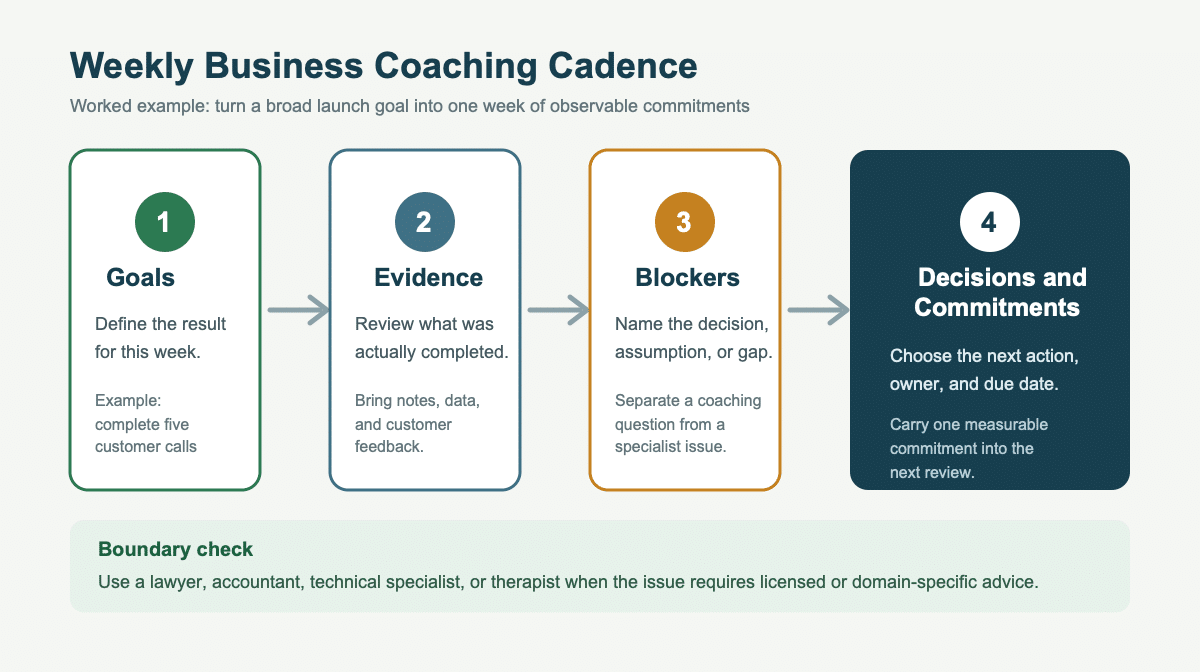
A coach can also help you examine the pressures that pull attention away from the plan and organize a practical startup growth plan. The cadence should produce observable commitments, not only a motivating conversation.
Acting as Your Constant Sounding Board
Running a startup can be a lonely job, especially before you have co-founders, investors, or a full team. A coach gives you a recurring place to discuss fears, ideas, and the assumptions inside your startup business plan.
As a sounding board, a coach can challenge an idea without competing for ownership of it. You can use the conversation to test an old idea, organize several new ones, and decide which deserve priority. The strongest coach does not simply agree or supply an answer. The coach helps you make your reasoning visible.
You may also need a second opinion on fears, ideas, and business plans running through your mind. A coach can help you harness ideas, tweak old ideas so they are more suitable for the venture, and figure out which options are worth prioritizing and pursuing. This role works only when the coach listens carefully and is willing to question your basis for choosing one direction over another.
Helping You Stay Up to Date With Relevant Trends
Technology, customer expectations, and marketing methods continue to change, but no business coach can be an expert in every field. A coach is most useful here when they challenge stale assumptions, help you identify a knowledge gap, and ask what evidence would justify changing the plan.
The business world is constantly changing, and emerging technologies can alter how a startup serves customers or runs internal tasks. Innovative ideas and strategies may help a venture remain competitive, but chasing every new tool can create extra work. A coach can help you understand the management trends that matter to the plan and identify the specialist insight needed before you act.
For a legal, tax, security, engineering, or clinical question, use the appropriate qualified specialist. Your coach can help you prepare the question, compare the advice with your goals, and turn a specialist recommendation into an accountable action. Continuing the engagement after launch may also help you decide when a tool or practice supports real startup growth and when it is only a distraction.

How Do You Choose the Right Business Coach?
Coaching quality is not uniform. Before hiring a coach, define what you want the engagement to change and what falls outside its scope. Then score each candidate against evidence you can verify.
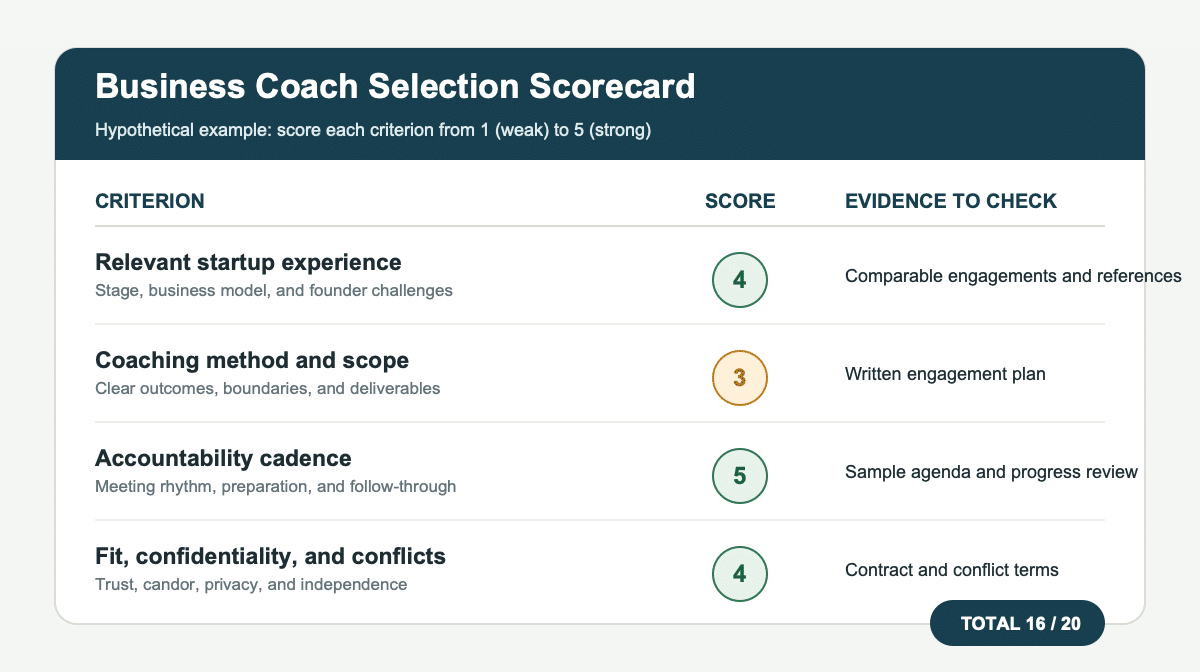
The scorecard is a hypothetical example. Use a one-to-five scale for relevant startup experience, coaching method and scope, accountability cadence, and fit, confidentiality, and conflicts. Ask for comparable references, a written engagement plan, a sample agenda, and clear contract terms. Add your scores only after reviewing the evidence.
ICF credentials designate coaches who have met education and experience requirements and demonstrated an understanding of coaching ethics and core competencies. A credential does not prove that a coach is the right fit for your startup, so confirm the credential in the ICF credentialed coach finder, check references, and evaluate the working relationship.
When Is a Business Coach Not the Right Resource?
Use a coach for structured reflection, accountability, and decision discipline. Use a mentor when you need informal experience from someone who has followed a similar path. Use a consultant or fractional executive when you need analysis, recommendations, or direct operating work. Use a lawyer, accountant, therapist, or technical specialist when the issue requires licensed or domain-specific advice.
A clear boundary protects both sides. It also helps you decide whether coaching is the missing resource or whether the startup needs expertise, execution capacity, or personal support instead.
Working With a Business Coach
Working with a business coach can support a tech startup launch when the coach has relevant experience, the goals are explicit, and the meetings produce decisions and follow-through. The best test is practical: after several sessions, you should be able to point to clearer priorities, documented commitments, and better questions for the specialists your business needs.
Frequently Asked Questions
What should a startup business coach help with?
A startup business coach should help you clarify goals, test assumptions, prepare decisions, and maintain accountability. The coach should not replace licensed or domain-specific specialists.
How is a business coach different from a mentor or consultant?
A coach uses questions and accountability to improve your decision process. A mentor shares experience informally, while a consultant analyzes a problem and recommends or implements a solution.
When should a tech founder hire a coach?
A tech founder may benefit from a coach when important decisions are repeating, priorities are drifting, or the founder lacks a neutral accountability partner. Hire for a defined need rather than a vague promise of growth.
What should you ask before hiring a business coach?
Ask about relevant startup experience, coaching method, scope, meeting cadence, confidentiality, conflicts, references, and credential verification. Request a written engagement plan before committing.