How Does the Decision-Making Process Affects Firm Success?

Every day, managers make decisions about human resources, partnerships, money, and products or services. A sound choice can still fail when the evidence is weak or the people responsible for execution were excluded. The decision-making process affects firm success because it shapes both the quality of the decision and how well the decision is executed throughout the organization.
The process matters as much as the final choice. A disciplined approach helps a firm define the problem, gather information, compare alternatives, involve affected people, assign responsibility, and learn from the result. It also connects decision-making with the broader problem solving process instead of treating each choice as an isolated event.
What Is the Decision-Making Process?
The decision-making process is a repeatable method for moving from an idea or problem to a choice, an action, and an evaluation. It establishes what the firm is deciding, who owns the decision, which information matters, who will be affected, what alternatives exist, and how the organization will assess the achievements or consequences that follow.
Organizations use different approaches to decision-making. In some cases, decisions come from management because speed, confidentiality, legal authority, or crisis conditions require a clear owner. Workers may not be allowed or may not have the opportunity to decide on behalf of the firm. A top-down approach can be appropriate, but a bureaucracy becomes a problem when layers of approval stifle useful participation without improving the quality of the decision.
Other organizations offer a chance for more people to be involved in decision-making and empower employees to make decisions within defined boundaries. A cleaner, for example, can have autonomy over the role, identify a recurring safety or supply problem, and make suggestions that reach the CEO and board. The cleaner may not choose the company strategy, but firsthand knowledge can improve the information available to those who do.
Participatory decision-making does not mean that everyone votes on every option. It means the decision owner deliberately gathers the knowledge and wisdom of participants who understand the work, the customer, the risk, or the implementation. Clear decision rights protect speed, while consultation reduces blind spots and helps affected people understand what will happen next.
A useful process also distinguishes consultation from authority. One person may initiate an idea, several participants may gather information and look for alternatives, and an accountable manager may still choose the path. Publishing those roles in a policy, procedure, project brief, or meeting record prevents people from confusing an invitation to contribute with a promise that every suggestion will be adopted.

What Is the Best Decision-Making Process?
The best decision-making process fits the importance, urgency, reversibility, and risk of the choice. A minor scheduling decision should not require the same analysis as a new partnership, a hiring plan, or a major product change. However, a consistent process gives managers and staff a shared sequence they can scale up or down.
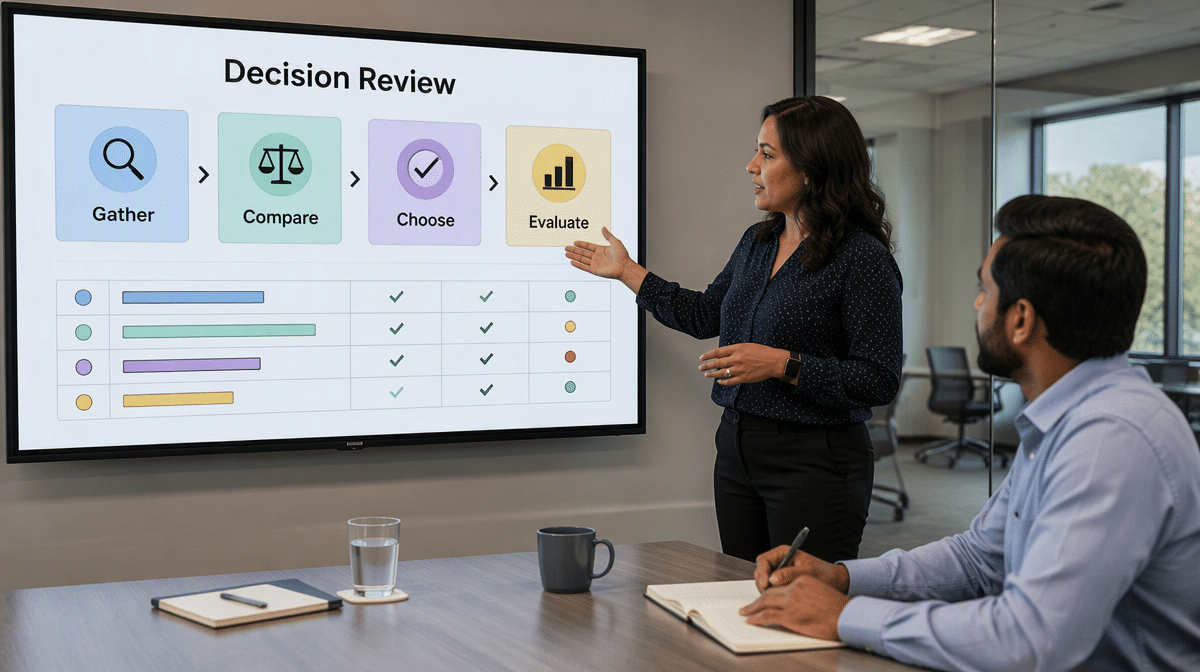
The original process can be outlined in the following eight steps:
- Initiate an idea. The idea may come from anyone in the firm. State the problem, opportunity, or target goals clearly enough that people know what is being decided and what is outside the scope.
- Gather information. Identify who the choice will affect and its likely impact on operations, people, money, products, and services. Separate verified facts from assumptions that still need to be tested.
- Look for alternatives. Ask whether there is a better, cheaper, faster, safer, or more rewarding way to achieve the goal. Include the option to delay or take no action when that is genuinely possible.
- Engage participants. Discuss the idea with affected people and subject-matter experts to understand their experience, concerns, and practical constraints. Effective employee collaboration depends on giving participants a clear question, not simply asking for general feedback.
- Weigh the evidence. Re-evaluate the idea and each alternative based on the information and feedback collected. Compare benefits, costs, risks, timing, and the confidence behind important assumptions.
- Choose. Pick the path of implementation based on the discovery, explain why it was selected, and name the decision owner. Record important tradeoffs so the firm can review the reasoning later.
- Take action. Implement the idea with an owner, resources, deadlines, and a communication plan. A decision without assigned action remains an intention rather than an operational choice.
- Evaluate. Assess the achievements, unintended effects, and lessons from implementation. Adjust the action or the process to achieve better results, and preserve what the organization learned for the next decision.
This sequence prevents a common mistake: choosing quickly, then searching for evidence that supports the preferred option. Gathering information and looking for alternatives before choosing makes assumptions visible. Engaging participants before implementation also gives the decision owner a chance to find operational constraints while they are still easier to address.
The amount of documentation should remain proportional to the choice. Routine, reversible decisions may need only a short checklist and a named owner. High-cost, high-risk, or difficult-to-reverse decisions need a clearer problem statement, evidence record, alternative analysis, approval path, implementation plan, and scheduled evaluation. The sequence stays consistent even when the depth changes.
How Does the Decision-Making Process Affect Firm Success?
A firm may pick any decision-making approach as part of its process. Each option carries consequences. The process influences which information reaches the decision owner, whether participants understand the choice, how quickly people act, and whether the organization notices a weak result early enough to adjust.
How Does Participation Enrich Decisions?
Involving other people and gathering more information can produce better, more enriched decisions when the participants contribute relevant experience. No one has a monopoly on knowledge and wisdom. Employees close to the work may see customer friction, process variation, supply limitations, safety risks, or service failures before those issues appear in a management report.
Participation is most useful when it is structured. Ask affected people what could prevent implementation, which assumptions appear weak, and what evidence would change their view. The goal is not to collect the largest number of opinions. It is to improve the facts, alternatives, and risk picture before the decision is made.
Why Do Inclusive Decisions Improve Execution?
People working in the firm are more likely to understand and embrace decisions when they participated in the process or can see how their concerns were considered. Inclusion does not guarantee agreement, but it can reveal resistance, training needs, unclear roles, and resource gaps before they create rework.
Evidence summarized by the CIPD on employee voice and productivity indicates that employee voice can strengthen the long-term productivity benefits of well-designed work practices. The practical lesson is conditional: participation works best when employees have useful information, a meaningful channel, and management that acts on relevant feedback.
How Can Decision-Making Build Brand Loyalty and Pride?
Firms rely on the ingenuity and innovation of their workers to thrive. When management explains why a choice was made, gives people appropriate autonomy, and recognizes useful suggestions, employees can see how their work contributes to the firm’s direction. That connection can build ownership, professional pride, and stronger commitment to implementation.
The opposite is mechanical compliance. If only a few people make decisions and frontline knowledge never travels upward, workers may do exactly what they were told while withholding ideas, warnings, and discretionary effort. They may be less willing to go the extra mile because the organization has shown that their experience does not influence the work.
Why Does Participatory Decision-Making Matter?
A participatory decision-making process can support increased productivity and better working conditions when cooperation is genuine and decision rights remain clear. The International Labour Organization’s workplace cooperation guidance connects information sharing and consultation with potential improvements in productivity, efficiency, competitiveness, job satisfaction, and working conditions.
These benefits are not automatic. Participation that has no scope, no decision owner, or no response to feedback can slow the process and damage trust. Management should tell participants whether they are providing information, recommending alternatives, sharing approval authority, or making the final choice. That clarity lets the firm gain broader insight without turning every issue into consensus management.

How Can a Firm Make Decisions Consistently?
One of the most crucial components of a small business is decision-making, but consistency does not mean every decision produces the same answer. It means comparable choices follow a recognizable process, use appropriate evidence, assign authority at the right level, and leave a record of why action was taken.
You and your executive team will make key decisions, while managers and staff employees will make many minor decisions, sometimes without executive participation. Define which decisions can be made at each level, which limits require escalation, and which people must be consulted. This gives employees autonomy without leaving them to guess where their authority ends.
Use a short decision record for choices that matter. Capture the issue, owner, participants, alternatives, evidence, selected action, expected result, and evaluation date. The record makes reasoning easier to review, reduces repeated debate, and helps the organization distinguish a poor decision from a sound decision that encountered an unpredictable result.
Make sure to implement a consistent process that everyone can follow. Review results at a cadence that matches the decision. A reversible operational choice may need a quick weekly check, while a major partnership or investment may require milestones over several months. Evaluation closes the loop by showing whether to continue, adjust, reverse, or replace the chosen path.
The strongest process is neither purely top-down nor participatory in every situation. It matches the participants, evidence, decision owner, action, and evaluation to the scope of the choice. That is how a firm improves decision quality, execution, learning, and accountability without creating unnecessary bureaucracy.
Frequently Asked Questions
What Is the Decision-Making Process?
The decision-making process is a repeatable method for defining an issue, gathering information, comparing alternatives, choosing a path, taking action, and evaluating the result. It also identifies the decision owner and the people affected by the choice.
How Does the Decision-Making Process Affect Firm Success?
The process affects firm success by shaping the quality of available evidence, the alternatives considered, employee understanding, implementation speed, and the firm’s ability to learn from results. A disciplined process improves consistency without guaranteeing a particular outcome.
What Are the Main Steps in a Decision-Making Process?
The main steps are to initiate an idea, gather information, look for alternatives, engage participants, weigh the evidence, choose, take action, and evaluate. The depth of each step should match the importance, risk, urgency, and reversibility of the decision.
Why Should Employees Participate in Decision-Making?
Employees can contribute firsthand knowledge about customers, processes, risks, and implementation constraints. Appropriate participation can improve the evidence behind a choice, reveal practical problems early, and help affected people understand how to carry out the decision.
How Can a Firm Evaluate Whether a Decision Was Successful?
Define the expected result, owner, measures, and review date before implementation. At the review, compare actual results with the target, identify unintended effects, test the original assumptions, and decide whether to continue, adjust, reverse, or replace the action.