How are Financial Controls Implemented?

Financial controls only work when approvals, records, reviews, and follow-up happen consistently. A policy may say who approves expenditures, who signs checks, who reviews ledgers to accounts, and who keeps the required records, but those words do not control anything until people use them in daily finance processes.
That is why financial controls are implemented through a connected system of policies and procedures, assigned responsibilities, evidence, monitoring, and corrective action. Sarbanes-Oxley Act requirements brought more attention to internal control over financial reporting, but the practical question applies to every organization: how are financial controls implemented so they reduce risk and improve performance?
What Are Financial Controls?
Financial controls are the documented responsibilities, approvals, reconciliations, records, and reviews used to protect assets and support reliable financial information. They form part of an organization’s broader internal control system and are built into its finance processes, policies, and procedures.
The Committee of Sponsoring Organizations of the Treadway Commission, commonly called COSO, provides a widely used framework for designing and evaluating these controls. The COSO Internal Control Integrated Framework connects internal control to operations, reporting, and compliance objectives, so control is broader than preventing an accounting error after it occurs.
Financial Controls Reduce Waste, Fraud, and Abuse
Historically, financial controls have often been discussed in terms of preventing fraud and abuse. That remains essential. Segregating duties, documenting approvals, reconciling accounts, restricting access, and reviewing exceptions can reduce opportunities for unauthorized transactions and help identify problems before they spread.

Financial controls also mitigate financial risks, support the attainment of financial objectives, and help an organization meet corporate governance, fiduciary duties, and due diligence obligations. Increasing regulatory requirements have made compliance with tax and public-company financial reporting rules a prominent control goal, but compliance is not the only goal.
The SEC’s Section 404 rules require covered public companies to report management’s responsibility for internal control over financial reporting and assess its effectiveness using a suitable recognized framework. COSO is a common choice, and the Public Company Accounting Oversight Board recognizes it as an example, but the rules do not require COSO alone.
The Purpose of Financial Internal Controls
In a narrow view, a financial control system identifies who approves expenditures, signs checks, reviews ledgers to accounts, lists the required records, and assigns responsibility for keeping them. Is this really all an internal control system does?
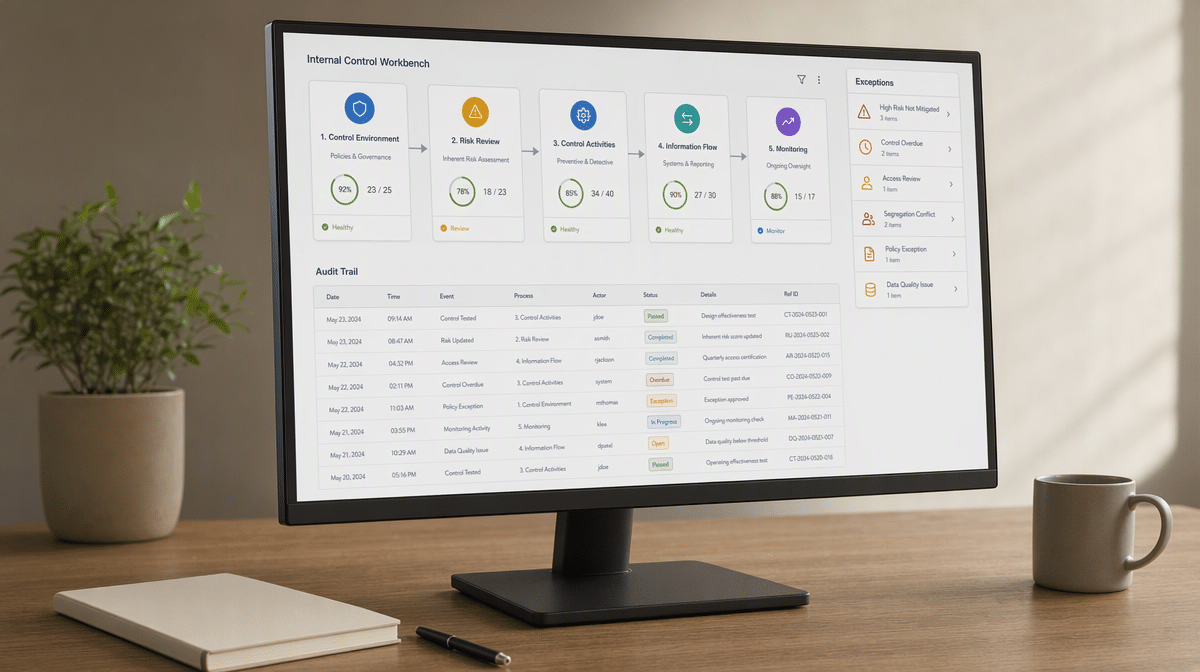
COSO says internal control supports three categories of objectives: operations, reporting, and compliance. Financial reporting and compliance are two obvious areas. The third, effectiveness and efficiency of operations, creates an important opportunity for improvement. If your only financial performance objectives are preventing fraud and complying with laws and regulations, the same controls are not being used to their full potential.
COSO Describes a Control System Framework
COSO describes five integrated components that must be present and functioning for an internal control system to be effective:
- Control Environment: The tone, integrity, accountability, and culture of an organization.
- Risk Assessment: Identifying and analyzing risks that could prevent objectives from being achieved.
- Control Activities: The policies and procedures that direct key organizational activities and responses to risk.
- Information and Communication: Capturing and disseminating useful information throughout the organization.
- Monitoring Activities: Evaluating whether controls remain present, function as designed, and lead to timely correction.
Implementation is not the act of writing five headings into a manual. Each component has to appear in operating responsibilities, records, approvals, reviews, communication channels, and management follow-up. The components reinforce one another, so a strong approval policy can still fail if people lack information or management never monitors exceptions.
How Do Financial Controls Drive Improvement?
Effectiveness and efficiency become clearer when one component, Control Environment, is applied to everyday management. Controls do not improve a process simply because a form was completed. They improve it when management sets realistic goals, assigns resources, watches results, and responds to what the evidence shows.
Control Environment
The Control Environment is the foundation for the other components of internal control. It is the tone and culture upon which other activities are conducted, and in most organizations it flows from the top. One practical test is simple: how involved is management in setting realistic goals and ensuring the organization has the resources to carry them out?
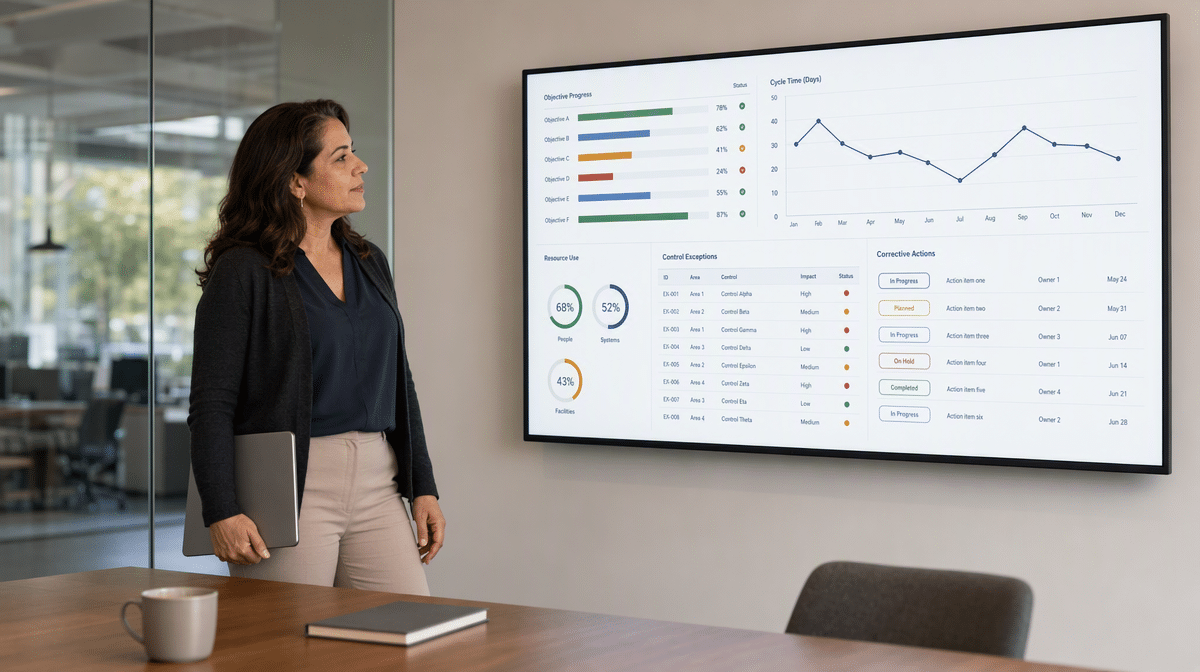
Consider two contrasting styles. In the first, organizational goals fall from the sky with no involvement from the people tasked with carrying out the activities required to reach them. Results are ignored altogether or ignored until the end of the period, when performance receives a nod of the head or a wag of the finger. That is not a functioning review control. It is a delayed reaction.
Management Objectives
At the other end of the spectrum, management sets goals and objectives through a collaborative process. Responsibility is assigned, assumptions are documented, and management regularly reviews progress, performance, and leading indicators to determine whether objectives will be met. If results are drifting, the review identifies whether corrective action should be taken while there is still time for it to matter.
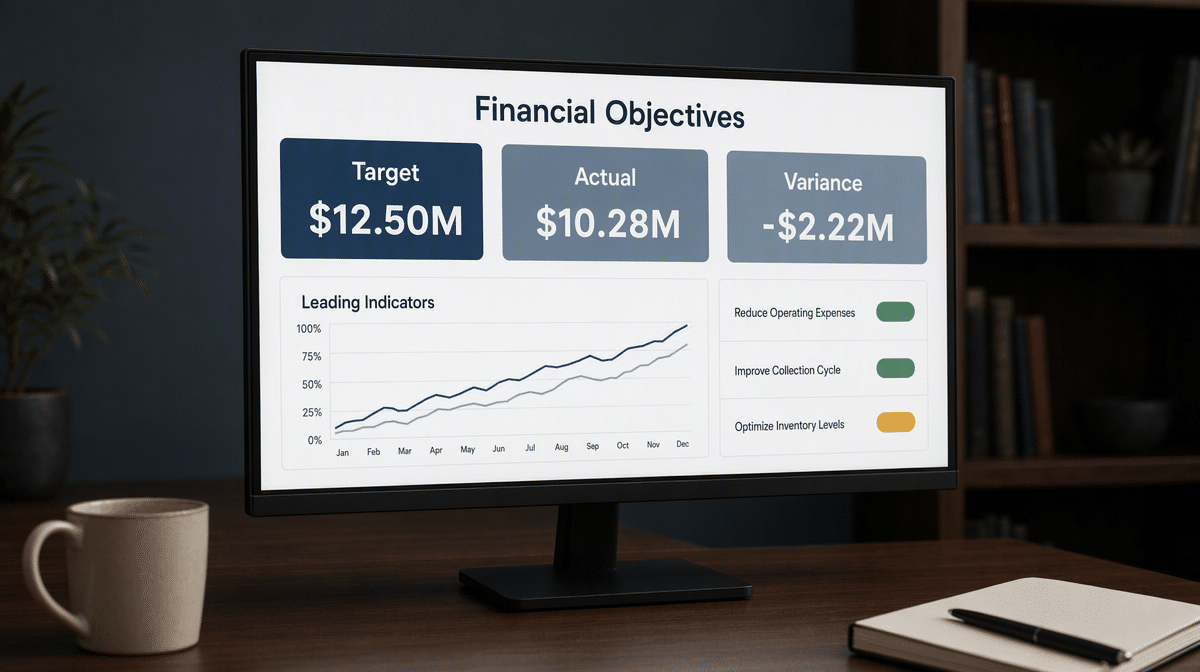
Sometimes there are valid reasons for missing objectives. How well those reasons are investigated, understood, and absorbed into organizational knowledge is also a function of the Control Environment. Participative management helps establish a tone in which using resources to reach objectives means something concrete rather than becoming empty phrasing.
Financial Controls for Process Improvement
Examples of controls that improve performance appear in every component. Through Control Activities, policies and procedures can incorporate process objectives, regular measurement and review, ownership of corrective actions, and communication between key departments. These controls create evidence that managers can use to change a process rather than merely confirm that a transaction occurred.
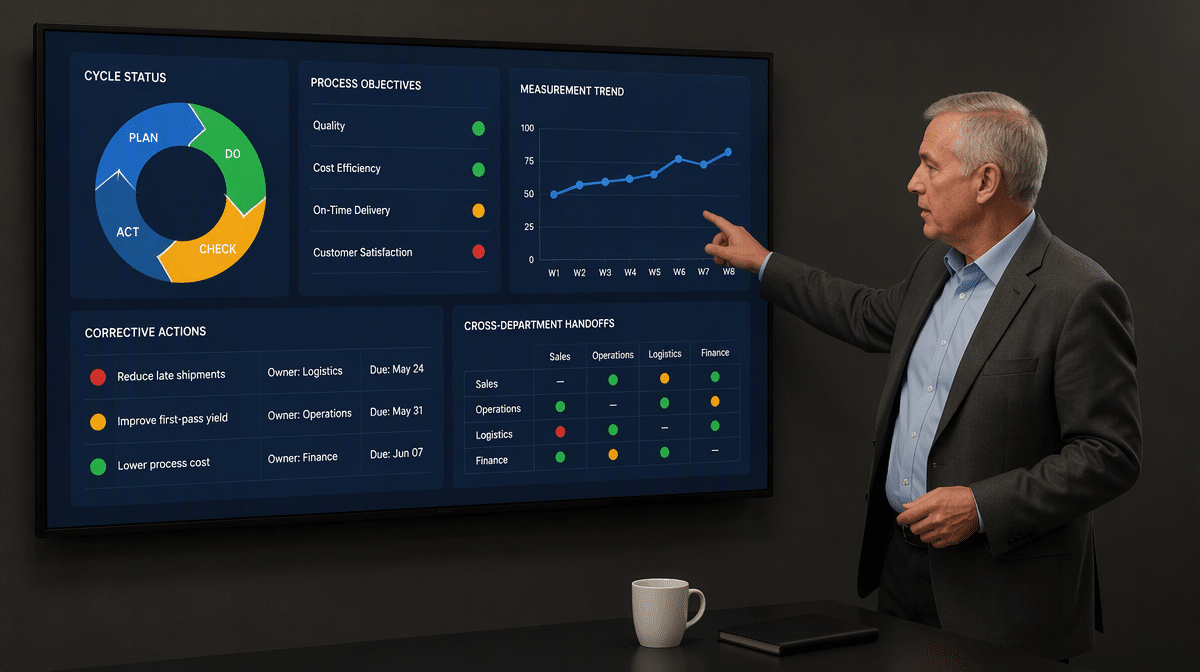
The procedures found in policies and procedures manuals can follow the Plan-Do-Check-Act philosophy of continually improving processes, including a Finance Policies and Procedures Manual. Plan the objective and control, do the work, check the evidence, and act on the result. The cycle makes monitoring and corrective action part of the process rather than an occasional audit event.
Process Procedures Communication
Communication activities can be built into processes and procedures, creating channels that are frequently missing in organizations. Strategic goals inform department and segment goals, while reporting from those areas gives management current information about risks, performance, and exceptions. This alignment reduces conflicting priorities, brings problems forward earlier, and coordinates corrective action across the organization.
How Can You Implement Financial Controls?
Start with the financial objectives and risks that matter most. Then define who owns each control, what evidence it produces, how often it operates, who reviews the evidence, what counts as an exception, and how exceptions are resolved. A practical implementation sequence is:
- Set clear financial, reporting, compliance, and operational objectives.
- Assess the risks that could prevent those objectives from being achieved.
- Assign responsibility and separate incompatible duties where practical.
- Document approvals, reconciliations, records, access rules, and review procedures.
- Train the people who perform and supervise each control.
- Monitor leading indicators, exceptions, and evidence at a defined cadence.
- Take corrective action and feed what was learned back into the process.
A control system should make responsibility visible and follow-up unavoidable. COSO fits this philosophy because control is not only about preventing fraud and complying with regulations. It is about having the structure and tools to be effective and efficient, and doing things a little better tomorrow, next week, next month, and next year.
Frequently Asked Questions
What Are Financial Controls?
Financial controls are documented responsibilities, approvals, reconciliations, access rules, records, and reviews that protect assets and support reliable reporting. They also help an organization manage risk and improve operations.
How Are Financial Controls Implemented?
Financial controls are implemented by connecting objectives and risks to assigned responsibilities, documented procedures, control evidence, management review, and corrective action. Training and monitoring make the controls part of daily work.
What Are the Five Components of COSO’s Internal Control Framework?
The five components are Control Environment, Risk Assessment, Control Activities, Information and Communication, and Monitoring Activities. The components work together to support operations, reporting, and compliance objectives.
How Do Financial Controls Reduce Fraud and Improve Operations?
Controls reduce fraud by separating duties, requiring approvals, restricting access, reconciling accounts, and reviewing exceptions. The same evidence helps managers find delays, resource problems, and opportunities for process improvement.
Why Does the Control Environment Matter?
The Control Environment establishes the tone, accountability, and management behavior that support every other control component. Policies are less effective when leaders set unrealistic objectives, ignore evidence, or fail to act on exceptions.