What Is the Process Approach to Business Process Management?

A business process can produce an output without proving that the output meets its objective. Business process management (BPM) uses the process approach to connect daily work with planned results, objectives, and your strategic vision.
The process approach to business process management defines the inputs, activities, outputs, customers, criteria, feedback, and corrective actions for a process. It gives managers a process management approach for deciding what to measure, monitor, and take action on, rather than treating each task as an isolated activity. The related process approach method helps you define those elements in a procedure.
What Is the Process Approach?
A well-defined business process is a series of connected steps used to transform inputs into outputs. The process approach manages those steps as a system: it establishes the process boundary, assigns responsibility, identifies required resources, defines the expected result, and uses evidence to decide whether the process is under control.
The International Organization for Standardization explains that organizations achieve more consistent results when activities are understood and managed as connected processes. Its process approach guidance also identifies inputs, outputs, interactions, controls, measures, resources, risks, and responsibilities as elements to consider.


How Do SIPOC and PDCA Work Together?
SIPOC and PDCA
SIPOC is an acronym for Supplier, Inputs, Process, Outputs, and Customer. Every input to your process has a supplier that provides it. Your business process converts the inputs into an output for a customer. The American Society for Quality SIPOC guide defines the same five elements and uses them to establish a high-level view of a process before detailed mapping.
SIPOC defines the flow and boundaries. PDCA adds the management cycle needed to control that flow. Together they prompt you to ask who supplies each input, what work changes it, who receives the output, what result is expected, what evidence is collected, and what action follows when actual performance differs from the objective.
Feedback Separates a Controlled Process From a Ballistic Process
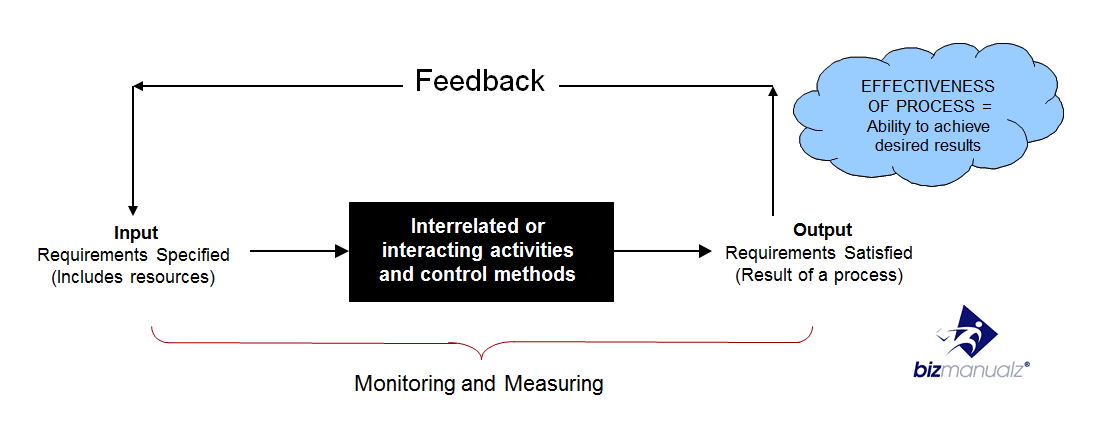
The original process graphic includes a red feedback line from the customer back to the process. That line represents the comparison of feedback and output data with the process objectives. Customer feedback is critical to developing a controlled process. Without feedback and criteria, you end up creating a “ballistic process” instead of a controlled process.
Ballistic processes blindly transform inputs into outputs. By adding process criteria, targets, or objectives to your feedback, you transform a ballistic process into a controlled process. Process feedback is what you measure, monitor, and take action on. Process criteria are what you compare that feedback with to maintain control.
Effective Processes
BPM is about planning effective processes that achieve a defined management strategy. A process is not effective merely because employees complete its activities. It is effective when its output meets the criteria that represent the intended strategy, customer requirement, quality level, timing, cost, or other objective.
This applies to production plans, production schedules, work center plans, maintenance plans, staffing plans, training plans, and other operating plans. Management’s job is to make plans, carry out those plans, collect data, compare performance with the plan, and use controls to keep the work on track. This is the essence of business process management.
PDCA and the Process Approach

PDCA is an acronym for Plan, Do, Check, Act. ISO describes the PDCA quality management cycle as planning what to do, doing what was planned, checking the outcomes, and acting on the findings for further improvement.
If you overlay the “P” of PDCA with the “P” of the SIPOC diagram, you get an easy graphical reminder of the elements needed for a complete business process management definition. Plan establishes the criteria. Do operates the process and produces feedback data. Check compares the data with the criteria. Act corrects the cause of a gap, standardizes a successful change, or revises the plan. The action step provides the correction needed to demonstrate that the process is under control.
What Is a Process Approach Example?
The following hypothetical worked example applies SIPOC and PDCA to an order-fulfillment process. It is a planning aid, not measured customer data.
| Process element | Hypothetical order-fulfillment example |
|---|---|
| Supplier | Inventory vendor and sales team |
| Inputs | Approved customer order, stocked item, shipping information |
| Process | Pick, pack, verify, and ship the order |
| Outputs | Correct, complete order dispatched as agreed |
| Customer | The purchaser receiving the order |
| Criteria | Correct item, complete quantity, and agreed dispatch time |
| Feedback | Verification result, delivery exception, or customer confirmation |
| Action | Correct the cause of any gap and update the process or control |
In the Plan step, the manager defines the order requirements and acceptance criteria. In Do, employees pick, pack, verify, and ship. In Check, the manager compares verification records and customer feedback with the criteria. In Act, the team corrects a recurring cause, such as an unclear location code, and then confirms whether the change produces the planned result. This is a productive process approach because the team controls performance with evidence instead of assuming that completed activity equals success.
Process Approach to Business Process Management
Add SIPOC and PDCA together and the acronyms make a complete set that reminds you of the elements needed to demonstrate that business processes are managed. The process approach to BPM is about creating controlled processes using SIPOC and PDCA to define, measure, monitor, and control. That is business process management in action.
- Define the supplier, inputs, process boundary, outputs, and customer.
- Assign responsibility and identify the resources needed to operate the process.
- Set criteria, targets, or objectives that represent the planned result.
- Run the process and collect feedback and performance data.
- Compare actual results with the criteria.
- Take corrective or improvement action and repeat the cycle.
If you are asking what is the process to apply this approach, begin with one important workflow and complete these six steps before expanding to connected processes. Keeping the first scope narrow makes gaps in ownership, criteria, and feedback easier to see.
Frequently Asked Questions
What is the difference between SIPOC and PDCA?
SIPOC defines the process boundary and flow from supplier through customer. PDCA defines the management cycle used to plan the work, run it, check the result, and act on what the evidence shows.
How does feedback create a controlled process?
Feedback becomes a control when it is compared with a defined criterion, target, or objective. The comparison shows whether the process meets its planned result and whether corrective action is needed.
What should a business measure in a process?
Measure the evidence that shows whether the output meets the process objective. Depending on the process, this can include accuracy, completeness, timing, cost, defects, exceptions, or customer feedback.
What is a ballistic process?
A ballistic process is the Bizmanualz term for a process that transforms inputs into outputs without adequate criteria, feedback, or corrective action. It may produce work, but managers cannot reliably show that the result is controlled.
How does the process approach support business strategy?
The process approach turns strategic objectives into operating criteria and measures. Managers can then compare actual process results with those criteria and act when the work moves away from the plan.
Download free policies and procedures to examine how pre-written templates define responsibilities, steps, records, and controls. The SIPOC plus PDCA model helps you evaluate whether those procedures connect everyday work to measurable objectives.