Why are Management Procedures Important?

Have you heard of management by objectives? Peter Drucker introduced the idea in The Practice of Management, published in 1954, as part of a broader approach to managing for results. This is basic goal setting: choose clear objectives, agree on them with your employees, and drive toward the result.
Results are important, but so is keeping control of how your organization produces them. Management procedures are important because they connect objectives to a defined process, assign responsibility, guide training, create a basis for auditing, and give managers a repeatable way to improve the work.
What Are Management Procedures?
Management procedures are the documented methods managers use to turn goals into consistent work. McDonald’s is a familiar franchise example. The company describes its franchise model as established systems, training, and operating standards that turn complexity into operational consistency. A procedure does not make every location identical, but it gives people a common method that can be taught, observed, measured, and improved.
You start by defining your process with a process map that builds visual communication and understanding. Next, write down what needs to get done, by whom, and when. Then deploy and practice the procedure. Observe the real work, correct gaps, and perfect the procedure until you have a consistent process. A franchise organization would need this discipline to roll a method out to hundreds of franchise owners and other successful franchises.
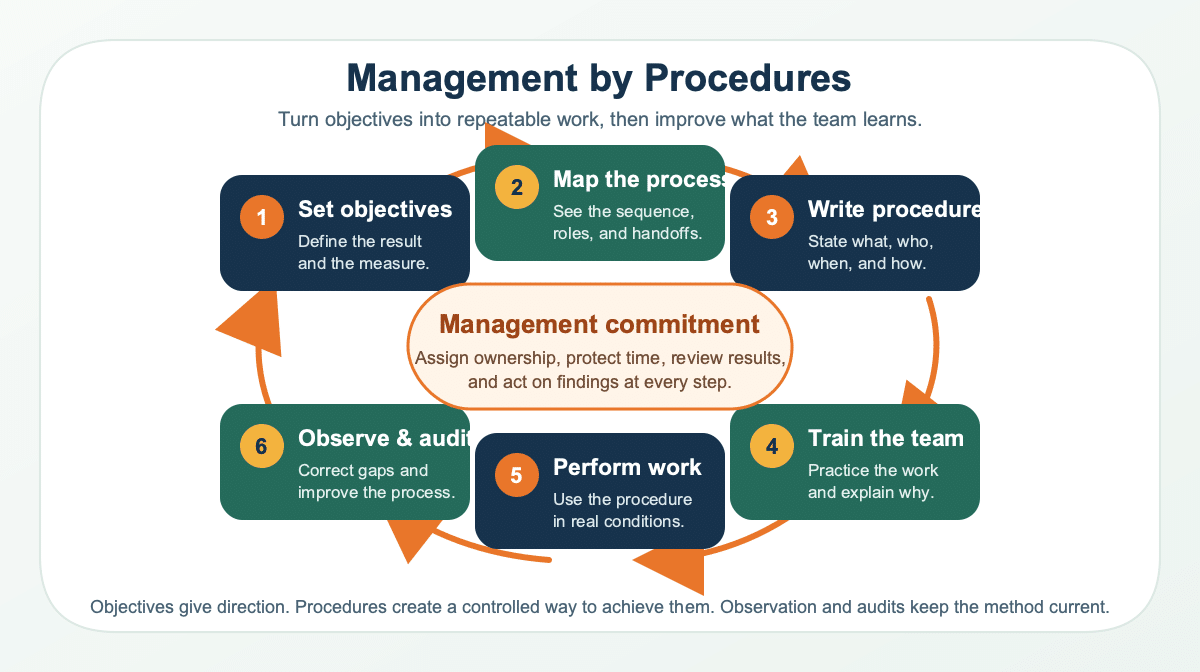
The cycle matters more than the document. Objectives give direction. The process map shows the sequence and handoffs. The written procedure states the method. Training helps people understand and practice it. Daily use reveals whether it works, while observation and auditing supply the feedback needed for correction and improvement.
More Than Paper Procedures
Management by procedures is not a paper exercise. It uses basic goal setting from the Management by Objectives approach and process checking from Management by Walking Around. The difference is that managers also maintain process documentation, including a process map, policies, procedures, and objectives that are clearly available to the people doing the work. These systems can reduce preventable errors and make work more consistent, but only when managers remain actively involved.
How Do Procedures Combine Objectives and Observation?
What Is the Limit of Management by Objectives?
There is nothing wrong with Management by Objectives when goals are balanced with attention to the method. We do not want to become overly focused on goals and begin ignoring the environment around us, including controls, customer experience, or process health. An objective tells the team where to go. A management procedure describes a controlled way to get there.
Management by Walking Around, PDCA, and Gemba Walks
Management is a contact sport, not only an objective-setting exercise. You have to get into the field to see what is happening in your company. The Plan-Do-Check-Act cycle uses four repeated steps to test changes and support continuous improvement. Checking means comparing actual work and results with the planned method, then acting on what you learn.
Lean thinking managers also walk around to find ideas for kaizen improvement events, see the work being performed, and understand whether the right work is being performed. The Lean Enterprise Institute defines a Gemba Walk as going to the actual place where value is created to observe and ask questions. Managers can then look for lean waste, compare practice with the procedure, and improve both.
What Gets Procedures Used?
1. Writing Procedures
First, make the required effort to write good procedures. A useful procedure names the owner, purpose, inputs, sequence, decision points, records, and expected result. Without investing in the resources to develop well-organized and clearly written documents that match the real work, it is unlikely they will be used. Employees will create their own methods or stop referring to the procedure.
2. Training Procedures
The next step is to conduct the necessary training. Training creates awareness of the procedure and can generate procedure buy-in. Proper training means the staff knows the procedure exists, understands why it matters, can practice the critical steps, and can raise questions when the written method does not match reality. People also need to believe having the procedure is useful.
3. Auditing Procedures
Finally, follow training with auditing. An audit should reveal whether the procedure is understood, accessible, current, and followed. It should also identify whether the procedure itself needs correction. Auditing is a key follow-up activity because managers review evidence, discuss gaps, assign corrective action, and return to confirm that the change worked. This attention helps prevent the perception that procedures are worthless, bureaucratic documents that should be ignored.
What Ties Procedures Together?
The total of writing, training, use, observation, and auditing gets procedures used. Doing only one does not guarantee success. One vital component links these activities together: management commitment. ISO explains that management systems use repeatable steps, leadership commitment, evaluation, and correction to support consistent results.
Management commitment means more than assigning resources. Leaders assign ownership, protect time for documentation and training, fund necessary tools, review measures, participate in audits, and act on findings. Management assigns and allocates the time, people, and money that determine whether the procedure becomes part of daily operations or remains a document on a shelf.
The Focus of Management Is the Focus of the Organization
Management makes the decisions about how people spend their time and how many people work on particular activities. If leaders spend most of their time on financial results while giving little attention to an organization’s internal processes, employees will notice. Visible attention tells the organization what matters.
Using a Balanced Scorecard
The Balanced Scorecard helps managers avoid a single-measure view. According to the concept, management should pay attention to four major things in a balanced way: customers, finances, learning and growth of organization members, and internal processes. The Balanced Scorecard uses financial, customer, internal business process, and learning and growth perspectives, as summarized by the Harvard Business Review. If an organization wants effective procedures, leaders must give internal processes and employee learning visible attention alongside financial and customer results.
| Perspective | Management procedure review question |
|---|---|
| Financial | Does the procedure control cost, rework, and resource use? |
| Customer | Does it help deliver the expected quality and response? |
| Internal process | Are the steps, handoffs, controls, and records working? |
| Learning and growth | Do employees understand the procedure and improve it? |
Why Are Management Procedures Important?
The practical answer is that procedures make management repeatable. Clear writing gives people a usable method. Training creates awareness, understanding, and buy-in. Auditing shows whether the method is followed and whether it still works. Management commitment makes all three happen and keeps the process connected to organizational objectives.
A franchise uses standards, operating procedures, training, and controls to promote consistent quality across locations. Your organization can apply the same principle without becoming rigid: define the best current method, teach it, observe it in use, and improve it when evidence shows a better way. Bizmanualz offers editable procedure manuals that can be adapted to your company’s needs.
Frequently Asked Questions
What is management by procedures?
Management by procedures is a practical approach that connects objectives to documented work, assigned responsibility, training, observation, auditing, and continuous improvement.
How is management by procedures different from Management by Objectives?
Management by Objectives defines the results to achieve. Management by procedures adds a controlled method for achieving them and a feedback loop for improving the work.
What makes employees use procedures?
Employees are more likely to use procedures that match real work, are easy to access, are supported by training, and are reinforced through observation, auditing, and corrective action.
What does management commitment look like?
Management commitment means assigning ownership, protecting time, funding training and tools, reviewing measures, participating in audits, and acting on findings.
How often should management procedures be reviewed?
Review procedures on a defined schedule and whenever audits, employee feedback, process changes, errors, customer issues, or new requirements show that the current method may no longer be effective.