

Air Water Soil Resource Management Procedure Template Word
The Air Water Soil Resource Management Procedure Template Word is a comprehensive document that provides a step-by-step guide for managing air, water, and soil resources in an organization. This template is designed to help organizations comply with environmental regulations and reduce their environmental impact.
The template includes detailed procedures for managing air emissions, wastewater, stormwater, hazardous waste, and other environmental aspects. It also provides guidance on how to monitor and report environmental performance, as well as how to identify and mitigate environmental risks.
Using this template can help organizations improve their environmental performance, reduce their environmental impact, and demonstrate their commitment to sustainability. It can also help organizations avoid costly fines and penalties for non-compliance with environmental regulations.
The Air Water Soil Resource Management Procedure Template Word is easy to customize to meet the specific needs of your organization. It comes in a Microsoft Word format, which allows you to easily edit and modify the document to fit your organization’s unique requirements.
Overall, the Air Water Soil Resource Management Procedure Template Word is an essential tool for any organization that wants to manage its environmental impact and comply with environmental regulations. It provides a comprehensive framework for managing air, water, and soil resources, and can help organizations improve their environmental performance and reduce their environmental impact.
Air Water Soil Resource Management Procedure
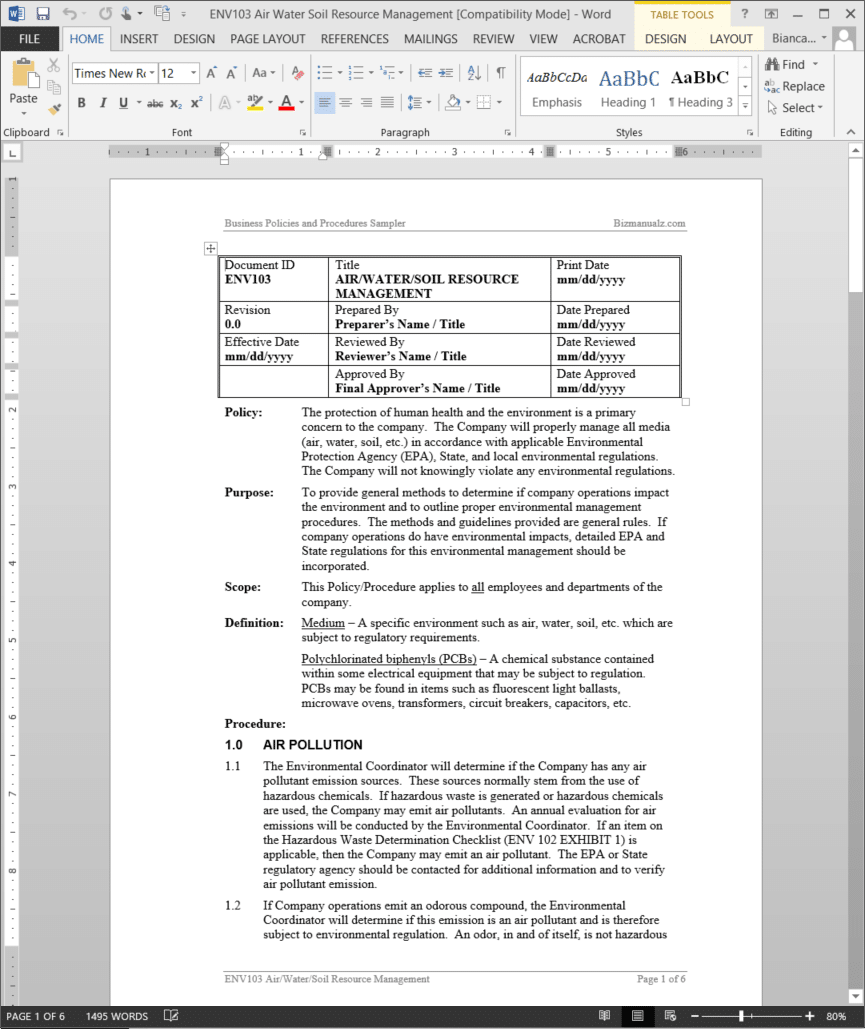
The Air Water Soil Resource Management Procedure provides general methods to determine if your company operations impact the environment and outlines proper environmental management procedures. The methods and guidelines provided are general rules.
If your company operations do have environmental impacts, detailed EPA and State regulations for this environmental management should be incorporated. This Policy/Procedure applies to all employees and departments of the company. (6 pages, 1486 words)
Air Water Soil Resource Management Definitions:
Medium – A specific environment such as air, water, soil, etc. which are subject to regulatory requirements.
Polychlorinated biphenyls (PCBs) – A chemical substance contained within some electrical equipment that may be subject to regulation. PCBs may be found in items such as fluorescent light ballasts, microwave ovens, transformers, circuit breakers, capacitors, etc.
 Air Water Soil Resource Management Procedure Activities
- Air Pollution
- Asbestos Management
- Water Pollution
- PCB Management
- Underground Storage Tank (UST) Management
Air Water Soil Resource Management Procedure References
- State and Regulatory Requirements
- ENV102-1 Hazardous Waste Determination Checklist

Reviews
There are no reviews yet.