How to Determine the Value of Your Business?
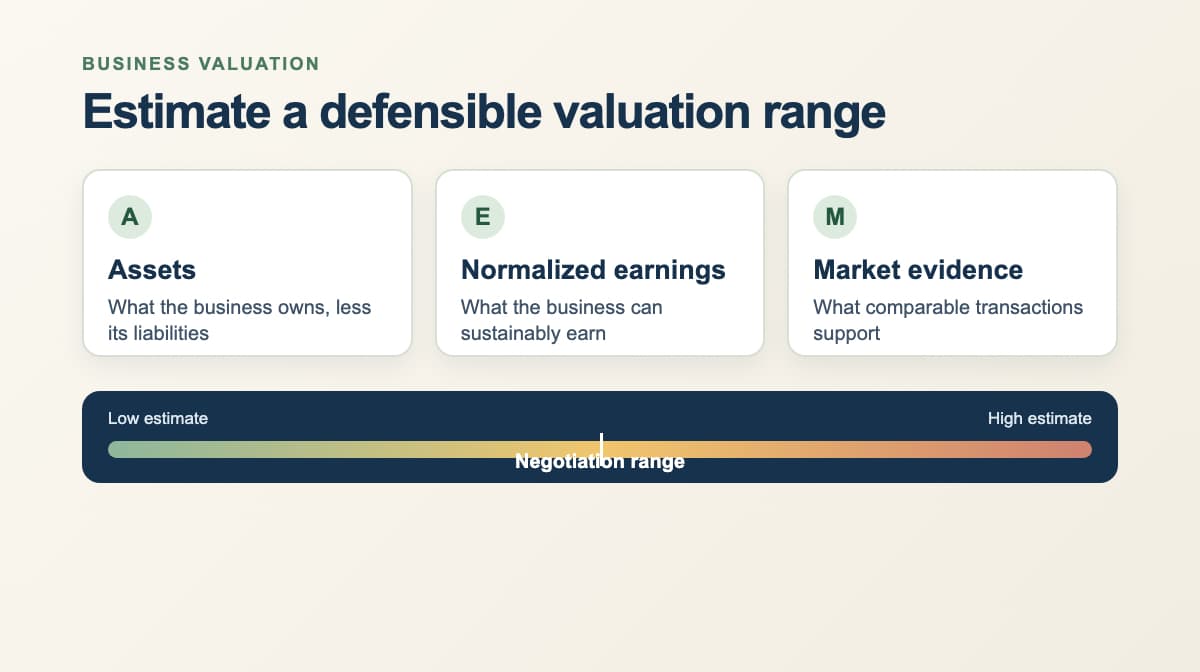
Whether you are looking for a business valuation to sell your business or merely wondering what it is worth, start by estimating a range rather than searching for one exact number. Compare the business’s assets, normalized earnings or cash flow, and relevant market evidence, then test the assumptions behind each estimate.
You can make a preliminary estimate yourself, but a qualified valuation professional may be appropriate when the result will support a transaction, financing decision, tax matter, or legal proceeding. The purpose of the valuation affects the methods, assumptions, and documentation you need.
Determining the Value of Your Business
Do you need to hire an expert, and if yes, who? Learning to unlock the value of your business can be tricky, but there are experts who can help. Your accountant is a good place to start because some accountants have developed business valuation expertise for owners looking to sell. Alternatively, can you value your business yourself? What do you need to take into account, and how will you know if you got it right?
The SBA describes three common valuation methods: the income approach, market approach, and assets approach. Use those approaches as cross-checks rather than forcing every business into a single formula. Begin with clean financial records, a clear valuation date, and a statement of why you need the estimate.
Asset Valuation
The first method you can employ to value your business is asset valuation. Your assets are essentially everything the business owns that has value and can be shown on a balance sheet. They can include property, vehicles, equipment, cash, supplies, inventory, and intellectual property.
The American Society of Appraisers’ standards define the asset-based approach as determining value from assets net of liabilities. Book value is only a starting point. You may need to adjust assets to a supportable current value and identify liabilities that a buyer would assume.
You also need to consider whether your business is a going concern or being liquidated. Those are different premises of value, and the likely proceeds can differ substantially. Often difficult to take into account when doing asset valuation is a factor known as goodwill. In other words, that is the intangible value of your business. It can include a transferable reputation, customer relationships, documented systems, and other advantages that continue after ownership changes.
Cash Flow Valuation
You can also consider proper cash flow as a means to value a business. Examine your cash flow statements showing inflows and outflows over a specific period, but do not assume that one unusually good or poor period represents sustainable performance. Make detailed notes when going over your cash flow. You know what each rise and dip means, and that context will help when negotiating with a buyer.
How much do the owners draw out of the business? Owner draws are distributions, not operating expenses, while owner compensation and other discretionary or nonrecurring items may require documented adjustments. EBITDA means earnings before interest, taxes, depreciation, and amortization. A valuation professional may normalize financial statements to show continuing operating performance, but normal recurring expenses should not simply be added back.
Those standards also say financial statements should be analyzed and, when appropriate, adjusted so revenues and expenses represent continuing results. Review several reporting periods and reconcile the figures to tax returns, bank records, and financial statements prepared by accountants. Forecasts should explain their assumptions instead of treating hoped-for growth as certain.
Gross Sales Valuation
Similarly, you can take into account your gross sales over a specific period, such as three or five years of revenue. However, the same issue arises as with cash flow valuation: history does not guarantee that the same level of sales and marketing performance can be replicated. Revenue alone also leaves out margins, customer concentration, owner dependence, working-capital needs, and the cost of producing those sales.
Revenue multiples can be useful only when the comparison and industry practice are relevant. The same standards define the market approach as comparing the subject business with similar businesses or interests that have been sold. The value of inventory can also be taken into account because it is a business asset, but use a realistic amount based on its condition, marketability, and expected selling costs.
Use a Business Valuation Range Worksheet
Record one indicated value for the asset approach, one for normalized earnings, and one for relevant market evidence. Use the same effective date and document every adjustment. Then reconcile the supported results into a low, most supportable, and high estimate. This worksheet is an organizational tool, not a professional appraisal.
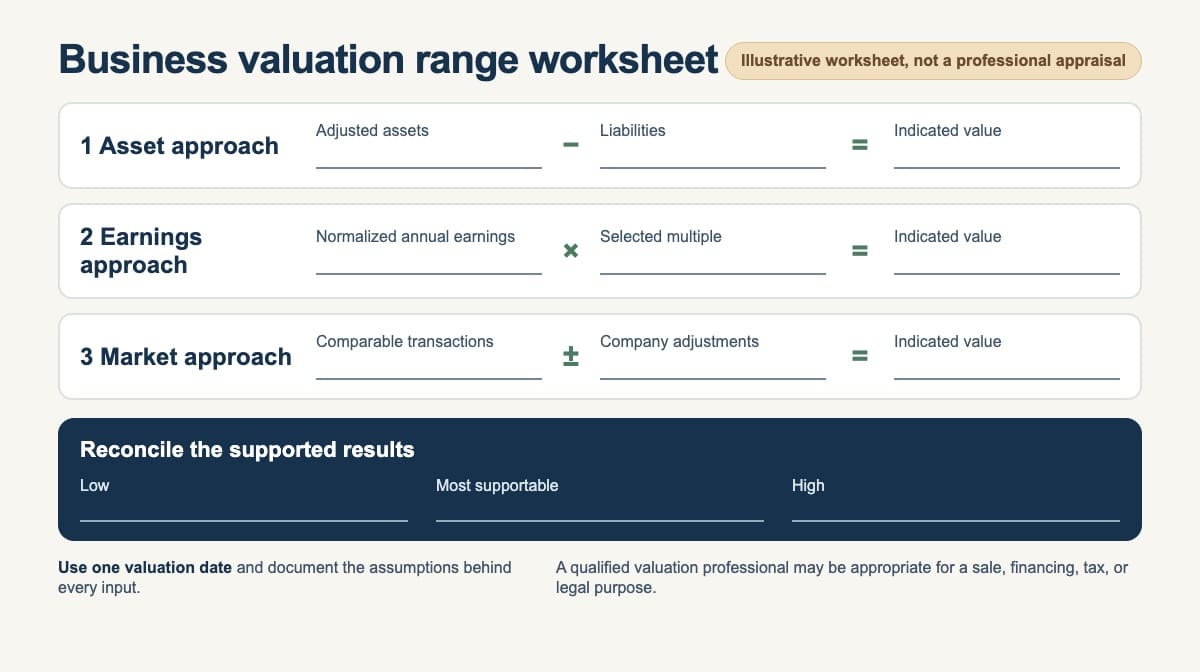
For the asset row, enter adjusted assets minus liabilities. For the earnings row, enter normalized annual earnings and the supported multiple or rate. For the market row, record comparable transactions and the adjustments needed to reflect differences in size, growth, risk, and profitability. Keep the calculations and supporting records with your valuation notes.
Other Business Valuation Considerations
You will also want to consider all the different ways your business is earning money. For example, you may be seeing income from sales, but you may also be hosting events, working with clients, offering services, licensing intellectual property, or receiving recurring subscription revenue. Separate recurring income from one-time income and note how dependent each stream is on the current owner, one customer, or one supplier.
Multitude of Revenue Streams
Considering all available revenue streams is especially important when determining the value of an online business. For instance, a website might currently be earning through ads alone but also have the potential to do affiliate marketing or sell its own products. Treat unproven opportunities as scenarios, not current earnings. Any projected revenue should be supported by credible assumptions, required investment, timing, and risk.
Other business valuation considerations include customer retention, the strength of contracts, employee continuity, pending liabilities, required capital spending, and the transferability of operating systems. Customer concentration and owner dependence can make otherwise strong revenue more fragile. A documented process can help a buyer understand how the business operates without relying only on the seller’s personal knowledge.
Should I Value My Business Myself?
You can prepare a preliminary estimate yourself by organizing the records, identifying assumptions, and comparing more than one method. If you feel you are not up to the task of calculating the value of your business, enlist the help of a professional. Business valuation specialists can help define the assignment and select appropriate approaches.
When looking for one, ask whether the professional has worked in your industry and has valued businesses of similar size operating in similar markets. Clarify the purpose, scope, standard of value, deliverable, assumptions, fees, and effective date before work begins. The standards require appraisers to define the purpose, standard of value, premise of value, and effective date as appropriate.
Why Is There No Accurate Business Valuation Method?
There is no single method that is completely accurate for every business and every purpose. The figure you calculate depends on the financial information, assumptions, valuation date, market evidence, and reason for the valuation. A sale price also reflects the terms a buyer and seller agree to, so it can differ from an appraised value.
If you use more than one of these business valuation methods, you can identify which assumptions have the greatest effect and determine a more defensible range. The standards explain that appraisers may use one or more methods and weigh them using informed judgment rather than a prescribed formula. Industry conditions, regulation, customer behavior, and new technological developments can also change what a buyer is willing to pay.
Determine the Value of Your Business
Valuing a business can be a lengthy and complex process based on customer lifetime value, growth of the business, cash flow, assets, revenues, risk, and relevant market evidence. Understanding what your business may be worth will give you a starting point for an asking price and for discussions with lenders, investors, partners, or buyers.
Always try to value your business before you start negotiating with a buyer. Even if someone offers a figure that seems attractive, compare it with the supported range and the transaction terms. Keep your assumptions, financial statements, asset records, customer information, and notes together so another person can follow how you reached the estimate.
Frequently Asked Questions
Can I determine the value of my business myself?
You can prepare a preliminary range by organizing your financial statements, adjusting documented nonrecurring items, and comparing asset, earnings, and market approaches. Use a qualified valuation professional when the result will support a sale, financing, tax, or legal decision.
How many years of financial records should I review?
Review enough history to distinguish recurring performance from unusual periods. Three to five years is a practical starting point for many established businesses, but the appropriate period depends on the business cycle, available records, and purpose of the valuation.
Is gross sales a reliable way to value a business?
Gross sales can provide context, but revenue alone does not show margins, operating costs, customer concentration, owner dependence, or risk. Use a revenue multiple only when relevant comparable transactions and industry practice support it.
What is the difference between business value and sale price?
Business value is an estimate developed for a stated purpose, standard, premise, and effective date. Sale price is the amount negotiated in a specific transaction and can also reflect deal terms, financing, buyer strategy, and bargaining conditions.
What should I prepare for a business valuation?
Prepare financial statements, tax returns, asset and liability records, customer and supplier information, contracts, payroll and owner-compensation details, inventory records, forecasts, and notes explaining unusual revenue or expenses.