NIST 800-53 Control Families: A Plain-English Guide
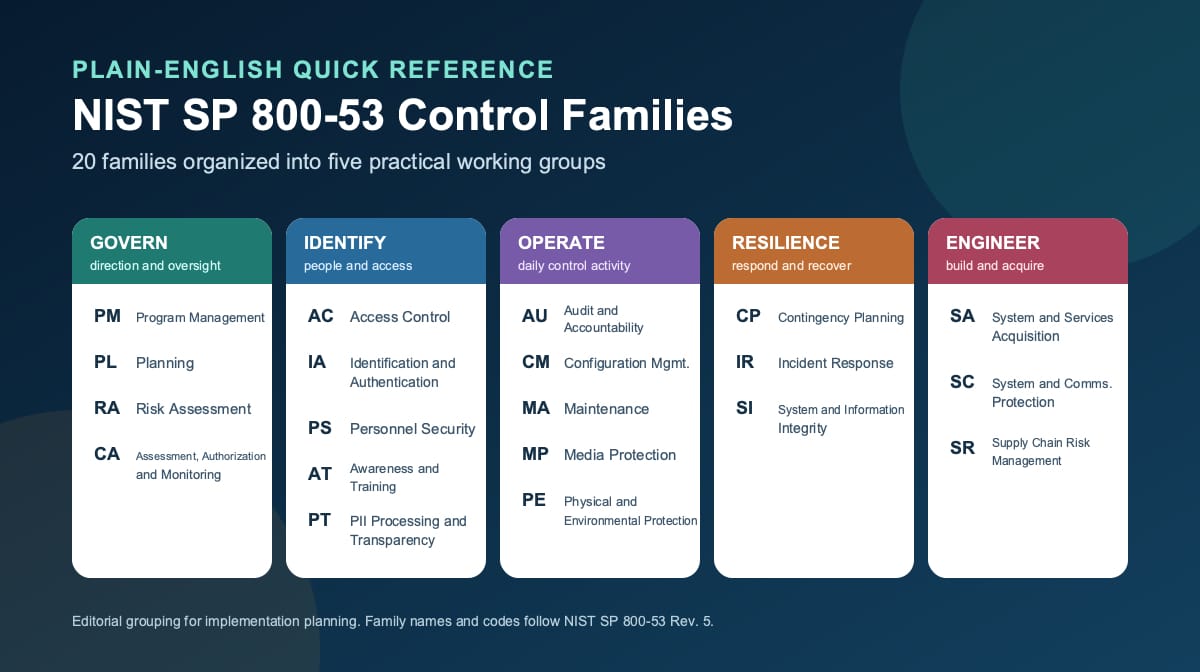
NIST 800-53 control families are groups of related security and privacy controls. They turn a very large catalog into manageable subjects such as access control, incident response, risk assessment, personnel security, and system integrity.
The family list is useful, but it is not an implementation plan by itself. You still need to decide which controls apply, assign accountable owners, write the necessary policies and procedures, operate the controls, and keep evidence. This guide explains all 20 NIST SP 800-53 Rev. 5 families and provides a practical owner map for getting started.
What Are the NIST 800-53 Control Families?
NIST SP 800-53 is a catalog of security and privacy controls for information systems and organizations. NIST describes the controls as flexible and customizable and says they are implemented as part of an organization-wide process to manage risk. That matters because the publication is a source catalog, not a one-size-fits-all checklist.
A control family is an organizing category. Each family brings together controls that address a related purpose. For example, the Access Control family covers how access is limited and managed, while the Incident Response family covers preparation, detection, handling, reporting, and recovery activities associated with incidents.
The family structure helps policy owners, system owners, auditors, and technical teams discuss the catalog without treating every control as an isolated task. It also creates a useful bridge between the control catalog and your IT policies, procedures, standards, system configurations, contracts, and records.
How Do Families, Controls, and Enhancements Fit Together?
The catalog has several layers. Understanding them prevents a common mistake: stopping at the family name and assuming that a broad policy statement is enough.
- Family: the subject area, identified by a two-letter code such as AC for Access Control.
- Control: a specific safeguard or outcome within that family, identified by the family code and a number.
- Control enhancement: an additional requirement that strengthens, extends, or adds specificity to a control.
- Discussion and related controls: explanatory material and relationships that help an organization understand intent and dependencies.
Suppose a company begins with the Access Control family. It might select controls for account management, access enforcement, separation of duties, least privilege, and remote access. The policy states the required outcomes, procedures explain how people request and approve access, technical standards define mandatory settings, and records show that access was granted and reviewed.
The complete normative publication is available in the NIST SP 800-53 Rev. 5 PDF. Use it when selecting or interpreting individual controls. A summary list can help you navigate, but it cannot replace the actual control text, parameters, discussion, or applicable requirements.
What Are the 20 NIST 800-53 Rev. 5 Control Families?
NIST SP 800-53 Rev. 5 organizes its catalog into 20 families. The descriptions below are plain-English orientation, not substitutes for the publication.
| Code | Control family | Plain-English focus |
|---|---|---|
| AC | Access Control | Limit system and information access to authorized users, devices, processes, and transactions. |
| AT | Awareness and Training | Prepare people to understand security and privacy responsibilities and perform assigned duties. |
| AU | Audit and Accountability | Create, protect, review, and act on records of relevant system activity. |
| CA | Assessment, Authorization and Monitoring | Assess controls, authorize operation, monitor risk, and track corrective action. |
| CM | Configuration Management | Establish secure configurations and control changes to systems and components. |
| CP | Contingency Planning | Prepare for disruptions, maintain backups, test recovery, and restore essential operations. |
| IA | Identification and Authentication | Identify users, devices, and processes, then verify their claimed identities. |
| IR | Incident Response | Prepare for, detect, analyze, contain, recover from, and report incidents. |
| MA | Maintenance | Authorize, control, monitor, and document system maintenance. |
| MP | Media Protection | Protect, transport, sanitize, and dispose of digital and physical media. |
| PE | Physical and Environmental Protection | Control physical access and protect facilities, equipment, power, and environmental conditions. |
| PL | Planning | Document security and privacy plans, rules of behavior, and system-level expectations. |
| PM | Program Management | Govern the organization-wide security and privacy program, resources, strategy, and oversight. |
| PS | Personnel Security | Manage security responsibilities before, during, and after employment or other personnel changes. |
| PT | PII Processing and Transparency | Manage personally identifiable information processing, notices, consent, purpose, and transparency. |
| RA | Risk Assessment | Identify threats and vulnerabilities, assess impact and likelihood, and understand risk. |
| SA | System and Services Acquisition | Build security and privacy requirements into development, purchasing, and service acquisition. |
| SC | System and Communications Protection | Protect system boundaries, communications, architecture, and shared resources. |
| SI | System and Information Integrity | Find and correct flaws, monitor threats, protect against malicious code, and preserve integrity. |
| SR | Supply Chain Risk Management | Identify and manage risks from suppliers, developers, service providers, components, and dependencies. |
The families overlap in practice. An incident may involve access records from AU, containment steps from IR, continuity actions from CP, integrity checks from SI, and risk decisions from RA. Treat the families as connected views of risk, not separate departmental silos.
How Should You Assign Owners to the Control Families?
Assign one accountable owner for each selected family or control set, even when several teams perform the work. The owner maintains the requirement, coordinates operators, resolves exceptions, reviews evidence, and reports gaps. A small company may give several families to one person, while a larger organization may divide a family among policy, system, privacy, and business owners.
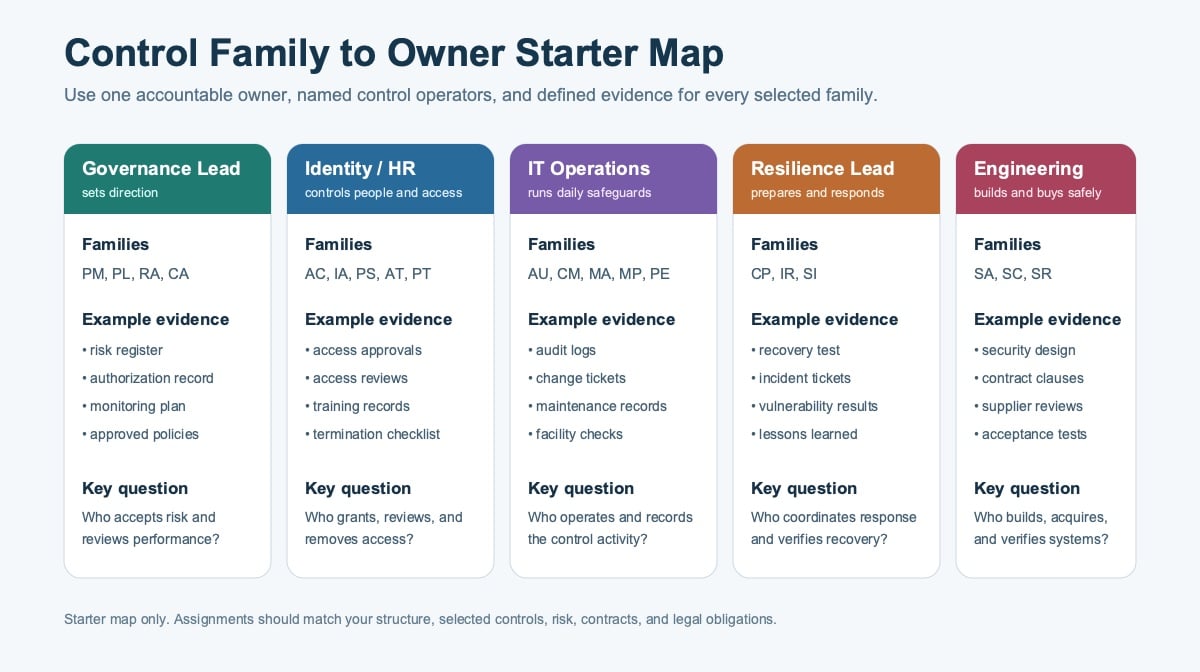
The map groups families by working relationship, not by an official NIST ownership model. Your information-security lead may own governance and risk. IT operations may run configuration, logging, maintenance, and media controls. Human resources may support personnel and training controls. Engineering and procurement may share acquisition and supply-chain responsibilities.
For each assignment, document four things: the accountable owner, the people who operate the control, the frequency or trigger, and the evidence retained. Evidence may include approvals, configuration records, access reviews, training completion, test results, tickets, contracts, logs, or exception records.
Worked Example: Map a Cloud File Service
Consider a 75-person company that stores client documents in a cloud file service. The company is not trying to implement the entire catalog at once. Its immediate task is to protect client files, keep the service available, and demonstrate that access and supplier risks are managed.
- AC and IA: the IT manager defines role-based access, requires approved authentication, reviews privileged access monthly, and keeps approval and review records.
- AU: the system administrator enables relevant audit events, protects the logs, reviews defined alerts, and retains review tickets.
- CP and IR: the operations manager defines outage and incident contacts, tests data recovery, records exercises, and updates the response procedure after lessons learned.
- SR and SA: procurement and the service owner document security requirements, review the provider, track contract commitments, and record renewal decisions.
- RA and CA: the security lead records risks, checks whether the selected safeguards are operating, assigns corrective actions, and reports unresolved exposure to management.
The example does not declare the company compliant. It creates a traceable chain from risk to selected controls, owners, operating work, and evidence. The same method can be expanded family by family as obligations, system complexity, and risk justify more coverage.
How Do the Families Fit Into the Risk Management Process?
Control selection begins with context, not with copying every catalog entry. The organization identifies the system or program boundary, the information involved, business and mission needs, threats, contractual commitments, and applicable legal or regulatory requirements.
FIPS 199 categorizes federal information and information systems according to confidentiality, integrity, availability, and the potential impact of compromise. That federal categorization step provides context for selecting and tailoring safeguards. A nonfederal organization can use the underlying questions to think clearly about impact, but it should not claim a federal categorization unless the relevant requirement and scope apply.
FIPS 200 specifies minimum security requirements for federal executive-agency information and information systems and a risk-based process for selecting controls. Its stated scope is important. NIST publications may be required by a federal relationship or adopted voluntarily, depending on the organization, system, contract, and governing rules.
- Define scope and impact. Identify the information, systems, services, users, locations, and dependencies covered.
- Select and tailor controls. Choose controls based on risk and obligations, set organization-defined parameters, and document exclusions or alternatives.
- Implement through real work. Translate selected controls into policies, standards, procedures, system settings, contracts, training, and assigned responsibilities.
- Assess operation and effectiveness. Test whether controls are implemented, produce the intended result, and have adequate evidence.
- Monitor and improve. Track changes, incidents, exceptions, vulnerabilities, findings, suppliers, and risk decisions over time.
This work belongs inside the organization’s broader approach to compliance standards and policies. A control reference tells you the expected safeguard. Your controlled documents explain how the safeguard operates in your environment.
How Can a Small Organization Use the Catalog Without Overbuilding?
Start with the systems and information that would cause the most harm if they were unavailable, altered, disclosed, or misused. Document the business process first. If you do not know who approves access, restores a system, contacts a vendor, or communicates during an incident, adding more control language will not solve the operating gap.
- Use a coverage matrix. List the selected family or control, owner, implementation document, operating activity, evidence, status, and next action.
- Prioritize common foundations. Identity, access, secure configuration, backups, logging, incident response, training, risk review, and supplier oversight support many other controls.
- Connect controls to existing work. Reuse change management, onboarding, purchasing, training, backup, and vendor-review processes instead of creating a parallel compliance bureaucracy.
- Keep policy separate from procedure. Put stable requirements in policy and tool-specific steps in procedures so operational changes do not force unnecessary policy rewrites.
- Record justified gaps. A named gap with an owner and treatment date is more useful than an unsupported claim of full compliance.
Protecting confidential information is a useful cross-family example. Access rules may come from AC and IA, handling from MP, logging from AU, incident duties from IR, supplier requirements from SR, and risk decisions from RA. The business process connects those requirements.
Your implementation should also connect to the organization’s core IT processes. Control work becomes sustainable when it is part of onboarding, access changes, system acquisition, configuration, maintenance, monitoring, incident handling, backup, and recovery.
What Common NIST 800-53 Implementation Mistakes Should You Avoid?
- Treating every control as automatically required. Determine scope, applicable requirements, selected controls, and tailoring decisions before declaring obligations.
- Using the family list as proof of compliance. A list shows coverage topics, not whether safeguards are implemented or effective.
- Assigning families only to IT. Human resources, facilities, procurement, legal, privacy, executives, business owners, and vendors may own essential parts of the control environment.
- Writing policies without operating evidence. A policy can state the rule, but approvals, logs, reviews, tests, training records, and tickets show that the rule is used.
- Ignoring dependencies. Access, logging, configuration, incident response, continuity, acquisition, and supply-chain controls often depend on one another.
- Claiming compliance too broadly. State the system, boundary, revision, selected controls, assessment basis, and date. Avoid turning a limited control review into an organization-wide claim.
A practical cybersecurity program does not begin with perfect paperwork. It begins with clear ownership, repeatable processes, evidence, and improvement. The same principle applies when a business works to improve cybersecurity: connect protective measures to how people actually operate systems and make decisions.
Frequently Asked Questions
How many NIST 800-53 control families are there?
NIST SP 800-53 Rev. 5 has 20 control families. They cover governance, access, training, audit, assessment, configuration, continuity, identity, incidents, maintenance, media, physical protection, planning, personnel, privacy, risk, acquisition, communications protection, system integrity, and supply-chain risk.
Is NIST SP 800-53 mandatory for every business?
No. Applicability depends on the organization, system, contract, federal relationship, governing requirement, and voluntary adoption decision. Determine the actual scope before using words such as required, compliant, or certified.
What is the difference between a control family and a control?
A family is a broad organizing category such as Access Control. A control is a specific safeguard or outcome within that family. A control enhancement adds requirements that strengthen or extend a control.
Where should a small organization start?
Start by defining the system and information in scope, identifying impact and obligations, and mapping existing safeguards. Then assign owners and prioritize foundational work such as access, configuration, backups, logging, incident response, training, risk review, and supplier oversight.