Information Security Policies: A Plain-English Guide
Information security policies are the written rules that explain how an organization protects information, who is responsible, and what people must do. A useful policy library turns broad security goals into clear expectations for employees, contractors, managers, and technology owners.
The strongest policy libraries are not one enormous document. They are a small, connected set of organization-wide rules, issue-specific policies, and system-specific requirements. This guide explains the main types, the elements each document should contain, and a practical way to map a policy library without confusing policies with procedures.
What Are Information Security Policies?
Information security policies are management-approved statements that define how an organization protects the confidentiality, integrity, and availability of information. They establish required behavior, decision rights, accountability, and the consequences of noncompliance.
A policy should tell readers what outcome is required and who owns it. It should not attempt to document every click, command, or technical setting. Detailed steps belong in procedures, while mandatory technical values belong in standards.
Security policies sit within the broader set of workplace policies and procedures. They apply to information in every form, including digital files, paper records, email, cloud services, portable media, conversations, and data handled by vendors.
How Does a Security Policy Library Fit Together?
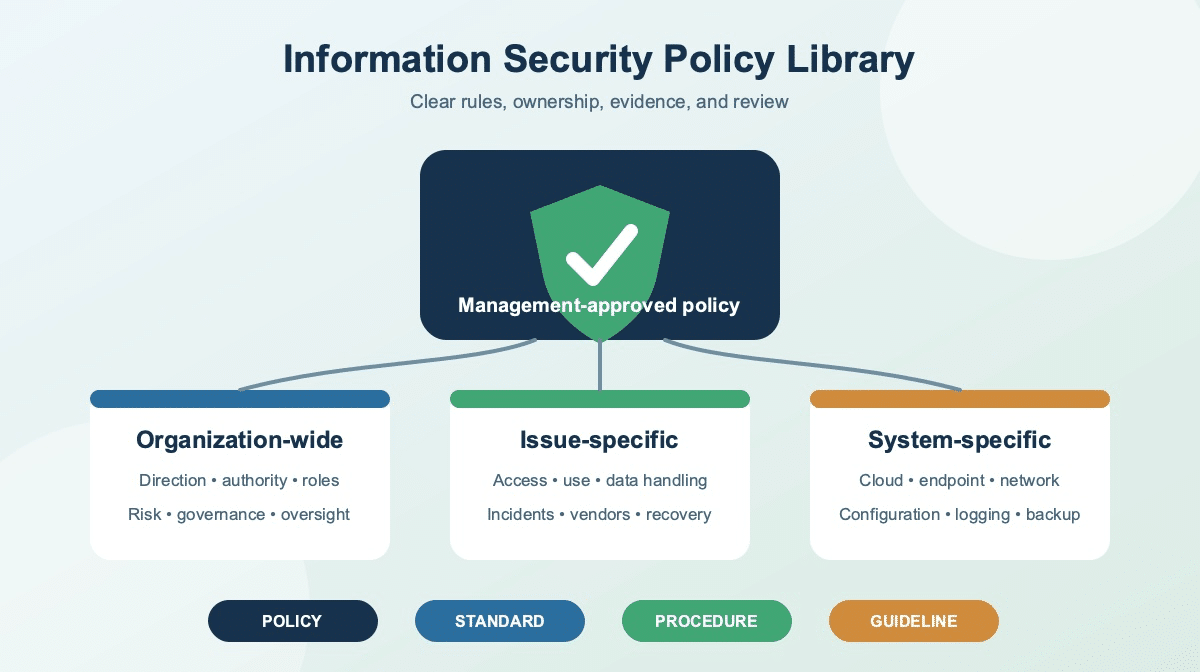
A clear document hierarchy prevents contradictions and makes updates easier. Use four document levels:
- Policy: states management intent, required outcomes, scope, and accountability. Example: access to sensitive information must be authorized and reviewed.
- Standard: defines a mandatory, measurable rule. Example: privileged accounts must use a specified authentication method.
- Procedure: explains the repeatable steps used to meet a policy or standard. Example: the steps for requesting, approving, provisioning, and removing access.
- Guideline: provides recommended practices when judgment is allowed. Example: suggestions for creating a memorable passphrase.
This structure lets a stable policy remain in force while procedures and technical standards change more frequently. It also makes policy examples easier to adapt because the purpose and rule can be separated from local tools and workflows.
What Types of Information Security Policies Do You Need?
Policy libraries are often grouped into three broad types. An organization-wide policy establishes the security program’s direction. Issue-specific policies address recurring subjects such as acceptable use or data handling. System-specific policies govern a particular platform, network, application, or device class.
| Policy type | Purpose | Typical documents | Primary owner |
|---|---|---|---|
| Organization-wide | Sets security direction, authority, responsibilities, and governance. | Information security, risk management, policy governance | Executive sponsor and security lead |
| Issue-specific | Defines rules for a recurring behavior or risk. | Acceptable use, access control, data classification, incident reporting, remote work, vendor security | Business or control owner |
| System-specific | Applies organization-wide rules to a defined system or technology. | Cloud administration, endpoint security, network access, application logging, backup configuration | System owner and technical custodian |
Most small organizations need one organization-wide information security policy plus a practical set of issue-specific policies. Start with acceptable use, access control, data classification and handling, incident response, backup and recovery, vendor security, remote access, and security awareness. Add system-specific documents only where a platform creates distinct risk or operating requirements.
Acceptable Use Policy
An acceptable use policy explains how people may use company devices, accounts, networks, software, email, internet access, and collaboration tools. It should cover prohibited activity, personal use, monitoring notices, approved software, reporting duties, and the return of assets.
Access Control Policy
An access control policy defines how access is requested, approved, granted, reviewed, changed, and removed. It should address least privilege, privileged access, shared accounts, authentication, segregation of duties, service accounts, and termination or transfer events.
Data Classification and Handling Policy
A data classification policy groups information by sensitivity and assigns handling rules. For each class, define storage, sharing, transmission, retention, destruction, and incident-reporting requirements. The rules should be specific enough that a person can decide how to handle confidential information without guessing.
Incident Response Policy
An incident response policy defines what must be reported, how quickly, and to whom. It assigns authority for triage, containment, communication, evidence preservation, recovery, legal escalation, and lessons learned. The corresponding procedure can provide contact details and step-by-step response actions.
What Should Every Information Security Policy Include?
A consistent template makes policies easier to understand and audit. Include the following elements when they are relevant:
- Purpose: the security outcome the policy is intended to achieve.
- Scope: the people, information, systems, locations, and third parties covered.
- Definitions: terms that readers must interpret consistently.
- Policy statements: direct, testable requirements written with words such as must, may, and must not.
- Roles and responsibilities: the owner, approver, control operators, users, and reviewers.
- Exceptions: who can approve an exception, required justification, compensating controls, expiration, and review.
- Evidence: records that demonstrate the policy is operating, such as access reviews, training records, approvals, or incident tickets.
- Enforcement: the consequences of noncompliance and the authority to act.
- Related documents: linked standards, procedures, forms, contracts, and legal requirements.
- Document control: owner, approver, effective date, version, next review date, and revision history.
A policy does not become effective merely because it was approved. Employees need the relevant rule at the point of work, managers need a way to handle exceptions, and owners need evidence that the rule is being followed. This is why well-managed IT policies connect governance with training, operating procedures, and review.
Worked Example: Map a Small-Business Policy Library
Consider a 60-person professional-services company that uses cloud email, file sharing, accounting software, laptops, and several outside service providers. Its first policy map might look like this:
Policy statement worksheet
Purpose: Protect client and company information from unauthorized access, disclosure, alteration, or loss.
Scope: Employees, contractors, company systems, approved cloud services, and vendors that handle company information.
Required behavior: Access must be approved by the information owner, limited to job duties, reviewed every quarter, and removed promptly when responsibilities change.
Owner and evidence: The IT manager owns the rule. Approval records, quarterly access-review results, and termination checklists provide evidence.
Exceptions and review: The security lead may approve a time-limited exception with documented risk and compensating controls. Review annually and after a significant incident, system change, or legal requirement.
The organization-wide policy establishes authority and shared responsibilities. Issue-specific documents cover acceptable use, access, data handling, incidents, backup, vendors, remote access, and awareness. System-specific standards then define configuration and administration requirements for cloud accounts, laptops, and the accounting system.
This map is intentionally small. A policy should exist because it resolves a real decision, risk, or obligation, not because a template list suggests one. The related key IT policies and procedures can help you identify gaps, but the final library should match your information, systems, workforce, contracts, and risk.
How Do You Write and Maintain Security Policies?
- Inventory obligations and decisions. Identify sensitive information, critical systems, contracts, laws, customer commitments, past incidents, and recurring questions.
- Assign an accountable owner. The owner should understand the risk, have authority to maintain the rule, and coordinate affected teams.
- Write testable requirements. Replace vague words such as appropriate, regularly, and secure with defined actions, frequencies, approvals, or referenced standards.
- Separate rules from steps. Keep stable management requirements in the policy and move tool-specific steps into procedures.
- Validate with the people who perform the work. Confirm that responsibilities, evidence, exceptions, and timing are practical before approval.
- Approve, communicate, and acknowledge. Use the appropriate authority, provide role-based training, and record acknowledgment when needed.
- Monitor and review. Track exceptions, control results, incidents, audit findings, and changes in systems or obligations. Update the document when those inputs show that the rule is incomplete or outdated.
How Do Standards and Regulations Affect Security Policies?
Frameworks and regulations can define control objectives, required topics, oversight roles, or evidence expectations. They do not remove the need to write policies in language that fits the organization.
NIST SP 800-53 provides a flexible, customizable catalog of security and privacy controls that organizations can use as part of an organization-wide risk management process.
The catalog includes control families such as access control, awareness and training, incident response, contingency planning, risk assessment, personnel security, and system integrity. These families can help you check policy coverage, but a control catalog is not a substitute for assigning local owners, defining scope, and documenting how requirements apply.
For organizations that handle Controlled Unclassified Information, NIST SP 800-171 Rev. 3 provides recommended security requirements for protecting the confidentiality of that information in nonfederal systems.
These requirements apply to nonfederal system components that process, store, or transmit Controlled Unclassified Information, or that protect those components. This is a scoped federal-contracting example, not a generic requirement for every small business.
FISMA 2014 assigns the Department of Homeland Security a role in administering information security policies for federal Executive Branch civilian agencies and overseeing agency compliance with those policies.
That example shows why policy scope matters. A federal requirement, customer contract, insurer condition, and voluntary framework may each create different obligations. Record the source of every binding requirement and obtain qualified legal or compliance advice when applicability is uncertain.
What Common Policy-Writing Mistakes Should You Avoid?
- One document tries to do everything. A long policy that mixes goals, technical settings, and screenshots becomes difficult to approve and maintain.
- The rule is vague. “Use strong security” cannot be tested. State the required behavior or reference a measurable standard.
- No owner is accountable. A committee can contribute, but one role should own each policy and its review.
- Exceptions are informal. Undocumented exceptions quietly become the real policy. Require approval, risk justification, compensating controls, and an expiration date.
- Approval is treated as implementation. Policies require communication, procedures, training, tools, monitoring, and evidence.
- The calendar is the only review trigger. Review after incidents, major system changes, new contracts, reorganizations, audit findings, and changes in law or risk.
Frequently Asked Questions
What is the difference between an information security policy and a cybersecurity policy?
An information security policy covers information in every form, including digital, paper, verbal, and physical records. A cybersecurity policy focuses more narrowly on digital systems, networks, software, devices, and electronic data. Many organizations use the terms together but should define the intended scope.
What are the three broad types of security policy?
The three broad types are organization-wide policies, issue-specific policies, and system-specific policies. The first sets overall direction, the second addresses recurring risks or behaviors, and the third applies requirements to a defined system or technology.
How often should information security policies be reviewed?
Set a scheduled review based on risk and obligations, commonly at least annually, and also review after a major incident, system change, contract, audit finding, organizational change, or new legal requirement. A documented trigger is more useful than an automatic date alone.
Is an acceptable use policy an information security policy?
Yes. An acceptable use policy is an issue-specific information security policy. It defines permitted and prohibited use of company devices, systems, accounts, networks, software, and communication tools.