What Is Your Business Return on Invested Capital?

Profit is used to drive growth, which is one aspect of your cash needs. But what are you going to do with excess cash once the business has more than it needs for payroll, vendors, taxes, and working capital?
Your options include purchasing assets, funding expenses, holding cash, paying down debt, or returning cash to shareholders. Do you have a return on investment plan for your capital?
If you think of spending cash as making an investment in your business, then understanding the return you are about to make becomes critical to your decision. Excess cash is not automatically idle cash. It is capital waiting for a decision.
The decision is not only whether an idea sounds useful. The decision is whether that use of cash can earn enough to compensate the business owner or shareholders for the risk they are taking. That is why return on invested capital, cost of capital, and return on investment belong in the same conversation.
| Investment | Typical Return Pattern | Risk |
|---|---|---|
| Government bonds | Lower return, market-rate dependent | Low |
| Broad stock market exposure | Higher long-term return potential with volatility | Moderate |
| Small or new business investment | Highest return requirement because capital is concentrated | High |
Returns are a function of risk. Treasury yields change with the market, which is why the U.S. Treasury publishes a daily yield curve rather than a permanent fixed rate. A business owner can use Treasury yield data as a low-risk benchmark, then ask how much more return a business project must earn to justify its additional risk.
Small businesses are considered risky investments because the capital is concentrated in one company, one market, and one management team. That is one reason venture capital funding often requires a much higher expected return than low-risk securities. Even for a closely held company, the owner should ask the same question: is this use of cash earning enough for the risk?
What Is Return On Invested Capital?
Return on invested capital, or ROIC, is used to determine the effectiveness of the cash invested in your business. It connects profit to the operating assets required to produce that profit.
A practical owner-level formula is:
ROIC = Net Profit / (Total Assets – Cash and Investments)
Cash and investments are subtracted because they are not operating investments in the business itself. They may be necessary reserves, but they are not the assets producing revenue, serving customers, or improving operations.
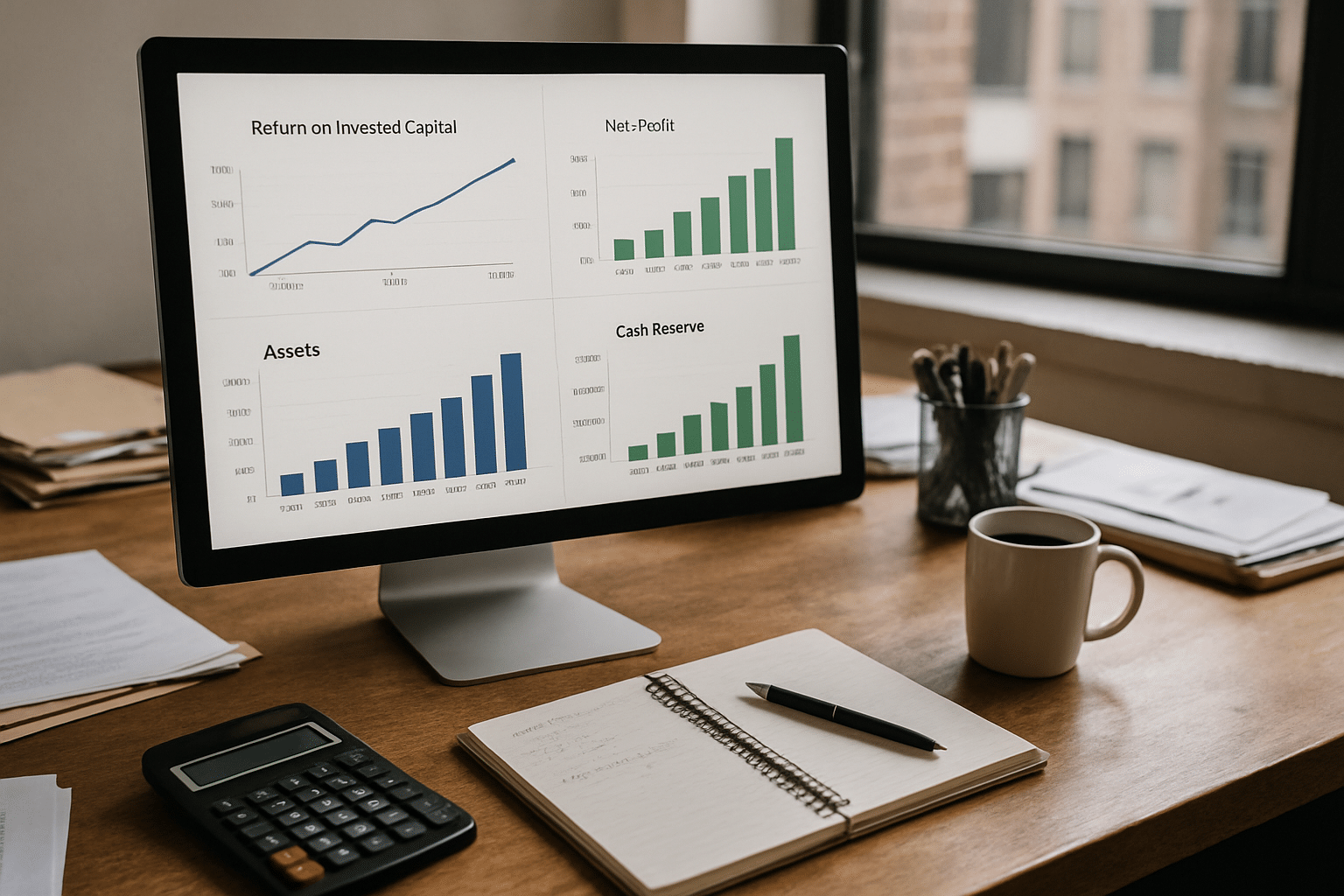
ROIC is different from a simple profit check. A company can produce profit and still use too much capital to do it. A company can also look cash-rich while underinvesting in assets, procedures, systems, or people that would produce better long-term returns.
If ROIC is low, the business may not be compensating shareholders for the risk they are taking. If ROIC is strong, the business has more room to reinvest cash, raise capital, or defend a growth plan.
Business Capital
It is all in how you spend your business capital. Your options include purchasing assets, spending cash on expenses, paying off debt, holding cash, or returning cash to shareholders. How do you know which ones to choose?
- Purchasing assets should usually be the first choice, but only to a point. The goal is to buy performing assets that can productively generate more profit. Returns vary by industry, asset type, and execution quality.
- Spending cash on expenses may be necessary when the expense supports sales, training, compliance, process improvement, or capacity. But expenses have to be controlled by profit. Spending too much can reduce profits to zero and constrain growth.
- Paying off debt is an investment decision. Reducing debt lowers interest expense, improves cash flow, and can make the company less fragile. Compare the interest cost you avoid with the return you expect from any alternative project.
- Holding cash above your working capital needs is usually a low-return use of capital. It may still be wise if you have specific plans for expansion, acquisition, seasonal volatility, or a large future purchase.
- Returning cash to shareholders should be the last option when the business has no better internal use for the money. Mature companies sometimes reach that point. If there are no good assets to buy, debt and expenses are already reasonable, and cash reserves are sufficient, returning cash lets shareholders invest elsewhere.

The best choice is not the one that sounds most conservative or most exciting. It is the one that produces the best risk-adjusted return while preserving enough liquidity for the business to operate safely.
What Is Cost Of Capital?
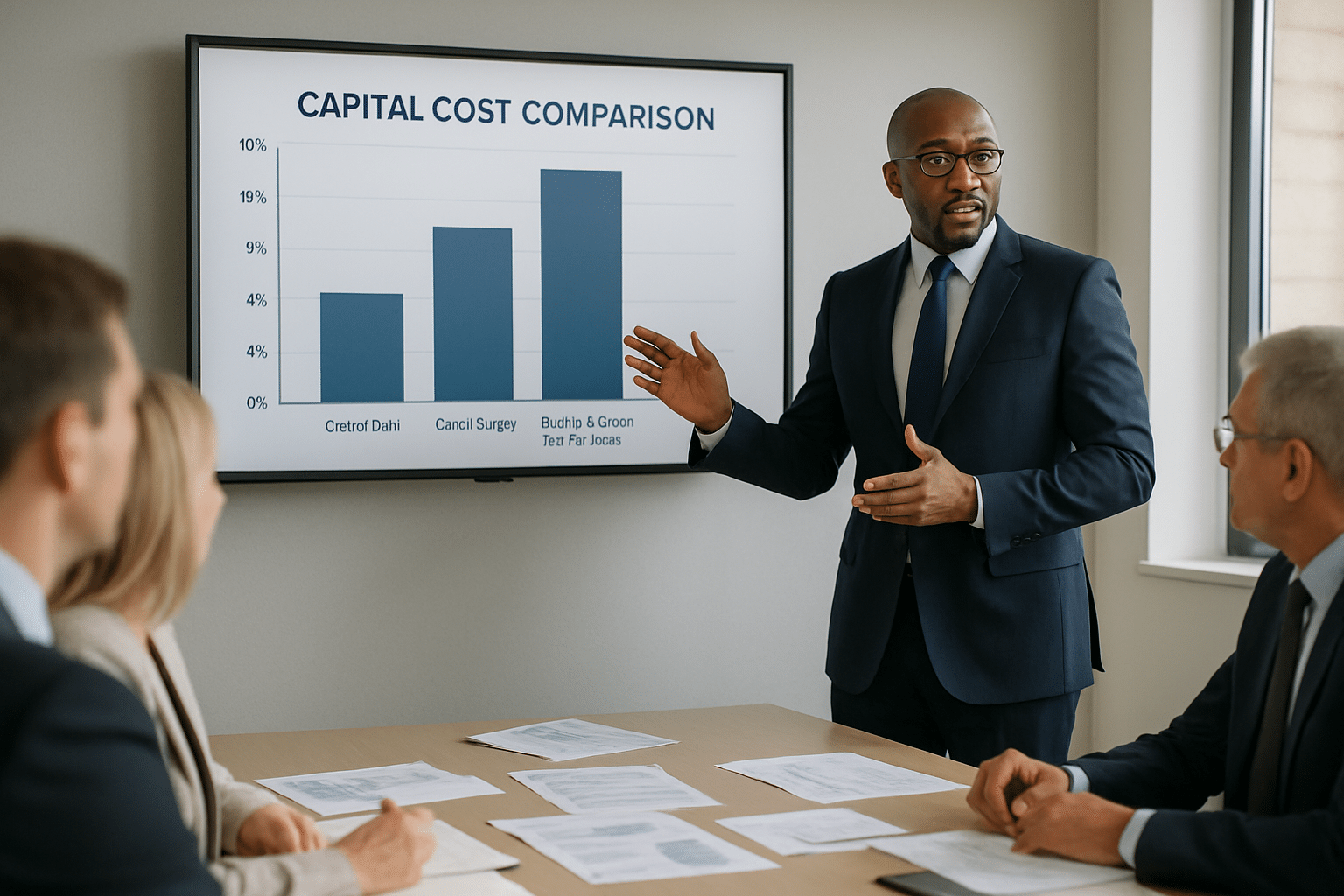
We know a business needs a decent return on invested capital to attract investor capital. But the business also needs the cost of capital, meaning the cost of debt and equity, to be lower than the return produced by the projects funded with that capital.
The goal is to find capital for as little as practical, then invest it in projects inside the business that return more than that capital costs. If a project earns less than the cost of capital, growth can destroy value even while revenue increases.
Weighted Average Cost Of Capital
To compare capital sources, businesses use weighted average cost of capital, or WACC. WACC weighs the contribution of each piece of debt or equity using the capital source’s cost factor and its percentage of the total capital structure.
WACC = (E / V x Re) + (D / V x Rd x (1 – Tc))
Where Re is cost of equity, Rd is cost of debt, E is market value of equity, D is market value of debt, V is total capital, and Tc is the corporate tax rate. The debt portion is adjusted for taxes because business interest is generally deductible. NYU Stern’s cost-of-capital data is a useful reference point for how widely WACC can vary by industry and risk profile.
Cost-of-capital data should not replace company-specific judgment, but it can keep your assumptions grounded. A small private company with concentrated owner risk usually needs a more conservative hurdle rate than a large public company with diversified shareholders.
Cost Of Equity Capital
It is easy to determine the cost of debt capital because the lender tells you upfront. If you borrow from a bank, your interest rate and loan terms are visible. If you use credit cards, the cost is usually much higher and easier to compare.
Equity capital is harder. For large public companies, analysts can estimate cost of equity by comparing dividends, market value, growth expectations, and risk. For a private small business, the owner has to be more practical: what return would make this risk worth taking compared with other investments available to the same owner?
Equity is often the most expensive form of capital because shareholders carry the residual risk. Debt can reduce the weighted average cost of capital, but debt also adds fixed obligations. Leverage can increase positive growth and magnify negative downturns. It keeps management focused, but it also reduces room for error.
How Should You Use Return On Investment?
Return on investment looks at whether a use of money produces more value than it costs. ROIC is the business-capital version of that question: how effectively are you using the capital invested in the company?
First, determine your revenue growth and compare it with equity growth. If revenue growth is less than equity growth, you may be able to grow through internal financing. You may still want to raise cash, however, if doing so lowers your weighted average cost of capital and gives you more room to fund profitable projects.
Use cash for productive assets first, followed by necessary expenses, debt reduction, adequate reserves, and shareholder return. That order is not absolute, but it forces the right discipline. Every dollar should have a purpose, and every purpose should be tested against expected return, risk, and liquidity.
Download Free Policies and Procedures to see how easy it is to edit MS Word templates to build your own policy and procedure management system.
Frequently Asked Questions
What Is Return On Invested Capital?
Return on invested capital measures how effectively a business turns operating assets into profit. It is commonly calculated as net profit divided by total assets less cash and investments.
How Is ROIC Different From ROI?
ROI is a broad measure of return on a particular investment. ROIC focuses on the capital invested in the business itself, which makes it useful for capital allocation and owner-level planning.
What Is A Good ROIC For A Small Business?
A good ROIC depends on industry, risk, debt levels, and owner expectations. The practical test is whether ROIC is comfortably above the company’s cost of capital and strong enough to compensate shareholders for the risk they carry.
Should A Business Pay Down Debt Or Invest In Growth?
A business should compare the interest cost avoided by paying down debt with the expected return from a growth investment. Debt reduction improves stability, while growth investments should earn more than the cost of capital.
Why Does Cost Of Capital Matter?
Cost of capital is the minimum return a business needs to justify using debt or equity capital. If projects earn less than that cost, the company can grow revenue while weakening shareholder value.