Quality Management System in 10 Easy Steps

A Quality Management System (QMS) is a management system, pure and simple. It is not quality’s management system or a program owned only by the quality department. It is the way your organization manages connected processes so it can consistently meet the customer’s requirements, produce better products and services, and improve performance.
To build a Quality Management System in 10 practical steps, define and map your processes, set a quality policy and quality objectives, identify defects and nonconformities, control documented information, establish quality processes, close competence and training gaps, use the system, measure and monitor performance, and take action on the results. If certification is part of your goal, use the current standard and plan the work with your certification body. ISO 9001:2026 is the current edition of the quality management systems requirements standard.
How to Build a Quality Management System
A useful QMS starts with the work your organization already performs. The goal is to make the sequence, interaction, responsibility, evidence, and measures for that work clear enough to manage. The ten steps below preserve that practical focus while aligning it with the current edition of ISO 9001.
1. Define and Map Your Processes
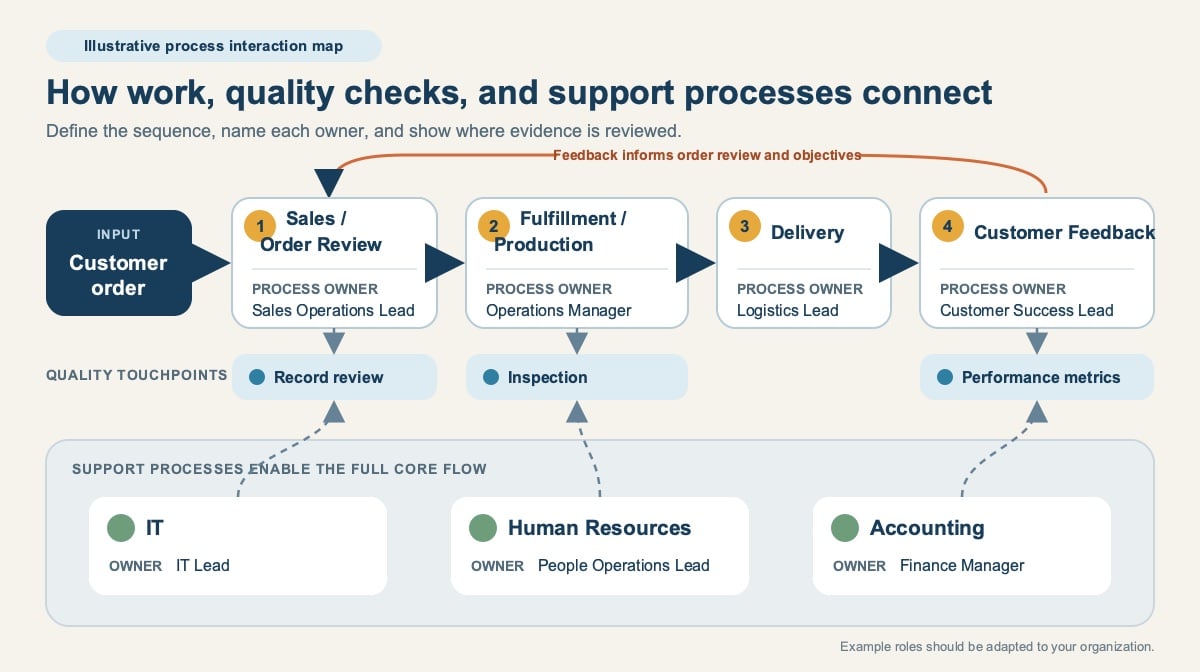
The process of creating process maps forces you to define your processes and the sequence and interaction of those processes. Maps are practical aids, not the only acceptable format. For each process, identify the owner, inputs, activities, outputs, customers, controls, records, measures, and links to other processes. This makes it easier to understand who is responsible for what and how each core business process contributes to the system.
- Follow an order through the system from customer request to delivery and feedback.
- Identify support processes for IT, Human Resources, and Accounting.
- Determine how quality interacts with each process through inspection, record review, or metrics that support quality objectives.
- Confirm the handoffs where an output from one process becomes an input to another.
2. Define Your Quality Policy
Your quality policy states the organization’s direction and commitments as they relate to quality. It should fit the organization’s purpose and strategic direction, provide a basis for quality objectives, and be clear enough for employees to apply in daily decisions. It is broader than a slogan or a restatement of what the customer wants.
- Quality: What must you do consistently to meet product, service, customer, and applicable requirements?
- Customer satisfaction: How will you understand customer requirements and evaluate whether you met them?
- Continual improvement: How will leaders use evidence to improve the system and its results? Many teams also use the phrase continuous improvement for this commitment.
3. Define Your Quality Objectives
Quality objectives turn the policy into measurable work. They should be relevant to the processes and results that matter, communicated to the people who influence them, and reviewed often enough to support decisions. Each objective needs an owner, a baseline, a target, a measurement method, a review cadence, and a response when performance moves off course.
- Derive objectives from your quality policy and business priorities.
- Make each objective measurable or otherwise evaluable.
- Deploy the objectives through the organization so each employee understands their impact on quality.
- Record results and discuss them in the operating and management-review routines that can act on them.
4. Define Defects and Nonconformities for Each Process
Defects and nonconformities may involve a product or service output, or a process that did not operate as planned. Define what failure looks like before it occurs. When a nonconformity appears, control the affected output, correct it as appropriate, evaluate whether the cause requires corrective action, and retain the evidence needed to learn from the event. The practical goal is not simply to count problems, but to correct nonconformities and prevent recurrence.
- Determine transaction volume or another useful denominator.
- Define product, service, and process defects that matter to the customer or the system.
- Define how defects and nonconformities are recorded, assigned, corrected, and closed.
- Define how results are charted and communicated so trends are visible.
5. Develop Your Documents and Records
Documented information should help people operate processes consistently and provide evidence of results. Start with the information needed for your business model, risks, process complexity, and competence needs. Avoid creating documents only to fill a binder. ISO 10013:2021 provides guidance for developing and maintaining documented information that supports an effective QMS.
- Maintain the policies, procedures, work instructions, forms, and process descriptions needed to control the work.
- Retain records that demonstrate results, decisions, approvals, competence, inspections, audits, reviews, and corrective actions.
- Control versions, access, changes, retention, and disposition so people can find the right information.
- If you use the Bizmanualz ISO 9001 2015 Procedures, treat it as a prior-edition resource and perform a documented gap analysis against ISO 9001:2026 before relying on it for transition work.
6. Define Your Quality Processes
Your quality procedures connect control, assurance, review, and improvement across the organization. Define how internal audits are planned, how management reviews the QMS, how nonconformities move into the corrective action process, how changes are controlled, and how actions addressing risks and opportunities are tracked. Preventive action still matters as an operating idea, but it should be built into risk-based planning and process control instead of treated as a separate paperwork exercise.
- Internal audit process and audit program.
- Corrective action and root cause analysis process.
- Management review, communication, and leadership commitment process.
- Risk, opportunity, change-control, and improvement routines.
ISO 19011:2026 provides current guidance on audit principles, audit-program management, conducting audits, and auditor competence.
7. Determine Your Competence and Training Needs
Everyone who affects QMS performance needs to demonstrate competence for their job. Training is one way to build competence and can occur on the job, in a class, or through other means such as education, experience, coaching, practice, and supervised work. Define the required competence for each role, close gaps, and evaluate whether the person can apply the knowledge and skills in actual work.
- Verify internal auditor competence through suitable education, experience, observation, and audit performance.
- Provide corrective action training to people who investigate causes and approve actions.
- Use Failure Modes and Effects Analysis (FMEA) when it fits the process risk. IEC 60812 describes how to plan, perform, document, and maintain FMEA or FMECA.
- Recheck competence after major process, product, technology, or responsibility changes.
8. Use Your Quality Management System
A documented system produces no value if people do not use it. Build QMS activities into ordinary operating rhythms and assign clear owners. The evidence should arise from the work, not from a last-minute exercise for an auditor.
- Keep collecting nonconformance data continuously where the process generates it.
- Keep reviewing nonconformance data continuously for correction and corrective action.
- Review FMEAs and other risk analyses after relevant changes, poor performance, or at planned intervals.
- Perform internal audits and management reviews at planned intervals.
- Follow the quality management strategies selected for each process and verify that people use the current documents.
9. Measure and Monitor Your Performance
If you are using the quality management system, you are collecting data. But what good is data you collect but do not understand? Choose quality performance metrics that reveal whether processes achieve planned results and whether quality objectives are moving in the right direction.
- Track quality-objective performance.
- Define practical performance benchmarks and thresholds.
- Review trends, patterns, and correlations instead of reacting to one isolated number.
- Connect each measure to an owner, a decision, and an escalation path.
- Use the results to discover improvement opportunities and verify whether previous actions worked.
10. Take Action That Improves Your Performance
If you have data and identified trends, it is time to act. Action is what the QMS is all about. Use corrective action for significant or recurring nonconformities, and use risk and opportunity planning to prevent undesirable results and improve performance. You are not tracking data only for the auditor, ISO, or the quality manager.
- Prioritize improvement opportunities by customer impact, risk, frequency, cost, and strategic importance.
- Focus on choosing opportunities that make a meaningful difference and achieve better results.
- Assign an owner, due date, resources, and expected result.
- Verify effectiveness after implementation and reopen the issue if the result does not hold.
- Reinforce your commitment to quality by sharing what changed and what the organization learned.
Put the Ten-Step QMS Plan Into Practice
Turn each step into an owned operating commitment. The checklist below is an original planning aid, not a substitute for the standard or advice from your certification body. Replace the hypothetical example with evidence and measures that fit your organization.
| Step | Owner | Evidence or output | Measure | Review cadence |
|---|---|---|---|---|
| 1. Map processes | Process owners | Process map, inputs, outputs, interactions | Handoffs defined | After process change |
| 2. Set policy | Top management | Approved quality policy | Policy remains suitable | Management review |
| 3. Set objectives | Functional leaders | Objectives, targets, plans | Progress to target | Monthly or quarterly |
| 4. Define nonconformities | Process owners | Criteria, log, dispositions | Rate and recurrence | Weekly or monthly |
| 5. Control information | Document owners | Current documents and retained records | Overdue reviews, obsolete use | By document risk |
| 6. Run quality processes | Quality lead | Audit, review, corrective-action plans | Completion and effectiveness | Planned intervals |
| 7. Build competence | Managers and HR | Competence criteria and evidence | Demonstrated performance | Role or process change |
| 8. Use the QMS | All process owners | Completed controls and records | Control adherence | Operating cadence |
| 9. Measure performance | Objective owners | Scorecard and analysis | Trend and threshold status | Monthly or quarterly |
| 10. Improve | Assigned action owner | Action and effectiveness evidence | Result sustained | After implementation |
| Hypothetical example: reduce order errors | Sales Operations Lead | Order-review checklist and error log | Errors per 100 orders | Weekly for eight weeks |
Whether you realize it or not, the management system you are using already influences quality. Build it deliberately, keep the evidence close to the work, and use results to choose the next improvement. The current edition does not require you to discard a working QMS and start again. ISO 9001:2026 guidance explains that customer focus, the process approach, risk-based thinking, and continual improvement remain at the center of the standard. Organizations transitioning from the prior edition should assess gaps, update what is necessary, engage their people, and plan certification timing with their certification body.
Frequently Asked Questions
What Is the Difference Between a QMS and ISO 9001?
A QMS is the management system an organization uses to direct and control quality. ISO 9001 is a requirements standard that provides a recognized framework for establishing, operating, evaluating, and improving that system. An organization can use a QMS without seeking ISO 9001 certification.
Does an Organization Need ISO 9001 Certification?
Certification is optional unless a customer, contract, regulator, or market requirement makes it necessary for your organization. ISO states that certification is optional and that it does not certify organizations or issue certificates. Independent certification bodies perform certification audits.
What Does ISO 9001:2026 Mean for an Existing QMS?
Use the new edition as a reason to assess the QMS you already have. Identify where current processes meet the requirements, document gaps, update processes or governance where necessary, engage the people who operate the system, and agree on a transition plan with your certification body if you are certified.