What is Meant by Quality in Education?

Ask yourself a blunt question: if a school is an organization, what exactly does it produce? Start by considering what the product is that you produce and what core processes are needed to produce that product. In the case of education, the product is learning, or a change in behavior as a result of learning something. That single shift in perspective is where quality begins.
So, what is meant by quality in education? If learning is the product, then quality is measured the way it is measured in any well-run operation: by how reliably the system delivers the intended result. You’re not simply grading students, you are auditing the process that produces their progress. Let’s look at what that means in practice.
Quality in Education
Look at quality in light of behavior change. What do you design and develop that causes behavior changes? Certainly that would include teaching methods, but also the curriculum, course length, how the day is structured, homework, grading, extracurricular activities, grade levels, and even the meals served. Is education using an end-to-end process design to deliver the vision of education, or is each classroom improvising in isolation?
If Education Were a Factory

Consider a factory that makes a product. The factory worker uses work instructions, methods, and tools to create the product. The system the worker uses consists of these very same work instructions, methods, and tools. Problems or defects with the product, produced as a result of those work instructions, methods, and tools, require changes to the system. The product is not the work instructions, methods, or tools. That seems obvious, but how would it work in education?
Take the teacher in a school. The teacher uses work instructions, methods, and tools to create the product we call learning, just like a factory worker. If the product produced (learning) has problems or defects, meaning learning is not occurring as expected, then the teacher must change their work instructions, methods, or tools to decrease the defect rate and increase the quality of the product. Teaching is to a school as working is to a factory.
People Don’t Create Defects, Systems Do
People use the system, made up of work instructions, methods, and tools, to create products. Neither teaching nor working is the product. Each represents the system used to create the product. The consumers are the students, parents, and society who all consume or benefit from the learning. Blaming the person is easy and almost always wrong; the leverage sits in the system.
The effectiveness of any system is a function of product flow. Variations and defects obstruct that flow, causing rework, delays, and unsatisfied customers. The work instructions, methods, and tools need to be aligned to deliver maximum learning at a maximal product flow, meaning steady progression through the grade levels. Effectiveness occurs when the two are aligned to produce the highest composite result.
Quality Education Basics
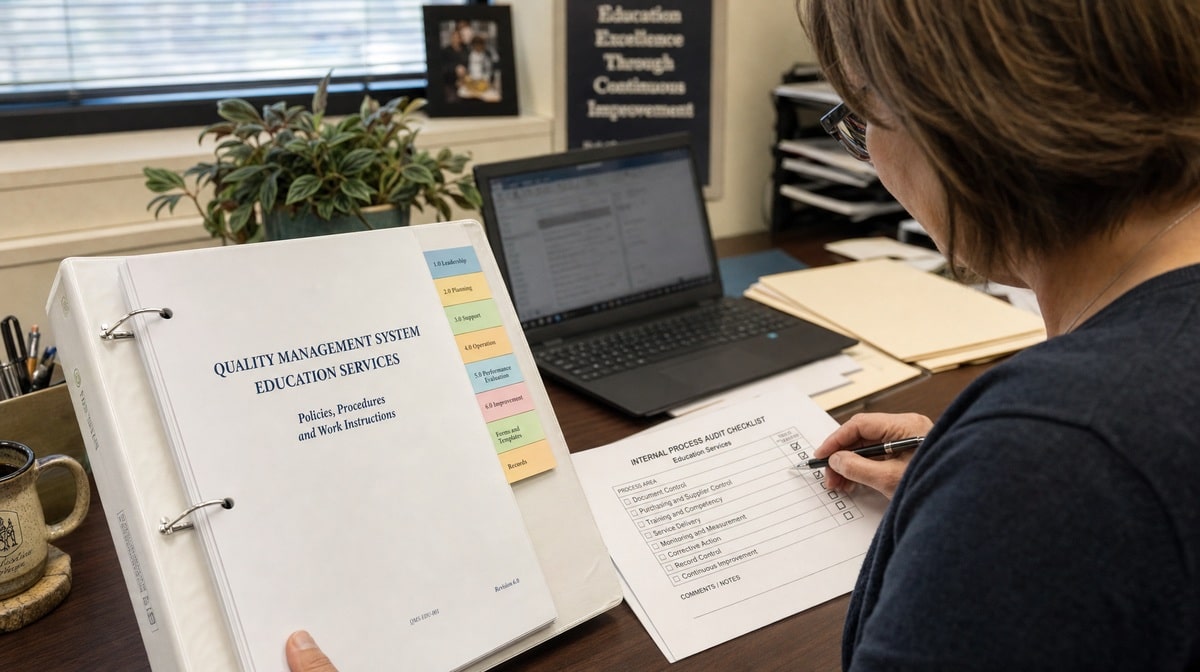
ISO 9000 lays out the basics of a quality management system that can apply to any industry. Education is an industry that can use the same fundamentals around purchasing, production and service provisions, customer property, control of nonconforming product, corrective action, and preventive action (now called risk management). It also helps to define what a good result looks like before you measure it; agencies such as the National Center for Education Statistics exist because learning outcomes are only manageable once they are consistently measured. Here is what each element would look like in a school.
Purchasing in Education
Think about art supplies, books, equipment, meals, sporting goods, or furniture that gets purchased. If there are purchasing specifications that are important to learning, then those items need to be controlled. Do you have an obligation to provide safe and healthy meals? What about sufficient supplies, equipment, or furniture for learning? What purchasing procedures does your company need?
Production and Service Provisions in Education
Think about the work instructions or teaching procedures that ensure some consistency or uniformity. How are they controlled, revised, distributed, and validated (how do you know they worked)? Can you trace or track learning, or the lack of it, to a specific teaching method or event?
Customer Property in Education
Think about what kids bring to school: coats, notebooks, books, and supplies. Do you have an obligation to care for their property, provide lockers, or control access? What do you do if an item is damaged or misplaced?
Control of Nonconforming Product in Education
A nonconformance can show up in the teaching methods, in student behavior or performance, or in the purchased items needed for learning. What do you do with broken furniture, equipment, or lockers? What is your process for removing them from the learning process so they do not hinder other students from learning?
Corrective Action in Education
What is your process for monitoring, reviewing, and adjusting the learning system as a result of complaints, comments, or audit findings? Each incident should be tracked, investigated, and resolved. A good complaint handling process, aligned with the principle of corrective and preventive action, is the best way to instill a culture of continuous improvement in your organization.
Preventive Action in Education
Do you review your methods and make changes before you receive complaints? If you fix an issue after a complaint, your action is corrective. If you fix it before anyone complains, it is preventive. So what are you doing to prevent complaints in the first place?
Education Quality

A class is like a manufacturing cell in a factory. The batch size is the number of students, but one class does not make a graduate; a student must pass through numerous classes, or manufacturing cells, to come out an educated student. How your students progress through the cells in your facility determines the learning effectiveness of your quality system. Manage the system, not the blame, and you now know what quality education is and how to apply it.
Frequently Asked Questions
What is meant by quality in education?
Quality in education means the learning system reliably produces the intended change in behavior, or learning, for its students. It is judged by how well teaching methods, curriculum, and supporting processes deliver consistent learning outcomes, not by any single lesson in isolation.
How does treating a school like a factory improve quality?
The factory analogy reframes teaching as a system of work instructions, methods, and tools that produces learning. When learning does not occur as expected, you improve the system rather than blame the person, which is where the real leverage for quality sits.
How does ISO 9000 apply to education?
ISO 9000 describes the basics of a quality management system that fits any industry. In a school those basics map to purchasing, production and service provisions, customer property, control of nonconforming product, corrective action, and preventive action.
What is the difference between corrective and preventive action in a school?
Corrective action fixes a problem after a complaint or defect appears, such as revising a teaching method that is not working. Preventive action changes the method before any complaint occurs, heading off the defect and building continuous improvement.
Who are the customers of a school’s learning process?
The consumers of learning are the students, their parents, and society, all of whom benefit from the education produced. Designing quality around their needs keeps the learning system aligned to the result it is meant to deliver.