The Complete Guide To System Availability Calculations

The availability equation turns operating time and downtime into a percentage you can use to evaluate a system, service, machine, or process. For a basic observed-time calculation, divide uptime by the total required time and multiply by 100.
The arithmetic is simple. Useful availability calculations depend on deciding what counts as required time, which downtime belongs in the calculation, and what action the result should trigger. This guide gives you the formulas, a worked example, a target-setting method, and a practical improvement plan.
What the Availability Equation Measures
Availability measures whether an item is able to perform when it is required. It combines two operational realities: how long the item runs and how quickly the organization restores it after downtime.
Demonstrated availability equals uptime divided by total required time, or uptime divided by uptime plus downtime. Written as a percentage, the basic availability calculation is:
Use the same unit throughout the equation. If uptime is measured in hours, downtime must also be in hours. Define the measurement window before collecting data, and state whether planned shutdowns are excluded or included.
Availability Is Not the Same as Reliability
Availability and reliability are related but different: reliability concerns failure-free operation over an interval, while availability also accounts for recovery from downtime. A system can fail more often but return to service quickly, or fail rarely but take a long time to repair. Those patterns can produce similar availability percentages while demanding different improvement work.
How To Calculate System Availability
Use a consistent five-step method so the percentage can be checked and repeated.
- Set the measurement window. Choose the shift, week, month, quarter, or year that matches the decision.
- Define required time. Record the time when the system was expected to be able to operate.
- Record downtime. Use incident, maintenance, monitoring, or production records rather than memory.
- Calculate uptime. Subtract included downtime from required time.
- Apply and document the formula. Save the inputs, exclusions, result, owner, and review date.
Ownership matters as much as arithmetic. Good information technology management defines who owns the target, who validates downtime records, and who approves exclusions.
Worked Availability Calculation
Assume a system is required for 720 hours during a 30-day reporting window. Incident and maintenance records show 9 hours of included downtime. The example is hypothetical, but the method is reusable.
| Input or step | Calculation | Result |
|---|---|---|
| Required time | Given | 720 hours |
| Included downtime | Given | 9 hours |
| Uptime | 720 − 9 | 711 hours |
| Availability | 711 ÷ 720 × 100 | 98.75% |
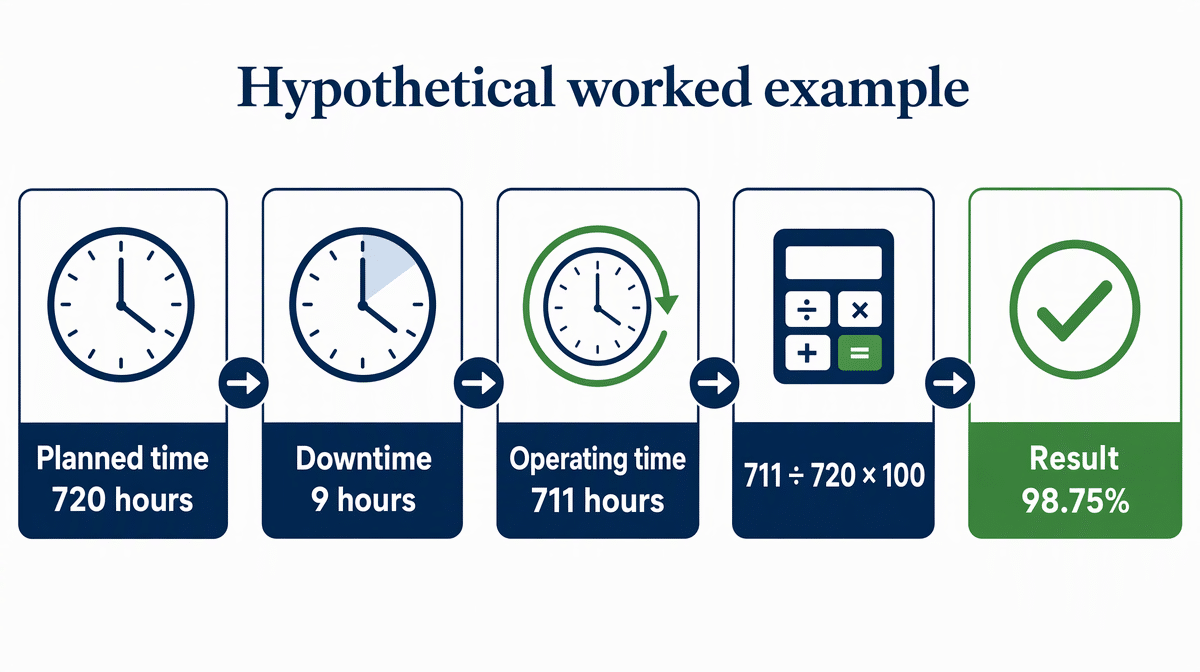
The result means the system was available for 98.75 percent of the defined required time. It does not, by itself, explain why downtime occurred or whether the target was appropriate. Pair the result with an incident count, downtime by cause, repair duration, business impact, and corrective-action status.
Which Availability Formula Should You Use?
There is no single formula for every decision. Select the boundary that matches what you need to manage.
| Measure | Use it for | Boundary |
|---|---|---|
| Observed or demonstrated availability | Reporting actual performance | Recorded uptime and included downtime |
| Inherent availability | Comparing failure and corrective repair characteristics | MTBF and MTTR, excluding preventive maintenance and support delays |
| Operational availability | Managing real operating support | Corrective maintenance, preventive maintenance, supply delay, and maintenance delay |
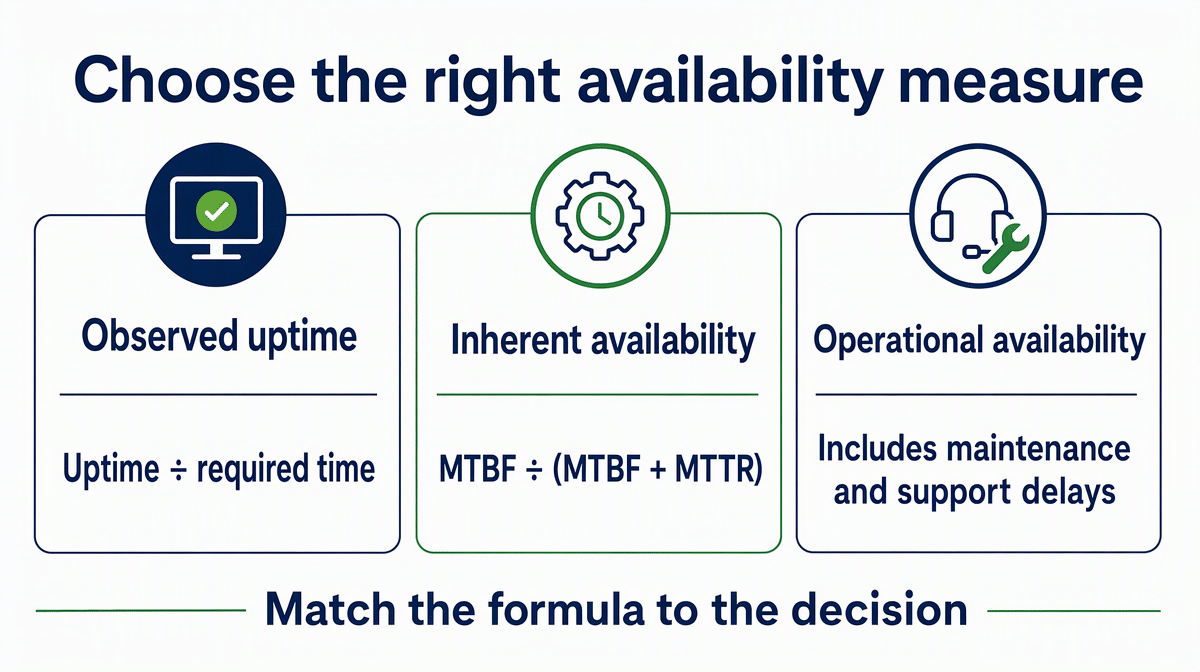
Operational availability includes corrective maintenance, preventive maintenance, supply delays, and maintenance delays. This broader measure is often more useful when the problem includes spare parts, scheduling, staffing, access, or administrative delay rather than equipment repair alone.
Choose the availability definition that fits the objective of the analysis and the data you can actually collect. Document that definition beside every reported percentage so two teams do not compare numbers built from different boundaries.
How MTBF and MTTR Change Availability
Inherent availability can be calculated as MTBF divided by MTBF plus MTTR. Mean time between failures describes the average operating interval between failures, while mean time to repair describes the average active corrective-repair duration.
The MTBF and MTTR formula treats failure and repair rates as constant over time. Use it as a planning or comparison model only when that assumption and the excluded delay categories fit the decision.
You can improve this equation from either side. Increase MTBF by removing recurring failure causes, improving operating conditions, or redesigning weak components. Reduce MTTR by improving diagnostics, access, instructions, tools, spare-part availability, and escalation paths.
How To Set an Availability Target
A target should reflect business impact, safety, customer commitments, recovery capability, and the cost of additional resilience. Do not copy a percentage because it sounds strong. Translate it into allowable downtime for the same measurement window used by the operating team.
A 99.9% availability target permits about 8.76 hours of unavailability per year, assuming no planned downtime. A monthly operating review can divide the annual objective into smaller budgets, but the team should state whether it uses a 30-day period, calendar month, or rolling window.
- Define scope: name the system, locations, users, and dependent services covered.
- Define required time: state business hours, continuous operation, maintenance windows, and exclusions.
- Define impact: distinguish complete outage, degraded operation, and partial user impact.
- Define response: set thresholds for investigation, escalation, corrective action, and management review.
- Define evidence: retain monitoring records, tickets, maintenance logs, cause codes, and approvals.
How To Improve System Availability
Start with the largest recurring sources of included downtime rather than the most visible incident. Group downtime by cause, system, shift, supplier, repair stage, or dependency. Then separate failure prevention from recovery improvement.
- Improve the data. Standardize timestamps, cause codes, planned-downtime rules, and closure checks.
- Remove repeat failures. Use root-cause analysis and controlled corrective action for the highest-impact patterns.
- Shorten diagnosis. Provide alerts, decision trees, system maps, and clear escalation ownership.
- Shorten restoration. Improve access, instructions, tools, parts, backups, and tested recovery procedures.
- Reduce support delay. Review approval, vendor, scheduling, supply, and handoff bottlenecks.
- Review the target. Compare actual performance with business impact and decide whether to accept, improve, redesign, or add redundancy.
Connect the metric to a controlled management process. A digital quality management system can keep maintenance evidence, nonconformities, corrective actions, approvals, and trend reviews together. Formal process improvement initiatives can turn recurring downtime causes into owned work with measures and completion criteria.
The final deliverable should be more than a percentage. Record the definition, inputs, exclusions, result, trend, leading causes, business impact, assigned actions, owner, due date, and next review. Keep the reporting window consistent across trend periods so the results remain comparable. That package makes the availability calculation auditable and actionable.
Frequently Asked Questions
What Is the Basic Availability Equation?
The basic availability equation is uptime divided by uptime plus downtime, multiplied by 100. Define required time and included downtime before using the result.
What Is the Difference Between Availability and Reliability?
Reliability focuses on operating without failure for a specified interval. Availability also reflects how quickly the system returns to service after downtime.
How Do MTBF and MTTR Affect Availability?
Higher MTBF generally improves inherent availability by increasing the operating interval between failures. Lower MTTR improves it by shortening active corrective-repair time.
Document system ownership, monitoring, incident response, backup, recovery, change, vendor, and continuity controls.
View the IT manualConnect availability trends with controlled records, maintenance evidence, corrective action, review, and continual improvement.
Review the digital QMS guide