The Complete Guide To Requirements Engineering
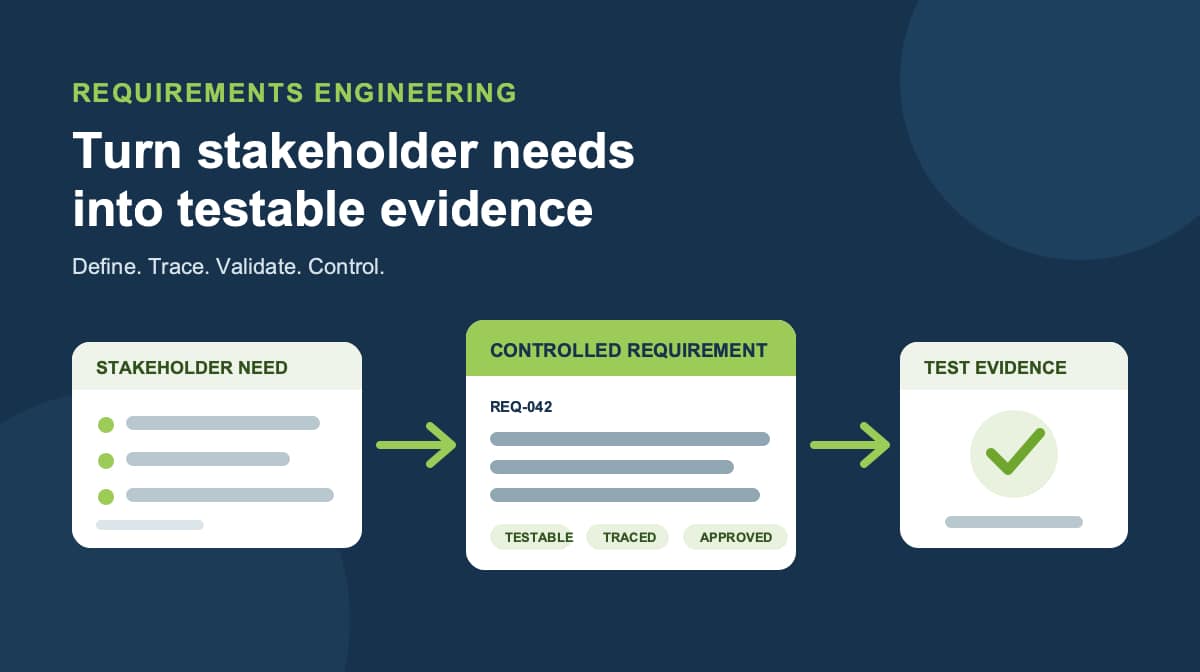
Turn project needs into controlled requirements
Use the practical process below, then connect the result to business process re-engineering when the project changes how work is performed.
Projects rarely fail because nobody had ideas. They fail when different people carry different versions of the need, important constraints remain implicit, or a late change reaches design and testing without a clear decision. Requirements engineering gives those conversations a controlled path from need to evidence.
A practical requirements engineering process defines the scope, identifies stakeholders, elicits needs, analyzes conflicts, writes clear engineering requirements, validates them, establishes an approved baseline, and maintains traceability as the project changes. This guide includes a seven-stage workflow and a worked traceability matrix that a small or midsize organization can adapt without building a large specialist department.
What Is Requirements Engineering?
Requirements engineering is the controlled work of discovering, analyzing, documenting, validating, and managing what a product, service, process, or system must accomplish. It translates stakeholder needs into statements that a team can design against, approve, test, and maintain.
The result is more than a list of requested features. A complete set of engineering requirements also covers performance, interfaces, data, safety, security, compliance, operations, maintenance, transition, and other constraints that affect whether the solution will work in its real environment.
NASA describes technical requirements definition as transforming stakeholder expectations into a complete set of validated technical requirements. The scale and documentation can be tailored, but the operating principle applies to ordinary business projects: the team should agree on the problem and the evidence of success before treating a solution idea as settled.
The Requirements Engineering Process at a Glance
The stages below form a loop rather than a one-way handoff. Analysis may reveal a missing stakeholder. Validation may expose an ambiguous requirement. A change request may require renewed elicitation and another approval decision.
The core records should stay connected throughout that loop. Maintain a stakeholder and source list, glossary, requirement register, issue and decision log, review record, approved baseline, traceability matrix, verification evidence, and change history at the level of detail the project needs. A small team may keep these views in one controlled workbook. A larger team may separate them across tools, but each requirement still needs a stable identifier that preserves the connection.
Requirements engineering process
Outcome, boundary, authority, and stakeholders
Needs, scenarios, constraints, and assumptions
Conflicts, feasibility, priority, and risk
Clear, testable requirement statements
Right need, shared meaning, usable evidence
Approval, version, owner, and decision record
Source, design, test, status, and change impact
Feedback loop: Return to the relevant stage when evidence changes, a conflict appears, or an approved change affects the baseline.
Step 1: Define the Scope and Stakeholders
Begin with the decision the project must enable, the result the organization expects, and the boundary of the system under discussion. A scope can cover a software application, an automated workflow, a new product, a policy-controlled process, an equipment change, or a combination of these.
Write down what is inside the project and what is outside it. Identify upstream inputs, downstream users, external interfaces, operating conditions, and the authority that will approve requirements. Clear boundaries prevent a local request from quietly becoming a company-wide redesign.
- Business outcome: the measurable condition the project should improve or protect.
- System boundary: the people, process, technology, data, and interfaces included.
- Stakeholders: users, customers, owners, approvers, operators, maintainers, support teams, and affected third parties.
- Decision rights: who may propose, clarify, approve, reject, defer, or change a requirement.
- Constraints: budget, schedule, regulation, policy, compatibility, capacity, security, and other fixed conditions.
Choose one requirements owner to maintain the register, organize reviews, record decisions, and follow open questions to closure. The owner facilitates the process. Subject matter experts still own the facts and authorized leaders still own approval.
Step 2: Elicit Stakeholder Needs
Elicitation gathers what stakeholders need, why they need it, how they work now, and what could prevent success. Use more than one method because interviews reveal reasoning, observation reveals actual practice, and records reveal exceptions that people may not remember during a meeting.
- Interview users, process owners, approvers, support staff, and technical specialists.
- Observe the current task, including workarounds, delays, handoffs, and infrequent exceptions.
- Review procedures, forms, reports, contracts, policies, audit findings, support tickets, and performance data.
- Map normal, alternate, error, recovery, start-up, shutdown, and maintenance scenarios.
- Use a workshop to compare perspectives and resolve vocabulary differences.
- Build a simple prototype when stakeholders need something concrete to react to.
Ask for the purpose behind each requested feature. A stakeholder may ask for a specific screen, approval, report, or notification because the current process has a risk or delay. Understanding that cause gives the team room to compare solutions without losing the real requirement.
Step 3: Analyze, Resolve, and Prioritize Requirements
Analysis turns raw statements into a coherent set. Group related needs, define terms, identify duplicates, expose contradictions, test feasibility, and separate requirements from design preferences. Record unresolved questions with an owner and due date rather than hiding uncertainty inside vague wording.
Prioritization should consider business value, user impact, risk reduction, legal or policy obligation, dependency, cost, and learning value. The same discipline used in lean product development can help the team delay unnecessary detail while protecting the requirements needed to test the most important assumptions.
Requirements analysis questions
| Question | What It Reveals | Possible Action |
|---|---|---|
| What outcome does this support? | Purpose and value | Keep, clarify, or remove |
| Who needs it and in which scenario? | User and operating context | Add scenario or boundary |
| Can it be verified objectively? | Testability | Add a measurable condition |
| Does it conflict with another requirement? | Tradeoff or inconsistency | Escalate a decision |
| Is this a need or a preferred design? | Solution bias | Restate the underlying need |
Step 4: Write Clear Engineering Requirements
Give each requirement a unique identifier and write one obligation per statement. A useful pattern is: the named system or process must perform a defined action, under a stated condition, to a measurable level. Add the rationale and source in separate fields so the requirement itself stays concise.
Requirement-writing pattern
[System or process] shall [observable action] [object or result] when [condition] within [measurable limit].
Hypothetical example: The purchase request workflow shall notify the assigned approver within five minutes after a complete request enters the approval queue.
The example is illustrative. Select limits from actual business, technical, contractual, and risk evidence.
Avoid words such as fast, easy, flexible, adequate, user-friendly, and where possible unless the project defines how to evaluate them. Avoid combining several obligations with and. If one part can pass while another fails, separate the statements so the team can trace and verify them independently.
- Necessary: supports an approved need, constraint, or risk response.
- Clear: has one reasonable interpretation for the intended readers.
- Feasible: can be achieved within known physical, technical, cost, and schedule constraints.
- Verifiable: has evidence that can show whether the requirement was met.
- Traceable: links to its source and to downstream design and verification work.
- Controlled: has an identifier, owner, version, status, and change history.
Step 5: Validate Requirements With Stakeholders
Validation asks whether the documented requirements describe the right result for the real need. Review the set with stakeholders in realistic scenarios, not only as isolated sentences. Walk through normal work, exceptions, failures, recovery, reporting, support, maintenance, and end-of-life conditions that matter to the project.
Use prototypes, examples, process models, calculations, simulations, or sample data when words alone leave room for different interpretations. Ask stakeholders to explain the requirement back in their own terms and describe what evidence would make them accept the delivered result.
- Does the set cover the intended outcome and important operating scenarios?
- Are stakeholder conflicts resolved or explicitly accepted by an authorized decision-maker?
- Are interfaces, assumptions, dependencies, and constraints visible?
- Can each requirement be verified with an identified method?
- Are terms, units, thresholds, and responsibilities unambiguous?
- Can the approving stakeholders explain what will change for them?
Step 6: Baseline and Approve the Requirements
A baseline is the approved version the team uses for design, planning, verification, and change control. It does not mean the requirements can never change. It means a change becomes a visible decision with a reason, impact review, authority, and updated record.
Before approval, close or disposition review comments and record accepted exceptions. Capture the baseline version, approval date, approvers, open assumptions, deferred requirements, and the location of supporting evidence. Give delivery teams a clear notice of what is approved and what remains unresolved.
For a project involving business process automation, the baseline should cover the process rules as well as the software behavior. Include roles, decision logic, data inputs, exceptions, escalation, records, access, and the manual fallback needed when automation is unavailable.
Step 7: Trace Requirements and Control Changes
Traceability connects each requirement backward to its source and forward to design, implementation, verification, and status evidence. This connection helps the team identify orphan requirements, uncovered needs, missing tests, and the parts of the project that a proposed change may affect.
NASA states that complete requirements traceability is a critical factor in successful requirements validation. A small project can maintain that connection in a controlled spreadsheet or table. A larger or regulated project may need a dedicated requirements tool, stricter access, and formal review records.
Every change request should identify the requirement, reason, requester, urgency, affected stakeholders, design and test impact, cost and schedule effect, decision, approver, and baseline version. Update linked artifacts together after approval so the matrix does not point to obsolete design or verification evidence.
A Worked Requirements Traceability Matrix
The matrix below shows how a small team can connect source, requirement, acceptance evidence, ownership, and change status. The example is hypothetical and describes a purchase request workflow rather than a specific product.
Hypothetical requirements traceability and validation matrix
| ID | Source and Need | Requirement | Acceptance Evidence | Owner | Status |
|---|---|---|---|---|---|
| REQ-001 | Finance policy: spending authority must be enforced | The workflow shall route each complete request to an approver whose active authority covers the request amount. | Scenario test across approval bands, including expired authority | Finance process owner | Validated |
| REQ-002 | Requester need: know whether a request is waiting | The workflow shall display the current status and assigned approver to the requester after submission. | User acceptance review using normal and reassigned requests | Procurement manager | Approved |
| REQ-003 | Audit need: preserve the decision record | The workflow shall record the decision, actor, timestamp, comment, and applicable approval rule for each completed approval step. | Record inspection after approve, reject, return, and delegate scenarios | Internal controls owner | Approved |
| REQ-004 | Operations constraint: approvers may be unavailable | The workflow shall escalate an unacted request to the designated backup after the approved response period expires. | Timed test with available, unavailable, and missing backup assignments | Operations manager | Change proposed |
Tailor the fields, approval method, and evidence standard to the project’s risk, scale, and obligations.
Common Requirements Engineering Failure Modes
A documented process can still produce weak requirements when the team treats completion of the document as the goal. Watch for the failure modes below during reviews and retrospectives. Each one points to a missing conversation, decision, or evidence link.
Starting With a Preferred Solution
A requested tool, screen, field, or approval route may be useful, but it is not automatically the requirement. Ask what outcome, risk, or operating condition created the request. Record the underlying need first, then compare design options against it.
Leaving Important Stakeholders Outside the Review
Project sponsors and frequent users may describe the normal case well while support teams, maintainers, auditors, or downstream operators carry the exceptions. Build the stakeholder list from the full life cycle of the result. Add a review question that asks who must operate, support, change, verify, or retire it.
Using Vague Quality Words
Words such as reliable, secure, intuitive, rapid, and scalable may express a valid concern, but they do not define a finish line. Ask what failure looks like, which conditions matter, and what evidence the approver will accept. Replace the quality label with measurable behavior, or define the review method when a numeric limit is not appropriate.
Approving Individual Statements Without Reviewing the Set
Each requirement can look reasonable on its own while the set remains incomplete or contradictory. Review realistic scenarios across several requirements at once. Check that data, roles, timing, exceptions, interfaces, security, records, and recovery behavior work together.
Treating Traceability as an Administrative Task
A matrix that is updated only before an audit does not support the project. Use trace links during impact analysis, design reviews, test planning, and acceptance. When a source, requirement, design element, or test changes, update the connected records as part of the same controlled decision.
Allowing Changes Outside the Baseline
Teams often make reasonable local adjustments that never reach the requirements record. The result is a delivered system, procedure, and test set that describe different realities. Make the change path quick enough to use, but require a reason, impact review, decision authority, and updated baseline before the new direction becomes official.
How To Tailor the Process to Your Project
Tailoring changes the amount of formality, not the need for shared understanding and controlled decisions. A short internal improvement may use a one-page scope, a workshop, a requirements table, and approval from one process owner. A high-risk, customer-facing, regulated, or multi-vendor system may require formal specifications, interface documents, dedicated tools, independent reviews, and detailed evidence.
- Keep: unique identifiers, sources, acceptance evidence, ownership, approval, versioning, and change history.
- Scale: the number of documents, review levels, modeling techniques, tool controls, and required signatures.
- Increase rigor when: failure can harm people, violate an obligation, expose sensitive information, interrupt critical operations, or create costly rework.
- Simplify when: the change is low-risk, reversible, locally owned, and easy to verify with direct stakeholder feedback.
Review the process after delivery. Compare requirement defects, late changes, rework, failed acceptance tests, decision delays, and traceability gaps. Use those observations to improve the next project’s elicitation questions, review checklists, approval rules, and evidence standards.
Separate the outcome and constraint from the first proposed solution.
Make every requirement clear enough to verify with an agreed method.
Trace source, design, test, approval, and change status through delivery.
Frequently Asked Questions
What Is the Difference Between a Stakeholder Need and an Engineering Requirement?
A stakeholder need describes the outcome or capability someone requires in context. An engineering requirement translates that need into a clear, bounded, and verifiable obligation that the team can design, approve, and test.
Who Owns the Requirements Engineering Process?
One requirements owner should maintain the register, organize reviews, and record decisions, but ownership is distributed. Stakeholders own their needs, specialists own technical facts, authorized leaders approve tradeoffs, and delivery teams provide design and verification evidence.
What Makes an Engineering Requirement Testable?
A requirement is testable when it describes observable behavior or a measurable result under stated conditions and the team can identify objective evidence that will show whether the requirement was met.
What Is a Requirements Traceability Matrix?
A requirements traceability matrix is a controlled table that links each requirement to its source, related design or process element, verification evidence, owner, status, and change history so the team can find gaps and assess impact.