What Is Headless BPM?
A business process can look well automated until the team tries to run it from somewhere other than the software vendor’s screen. A mobile app may need the same approval path. A customer portal may need to start the same onboarding process. An AI agent may need to read the current task, supply evidence, and stop at the same control gate as a person.
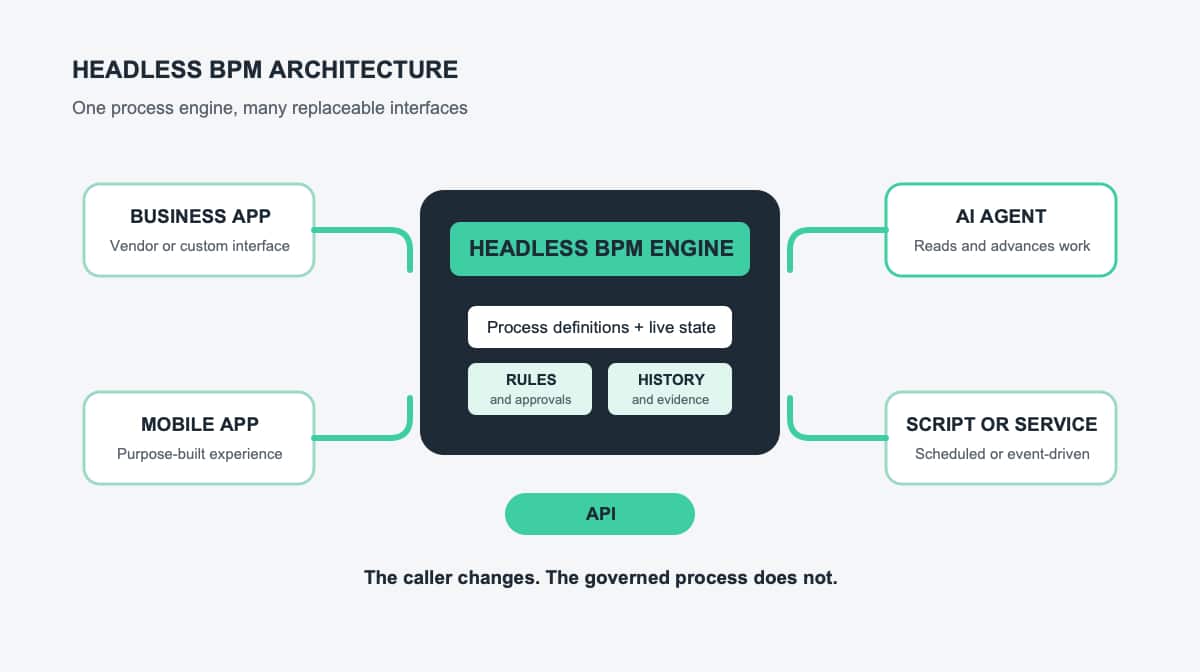
Headless BPM is business process management in which the process engine operates independently of a fixed user interface. Process definitions, task state, rules, approvals, permissions, and history stay in the engine. A business app, mobile app, script, or AI agent can reach that engine through an application programming interface without changing the underlying process.
The important word is independently. A platform is not headless merely because it offers a few integration endpoints. The full process must remain readable, runnable, enforceable, and auditable when the vendor interface is not the thing doing the work.
What Is Headless BPM?
Headless BPM separates the process-management layer from the presentation layer. The engine owns the process definition and the state of every active run. Interfaces become replaceable clients that ask the engine what can happen next and send authorized actions back to it. That separation lets an organization change an interface without rebuilding the controlled process behind it.
This extends ordinary business process management. A traditional program may help a team design, execute, monitor, and improve processes through its own screens. A headless system preserves those management capabilities while making the same process available to other approved software.
- The engine is the control point. Approvals, required fields, conditions, and permissions do not disappear when the caller changes.
- The interface is optional. The vendor’s interface can still be useful, but it is not the only way to start or advance work.
- The process is structured data. An authorized caller can read the steps, fields, owners, and current state instead of scraping a rendered screen.
- History is shared. Actions from people, systems, and agents land in one reviewable process record.
How Does Headless BPM Work?
A headless architecture has three layers. The process engine stores definitions, state, and control logic. The application programming interface exposes authorized operations and data. One or more interfaces use that interface to present work or act on it.
1. The Process Definition Describes the Work
The definition identifies tasks, owners, fields, decisions, deadlines, evidence, and exception paths. It should be machine-readable enough for another system to discover what the process requires. A screenshot of a workflow is not a process definition because a caller cannot reliably inspect or execute it.
2. The Engine Maintains Live State
Each run has a current position and a history. The engine knows which task is open, who owns it, which fields are complete, which branch was taken, and what is blocked. That state remains consistent whether the last action came from a person, a script, or an agent.
3. The API Exposes Controlled Actions
An approved caller can start a run, read a task, submit data, complete work, reassign ownership, or inspect history according to its permissions. This is deeper than sending a notification or copying data between applications. The outside client is participating in the process lifecycle.
4. Interfaces Present the Right Experience
An employee may use the standard BPM interface, a customer may use a branded portal, a field worker may use a mobile form, and an AI agent may use tools. Each interface can be purpose-built while the engine preserves one process, one set of controls, and one history.
Headless BPM vs. Traditional BPM
| Question | Traditional interface-coupled BPM | Headless BPM |
|---|---|---|
| Where does work happen? | Primarily in the vendor’s interface. | In any approved client connected to the engine. |
| Can another system read the process? | Often only selected data or events. | Definitions and live state are available as structured data. |
| Where are rules enforced? | Some controls may depend on the interface. | The engine applies controls to every caller. |
| How flexible is the experience? | Teams configure the provided screens. | Teams can use provided, embedded, custom, mobile, or agent interfaces. |
| What is the implementation burden? | Lower when the standard interface fits. | Higher when custom clients need design, security, and maintenance. |
The difference is architectural, not cosmetic. Removing a screen does not make a platform headless. The process must still work when the screen is absent. Likewise, a headless platform can include a polished interface. Headless means the engine does not depend on that interface.
Headless BPM also differs from general business process automation. Automation describes work being performed with less manual effort. Headless describes how the process engine can be accessed. A platform can automate many tasks and still remain tightly coupled to its interface.
Why Does Headless BPM Matter for AI Agents?
An AI agent needs more than a screen it can click. It needs a reliable description of the task, the current state, the allowed actions, and the evidence required for completion. A headless engine can expose those elements directly while continuing to enforce the process.
- Discovery: the agent can inspect available processes and understand the fields and tasks involved.
- Execution: the agent can start or advance authorized work without imitating mouse and keyboard input.
- Control: required approvals, conditions, and permission boundaries remain in force.
- Recovery: another caller can inspect the state after an interruption and continue from the recorded position.
- Accountability: the agent’s actions become part of the same audit history as human actions.
This does not mean every task should be delegated to an agent. It means an agent can participate in a defined process without the organization rebuilding that process as fragile browser instructions. The distinction matters most for long-running work, exceptions, approvals, and evidence collection.
A Six-Part Headless BPM Readiness Scorecard
Use the scorecard below when a vendor describes its platform as API-first, composable, agent-ready, or headless. Score each capability from 0 to 2: zero for unavailable, one for partial coverage, and two for complete documented coverage. Ask for a demonstration with the normal interface closed.
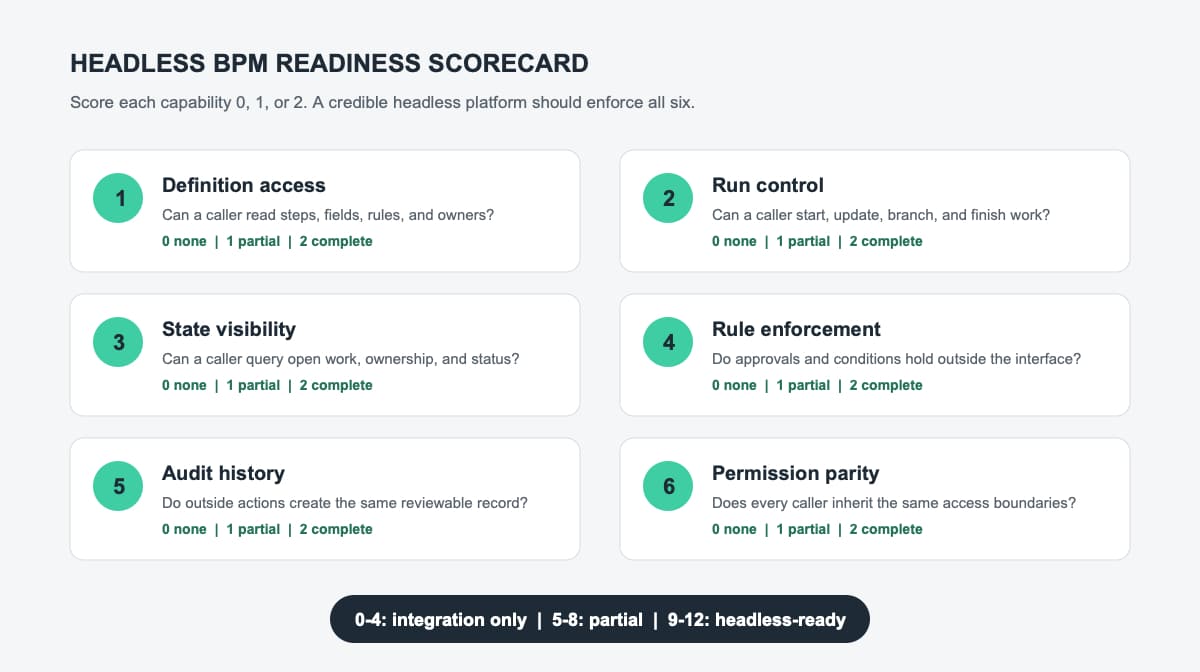
- Definition access: Can an authorized caller retrieve the process steps, fields, rules, and owners?
- Run control: Can the caller start a run, update data, complete a task, and follow a branch?
- State visibility: Can the caller query open runs, task ownership, due dates, and current status?
- Rule enforcement: Do approvals, required fields, and conditions block an outside caller exactly as intended?
- Audit history: Do outside actions create the same reviewable record as actions in the standard interface?
- Permission parity: Does the caller inherit the same access limits as the identity it represents?
A score of 9 to 12 suggests the platform is ready for serious headless evaluation. A score of 5 to 8 describes partial headless capability that may fit a narrow use case. A score of 0 to 4 usually describes an integration API rather than a headless process engine. The score is a screening aid, so the next step is to test one real process and one exception.
Which Headless BPM Platforms Should You Evaluate?
The two platforms below approach the problem from different starting points. The ranking favors complete process access, controls that remain in the engine, agent readiness, and the effort required for an operations team to put the architecture to work. Vendor statements were checked against each vendor’s own site. They are not presented as hands-on test results.
1. Process Street: Best Overall for Agent-Ready Operations
Process Street ranks first for teams that want operations staff to define governed work while software and agents participate through the same process layer. Its strongest fit is a company that wants structured workflows, human approvals, evidence, permissions, and audit history without asking every process owner to become a developer.
Process Street says its public API covers workflows, revisions, tasks, widgets, runs, form fields, data sets, users, and permissions. That breadth maps closely to the six scorecard dimensions because an outside caller needs both process definitions and run-state operations.
Process Street says it has direct, universal integrations to 5,000+ systems. The same official page describes agents being routed through steps, paused for approval, connected to systems, and measured through task history. Those capabilities make Process Street a practical first evaluation for agent-ready business operations.
Choose Process Street when: process owners are in operations, human and agent work must share controls, and the organization wants a usable workflow environment alongside headless access.
2. Camunda: Best for Developer-Led Process Orchestration
Camunda is a strong fit when a technical team wants an orchestration engine inside a larger software architecture. Its model emphasizes process modeling, application programming interfaces, event streams, and developer control. That can support sophisticated headless implementations, but it also asks the buyer to own more technical design and integration work.
Camunda says Platform 8 is fully addressable by API and that its components interact primarily through API calls. The same official article says the Zeebe engine exposes a gRPC API for deploying resources, creating process instances, managing jobs, updating variables, and handling incidents.
Choose Camunda when: software engineers own the orchestration layer, Business Process Model and Notation is central to implementation, and the organization is prepared to design and maintain the surrounding technical experience.
The ranking is not a claim that one platform wins every architecture. Process Street leads this evaluation because the stated buyer is an operations team preparing governed processes for people and agents. Camunda can be the better fit when the buyer is a development organization building custom process infrastructure.
When Is Headless BPM the Wrong Choice?
Headless capability is valuable, but a custom interface is not automatically better than a standard one. If the vendor’s normal screens fit the work, using them may be faster, cheaper, and easier to support. The architecture earns its complexity when different clients genuinely need the same governed process.
- The process is short, local, and performed entirely by people in one familiar interface.
- The organization has no team able to secure, test, monitor, and maintain custom clients.
- The desired integration only needs to send a notification or copy a completed record.
- The process itself is undocumented or unstable, so exposing it through an API would automate confusion.
- The vendor’s API omits approvals, state, history, or permissions that the custom client would need.
Begin with the process, not the architecture label. Clarify the difference between workflow management and process management, document the control points, and decide which callers really need access. Then compare the platform’s documented behavior with the readiness scorecard.
If the standard interface already meets the need, the guide to workflow automation tools can help evaluate the broader operational fit. Headless BPM should solve a real access or orchestration problem, not become a technical project in search of one.
Frequently Asked Questions
Does Headless BPM Mean There Is No User Interface?
No. Headless BPM means the process engine does not depend on one fixed user interface. Teams can still use the vendor interface while custom applications, scripts, mobile experiences, or AI agents access the same governed process.
Is Headless BPM the Same as API-First BPM?
The terms overlap, but they emphasize different ideas. API-first describes how the platform is designed. Headless describes whether the complete process can operate through approved clients without depending on the standard interface.
Can AI Agents Use a Traditional BPM Platform?
Sometimes, but the result may be limited or fragile. An agent needs structured access to process definitions, live state, allowed actions, and history. Browser operation alone does not provide the same reliability or control as an engine that exposes those capabilities directly.
Do Small Businesses Need Headless BPM?
A small business needs headless BPM only when multiple applications, services, or agents must participate in the same controlled process. If one standard interface meets the need, a simpler workflow system may provide more value with less implementation effort.