Workplace Policies and Procedures: A Complete Guide

Workplace rules often become visible only when something goes wrong. Two supervisors handle the same attendance problem differently, an employee reports harassment but does not know whom to contact, or a manager approves an exception without recording why. The organization may have good intentions, but employees experience uncertainty.
Written workplace policies and procedures replace that uncertainty with shared expectations and repeatable action. They tell employees what the company requires, explain how work should be performed, and give managers a consistent basis for decisions.
This guide explains which company policies matter, how policies differ from procedures, how to write and implement them, and how to keep the entire system current. It also includes practical workplace policy examples for human resources, safety, information security, conduct, and daily operations.
What Are Workplace Policies and Procedures?
Workplace policies and procedures are controlled documents that define company rules and explain how employees carry them out. A policy states the organization’s position, expectation, or required outcome. A procedure assigns responsibilities and describes the steps, records, systems, and timing needed to follow that policy.
Together, the two documents connect leadership intent with everyday work. A policy might require a workplace free from harassment. Its procedures then explain reporting channels, intake responsibilities, investigation steps, confidentiality practices, anti-retaliation protections, corrective action, and recordkeeping.
Policies Set Direction and Boundaries
A policy tells employees what is required, allowed, prohibited, or encouraged. It establishes boundaries for judgment without trying to predict every situation. An attendance policy, for example, can define punctuality expectations, notification requirements, approved leave, and the authority to address repeated problems.
Good policies also explain purpose and scope. Employees should understand why a rule exists and whether it applies to full-time staff, part-time staff, contractors, remote workers, temporary employees, or particular locations.
Procedures Turn Direction Into Action
A procedure translates the policy into a sequence people can follow. It identifies the trigger, responsible role, required inputs, steps, approvals, systems, forms, records, exceptions, and completion criteria. The procedure should be detailed enough for a trained employee to perform the work consistently.
Companies often organize related documents in a controlled policies and procedures manual. A manual gives employees one reliable place to find approved rules instead of searching old emails, shared-drive folders, or conflicting files.
Why Do Workplace Policies and Procedures Matter?
Documents alone do not create a well-run workplace. Their value comes from the decisions and behaviors they make more consistent. Effective policies and procedures help an organization communicate expectations, reduce avoidable variation, protect employees, preserve evidence, and respond to problems fairly.
- Consistency: Similar situations receive similar treatment across managers, teams, and locations.
- Clarity: Employees know what is expected and where to go when a situation falls outside the normal rule.
- Accountability: Owners, approvers, performers, and reviewers are named before a problem occurs.
- Compliance support: Legal and regulatory obligations are translated into operating controls, records, and review points.
- Training: New and existing employees have a stable reference for learning how work is done.
- Continuity: Critical knowledge remains available when an experienced employee changes roles or leaves.
Clear rules can also improve trust. Employees are more likely to view a decision as fair when the standard was communicated in advance, applied consistently, and supported by a visible appeal or exception process. Managers gain protection too because they can explain decisions through approved criteria rather than personal preference.
Which Workplace Policies Does a Company Need?
There is no universal policy list for every employer. The right library depends on jurisdiction, workforce size, industry, hazards, data, contracts, benefits, operating model, and company values. Start with the areas that create the most legal exposure, employee impact, financial risk, or repeated management decisions.
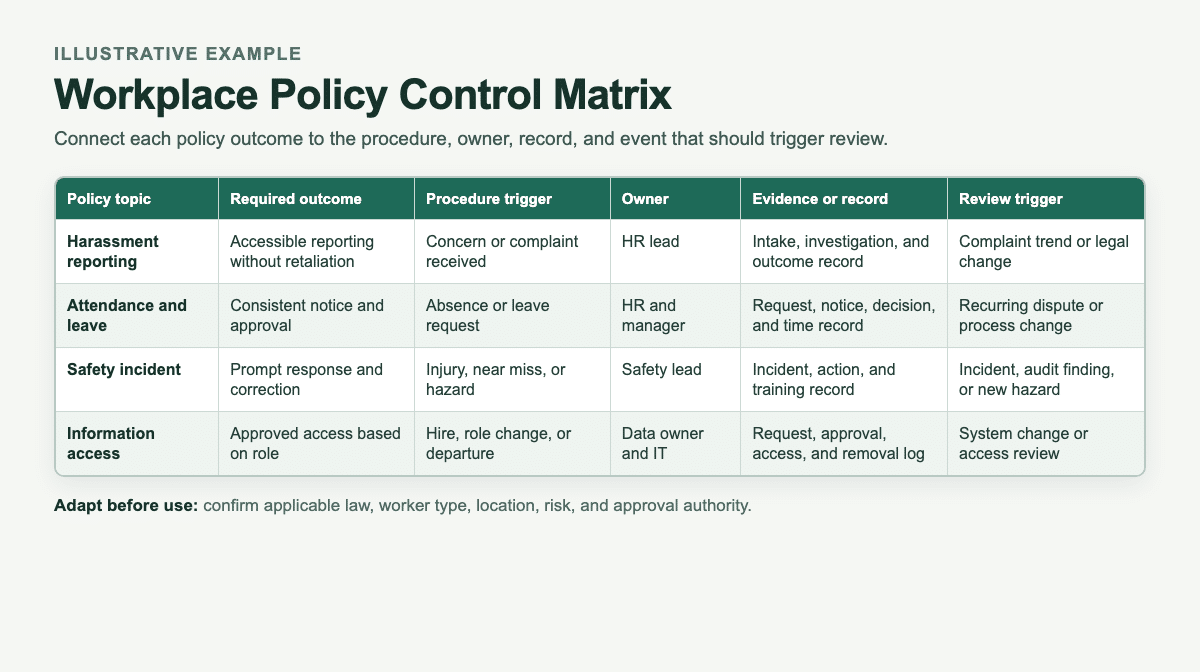
Use the illustrative matrix below as a starter. For each policy, record the required outcome, the event that starts the procedure, the accountable owner, the evidence kept, and the events that force an early review. The sample rows are not legal requirements; adapt them to your workforce, location, and risk.
Employment and Conduct Policies
Core HR policies commonly address equal employment opportunity, anti-harassment, retaliation, standards of conduct, attendance, leave, accommodations, performance management, discipline, conflicts of interest, workplace relationships, and employee records. The policy set should reflect the company’s actual employment practices rather than generic language copied from another organization.
Pay, Benefits, and Work Arrangements
Policies may cover timekeeping, overtime authorization, payroll corrections, expense reimbursement, benefits eligibility, paid time off, remote work, flexible schedules, business travel, and use of company equipment. Procedures should show employees how to record time, request leave, report an error, obtain approval, and submit required documentation.
Safety, Security, and Emergency Policies
Depending on the workplace, this group may include hazard reporting, personal protective equipment, incident response, emergency evacuation, workplace violence, visitors, physical access, severe weather, business continuity, and substance use. Each rule should connect to a practiced procedure, not merely a statement that safety matters.
Information and Technology Policies
Common technology topics include acceptable use, passwords, access control, privacy, confidential information, records retention, mobile devices, software installation, social media, cybersecurity incidents, artificial intelligence, and remote access. The procedures should identify who grants access, how approvals are recorded, when access is reviewed, and how it is removed.
Operational and Governance Policies
Operational policies may govern purchasing, vendor approval, quality, customer complaints, document control, delegated authority, financial approvals, inventory, maintenance, and records. Reviewing real examples of policies and procedures can help a team understand document structure before adapting it to its own roles and risks.
What Is the Difference Between a Policy and a Procedure?
A policy answers what and why. A procedure answers who, when, where, and how. Keeping those functions distinct makes the policy stable enough to guide decisions while allowing the procedure to change when systems, forms, staffing, or workflow change.
- Policy: All nonpublic employee information must be limited to authorized users with a legitimate business need.
- Procedure: A manager submits an access request, the data owner approves it, IT assigns the correct role, the system records the change, and access is reviewed every quarter.
- Policy: Employees must report workplace injuries promptly.
- Procedure: The employee seeks emergency help if needed, informs a supervisor, completes the incident form, and participates in the investigation and corrective-action process.
A policy should not become a long sequence of software clicks, and a procedure should not invent a new company rule. When a detailed step no longer works, the team can update the procedure without changing the underlying policy. When leadership changes the acceptable risk or decision boundary, both documents should be reviewed for alignment.
Standards, Guidelines, and Work Instructions
Some organizations use additional document types. A standard sets a mandatory technical or performance requirement, such as a password length or inspection tolerance. A guideline recommends a preferred approach while allowing judgment. A work instruction gives detailed directions for one task, machine, form, or system screen. Naming each document type clearly prevents employees from treating advice as a rule or mistaking a detailed job aid for company policy.
How Do You Write Workplace Policies and Procedures?
Start with the business need, not a template. Identify the recurring decision, incident, obligation, or control weakness the document must address. Then involve the people who understand the work, the risk, and the employees affected by the rule.

1. Define the Purpose and Scope
Write a short purpose statement that explains the intended outcome. Define which employees, locations, activities, systems, or records are covered. If the rule differs by jurisdiction or worker type, make that boundary explicit and obtain qualified legal review where appropriate.
2. Assign an Owner and Approval Authority
Every document needs an owner responsible for accuracy, consultation, publication, training, monitoring, and review. It also needs a named approval authority. Ownership without authority produces neglected documents, while authority without operational ownership produces rules nobody can maintain.
3. Write the Policy Statement
State the rule in direct language. Use must, may, will, or is prohibited when those words reflect the intended requirement. Define key terms, responsibilities, decision limits, exceptions, and escalation routes. Avoid vague instructions such as use good judgment unless the policy also explains the relevant standard.
4. Map the Procedure
Observe how capable employees perform the work, including normal cases and common exceptions. Record the trigger, inputs, sequence, handoffs, approvals, controls, outputs, and records. The Bizmanualz method for how to develop effective policies and procedures emphasizes clear purpose, user involvement, usable detail, testing, and improvement.
5. Test With Real Users
Ask an employee who did not write the procedure to follow it. Watch for missing decisions, undefined terms, unavailable forms, incorrect system names, unclear handoffs, and steps that rely on unspoken knowledge. Testing turns a plausible draft into a usable operating document.
Include employees from different shifts, locations, levels of experience, and accessibility needs when the procedure affects them. A step that works for a headquarters employee may fail for a field technician or remote worker. Broader testing exposes hidden assumptions before the document becomes an official requirement.
6. Approve and Control the Document
Record the owner, approver, effective date, version, related documents, and next review date. Publish one controlled version and remove obsolete copies from normal use. A documented policy governance and review process keeps drafting, approval, distribution, implementation, and revision connected.
How Do Workplace Policies Support HR and Legal Compliance?
A policy is not proof of compliance by itself. It must accurately reflect applicable requirements and be supported by procedures, training, records, monitoring, investigation, enforcement, and correction. Requirements vary by location, industry, workforce, and company size, so employers should use qualified legal or HR counsel for advice about their specific obligations.
The U.S. Department of Labor’s recordkeeping guidance illustrates why procedures matter. Covered employers need accurate employee, hours, and wage records, with applicable retention periods. A useful workplace procedure therefore assigns record ownership, required fields, review controls, storage, retention, and secure disposal.
The U.S. Equal Employment Opportunity Commission describes promising practices for preventing harassment that include comprehensive policies, accessible complaint systems with multiple reporting paths, prompt and impartial investigations, anti-retaliation measures, regular training, and periodic review. The EEOC presents these as practices that can strengthen prevention and compliance efforts, not as independent legal mandates.
Organizations should identify the compliance standards that require documented policies and procedures, then map each obligation to an owner, control, record, review frequency, and escalation path. This turns a legal or contractual requirement into work employees can actually perform and auditors can trace.
How Do You Implement Policies and Procedures in the Workplace?
Publication is the beginning of implementation, not the end. Employees need to know what changed, why it matters, when it takes effect, where to find it, and what they must do differently. Managers need enough preparation to answer questions and apply the rule consistently.

- Communicate: Announce the policy in plain language and identify the affected roles.
- Train: Use realistic scenarios, decisions, and procedure practice instead of relying only on a slide deck.
- Acknowledge: Record receipt or completion when the subject, law, contract, or risk warrants it.
- Equip: Make forms, systems, contacts, job aids, and reporting channels available on the effective date.
- Coach managers: Give supervisors escalation guidance and a consistent approach to questions and exceptions.
- Monitor: Review records, complaints, incidents, exceptions, and process measures for evidence the rule works.
Employees should also have a safe way to raise concerns about unclear, impractical, or unfair application. Feedback can reveal that a procedure conflicts with the real workflow, a form is unavailable, or two policies give different instructions. Treat those reports as inputs to document improvement rather than resistance to control.
Handle Exceptions Consistently
Not every situation fits the normal rule. An exception process should identify who can approve a deviation, which reasons are acceptable, what risk review is needed, how the decision is documented, and when the exception expires. Employees should never need personal influence or an informal favor to obtain a legitimate review.
Managers should also distinguish an exception from an accommodation, protected leave request, complaint, or emergency response. Those situations may require a separate confidential process and specialized review. Clear routing protects the employee and keeps a supervisor from making a decision outside their authority.
How Do You Maintain a Workplace Policy System?
Policies and procedures lose value when employees cannot tell which version is current. A basic document-control system should provide unique titles, owners, approvals, effective dates, version history, related-document links, controlled access, review dates, and an archive for superseded versions.
Review on a Schedule and After Triggers
Set review frequency according to risk and rate of change. High-risk employment, safety, privacy, security, and financial-control policies may need more frequent attention than stable administrative documents. Trigger an immediate review after a legal change, incident, audit finding, recurring complaint, system replacement, acquisition, organizational change, or repeated exception.
Measure Use, Not Just Publication
Useful measures can include training completion, acknowledgment rates, policy search terms, help requests, processing errors, overdue approvals, incident trends, exception volume, audit findings, and time to resolve complaints. A document that exists but is never found or followed needs redesign, communication, or retirement.
Combine quantitative measures with employee and manager feedback. A high acknowledgment rate proves that people received a document, not that they understood it. Short knowledge checks, scenario discussions, process observation, and targeted interviews can show whether employees know what to do when the relevant event actually occurs.
Control Exceptions and Retire Obsolete Documents
Define who can approve an exception, what evidence is required, how long it lasts, and how it is reviewed. Repeated exceptions often signal that the rule or procedure no longer fits the business. When a document is replaced, remove it from normal access, preserve the required record, and link employees to the current version.
The strongest workplace policy system is not the one with the most documents. It is the one employees can understand, managers can apply, owners can maintain, and leaders can verify. Clear policies establish the decision boundary. Practical procedures make the expected behavior possible.
Begin with the highest-risk and most frequently used topics, then expand the library deliberately. A smaller set of approved, trained, measured, and maintained documents creates more control than hundreds of unowned files. Each addition should solve a defined problem and fit the same governance system.
Frequently Asked Questions
What Are Workplace Policies and Procedures?
Workplace policies state a company’s rules, expectations, and decision boundaries. Workplace procedures explain the roles, steps, systems, records, and timing employees use to follow those policies consistently.
What Are Examples of Policies and Procedures in the Workplace?
Examples include anti-harassment, attendance, leave, workplace safety, remote work, acceptable technology use, information security, expense reimbursement, incident reporting, performance management, document control, and emergency response.
What Policies Should Every Workplace Have?
There is no universal list for every employer. Most organizations need policies covering employment conduct, harassment and retaliation, pay and timekeeping, leave, safety, confidential information, technology, reporting concerns, records, and emergency response, adjusted for applicable law and business risk.
What Is the Difference Between an HR Policy and an HR Procedure?
An HR policy defines the employer’s rule or required outcome, such as providing multiple channels for reporting harassment. The related HR procedure identifies who receives a report, how it is documented, how an investigation proceeds, and how the outcome is communicated.
How Often Should Workplace Policies and Procedures Be Reviewed?
Set a scheduled review based on the policy’s risk, legal requirements, and rate of change. Review sooner after legal changes, incidents, audit findings, system changes, organizational restructuring, recurring complaints, or repeated exceptions.