How To Use Outsourced Bookkeeping in a CPA Firm (Step-By-Step)

A CPA firm can have more client work than its team can process, yet adding permanent staff for every peak is expensive and slow. The real problem is not simply a lack of hands. It is deciding which work can move outside the firm without weakening accuracy, client confidentiality, or professional judgment.
Outsourced bookkeeping works best when the firm treats it as an operating model, not a last-minute handoff. A defined scope, controlled access, documented review steps, and measurable service standards let an external team create capacity while the CPA firm retains accountability.
This step-by-step guide explains how to use outsourced bookkeeping for CPAs, from selecting the right work and provider through onboarding, quality control, security, and expansion.
What Is Outsourced Bookkeeping for CPAs?
Outsourced bookkeeping for CPAs is an arrangement in which an external provider completes defined transaction-processing and record-maintenance tasks for a CPA firm or its clients. Common assignments include transaction coding, accounts payable support, accounts receivable support, bank and credit-card reconciliations, payroll data preparation, month-end schedules, and management-report preparation.
The provider performs production work under an agreed workflow, while the CPA firm controls the engagement, accounting policies, final review, client communication, and any work requiring licensed professional judgment. That boundary matters because the work a CPA performs can extend beyond bookkeeping into assurance, tax, advisory, and other responsibilities.
Outsourced bookkeeping is also different from outsourced CFO services. Bookkeeping focuses on complete and accurate transaction records. CFO work focuses on financial strategy, forecasting, capital decisions, and executive guidance. A firm may offer both, but it should define them as separate services with separate review requirements.
When Should a CPA Firm Outsource Bookkeeping?
A CPA firm should consider outsourcing when demand repeatedly exceeds available production capacity, bookkeeping is consuming senior staff time, recruiting delays threaten service levels, or seasonal volume creates costly swings in workload. Outsourcing may also help a firm standardize a fragmented bookkeeping service before it grows.
Do not outsource merely because a process is difficult. First ask whether outsourcing is good for the business and whether the process is stable enough to transfer. A broken, undocumented workflow usually becomes harder to manage when another organization is added to it.
- Good candidates: recurring, rules-based tasks with consistent inputs, clear due dates, documented accounting policies, and an objective definition of completion.
- Poor candidates: ambiguous cleanup work, unresolved client disputes, unusual transactions requiring frequent judgment, and work without a reliable source-document trail.
- Keep inside the firm: final approval, client advice, policy decisions, material adjustments, assurance conclusions, and engagement-level accountability.
Start with one service line or a small group of similar clients. A controlled starting point makes it possible to compare turnaround time, error rates, review effort, and client impact before the firm commits more work.
Step 1: Define the Scope and Responsibility Matrix
Build a Complete Task Inventory
List every task in the bookkeeping cycle, the information it needs, the person who performs it, the person who reviews it, and the evidence that proves it is complete. This creates a responsibility matrix that prevents work from falling into the gap between the firm, the provider, and the client.
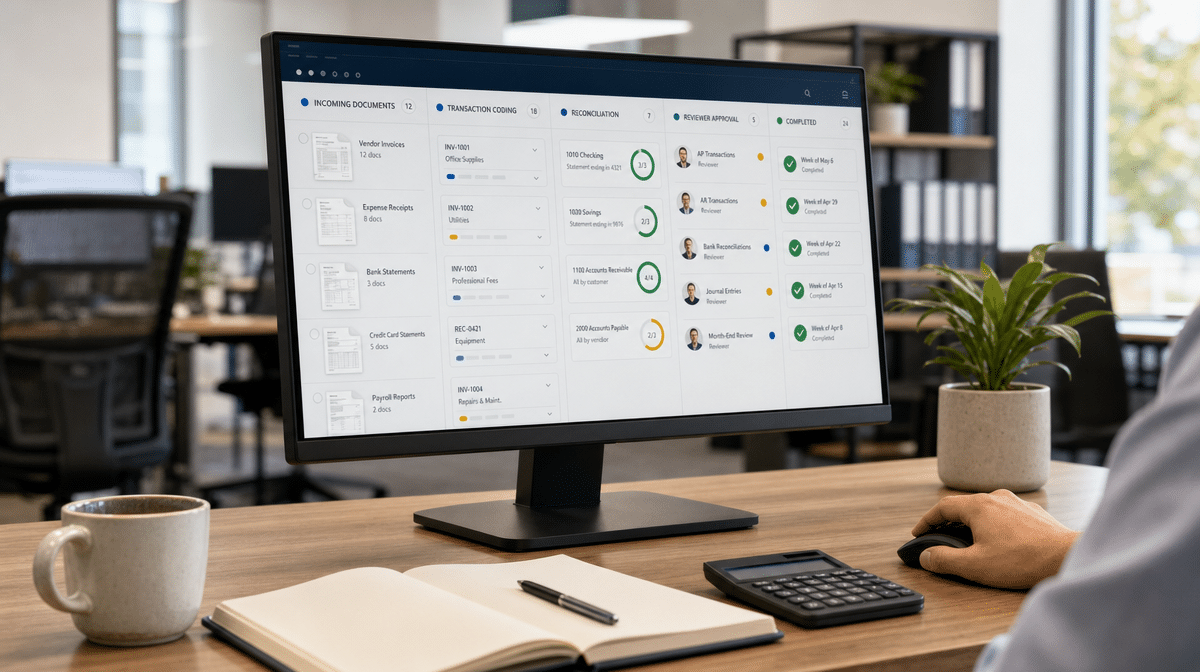
Define the scope at the task level. “Handle monthly bookkeeping” is too vague. “Code bank and credit-card transactions by the fifth business day, reconcile all accounts, attach supporting schedules, and place exceptions in the review queue” gives both teams an observable standard.
- Systems and client entities included in the engagement
- Transaction types the provider may process
- Accounting policies and chart-of-accounts rules to follow
- Documents the client or firm must supply and their deadlines
- Materiality or dollar thresholds that trigger review
- Items the provider must never approve or post without authorization
- Required schedules, reports, and workpapers
- Turnaround times, escalation paths, and close-calendar dates
Set Decision Rights and Escalation Thresholds
Include a RACI-style assignment for each step: who is responsible, accountable, consulted, and informed. The CPA firm should remain accountable for the engagement even when the provider is responsible for production.
Write down the decisions the provider can make independently and the conditions that require escalation. Examples include unfamiliar vendors, transactions above a stated amount, prior-period changes, missing support, negative balances, and entries involving owner or related-party accounts. A clear threshold prevents both silent assumptions and unnecessary questions.
Step 2: Prepare Systems, Access, and Security Controls
Limit Access by Role and Client
Map every system the provider will touch, including accounting software, document storage, expense tools, payroll platforms, payment systems, and communication channels. Then grant only the access required for the assigned tasks. Shared administrator accounts make activity harder to trace and should not be the default.
Use named user accounts, multifactor authentication, role-based permissions, and documented approval levels. The SBA’s small-business cybersecurity guidance recommends MFA for financial and accounting accounts, restricting privileges, auditing access, and protecting sensitive accounting files. Those controls are directly relevant when an external team handles client records.
- Give the provider the lowest practical permission level.
- Separate transaction preparation from payment approval.
- Prohibit local downloads unless the workflow requires and protects them.
- Use the firm’s approved password manager and secure document exchange.
- Record when access is granted, changed, reviewed, and removed.
- Set an immediate offboarding process for provider personnel who leave the account.
Test Security and Continuity Before Launch
Document data-location, retention, backup, incident-notification, and subcontractor rules in the agreement. If the provider uses additional subcontractors or offshore personnel, the CPA firm should know who can access client information and which controls apply to them.
Test a lost-password event, an unavailable team member, and a provider outage before live deadlines depend on the process. The firm should know how work is reassigned, how access is restored, where approved copies are stored, and how a security event reaches the engagement leader.
Step 3: Evaluate and Select a Bookkeeping Provider
Score Evidence, Not Promises
Choose a provider for process quality and control maturity, not just hourly cost. A low rate can disappear quickly if the firm spends excessive time correcting entries, chasing missing workpapers, or translating unclear questions.
Evaluate experience with CPA-firm workflows, accounting platforms, client industries, month-end close routines, and U.S. accounting practices. Confirm who will perform the work, who will supervise it, how backups are assigned, and what happens during peak periods.
- Competence: relevant bookkeeping experience, platform certifications, training practices, and supervisor qualifications
- Controls: access management, segregation of duties, quality review, incident response, and business continuity
- Communication: defined channels, response targets, meeting cadence, written escalation procedure, and time-zone coverage
- Commercial terms: scope, pricing basis, minimum volumes, change requests, exit assistance, and ownership of workpapers
- Evidence: references from comparable firms, sample workpapers, security documentation, and a realistic pilot plan
Licensing requirements vary by jurisdiction and service. The firm should verify representations about credentials and understand the relevant CPA licensing requirements when a role or service is described as CPA-level work. Do not let a provider’s marketing language blur the difference between bookkeeping support and professional services.
Step 4: Run a Controlled Pilot and Onboard the Team
Create Pilot Success Criteria
Run a pilot with a limited number of clients, one bookkeeping cycle, and a defined success scorecard. Select work that is representative enough to reveal process problems but not so complex that every exception is unique.

Prepare a provider handbook containing the chart of accounts, coding rules, close calendar, sample completed workpapers, naming standards, exception examples, and contact list. Record short demonstrations for repetitive system steps, but keep the written procedure as the controlled source of truth.
Communication should be designed before the first transaction moves. The AICPA and CIMA resource on communication channels for outsourcing success identifies communication breakdowns, process failures, and mismatched expectations as common sources of outsourcing stress. Set one task system for routine work, one secure channel for client data, and one escalation path for urgent exceptions.
- Hold a kickoff covering scope, systems, security, deadlines, and decision rights.
- Walk through one complete cycle using sample or controlled client data.
- Require the provider to perform the next cycle while the firm observes.
- Review every material output during the pilot.
- Log questions and revise the procedure when a rule was genuinely unclear.
- Complete a pilot review before adding clients or tasks.
Step 5: Review Quality and Manage Exceptions
Track the Root Cause of Every Material Error
Quality control must be built into the workflow. Do not rely on a senior employee remembering to check whatever arrives. Create a review queue with due dates, risk levels, supporting evidence, reviewer signoff, and a record of corrections.
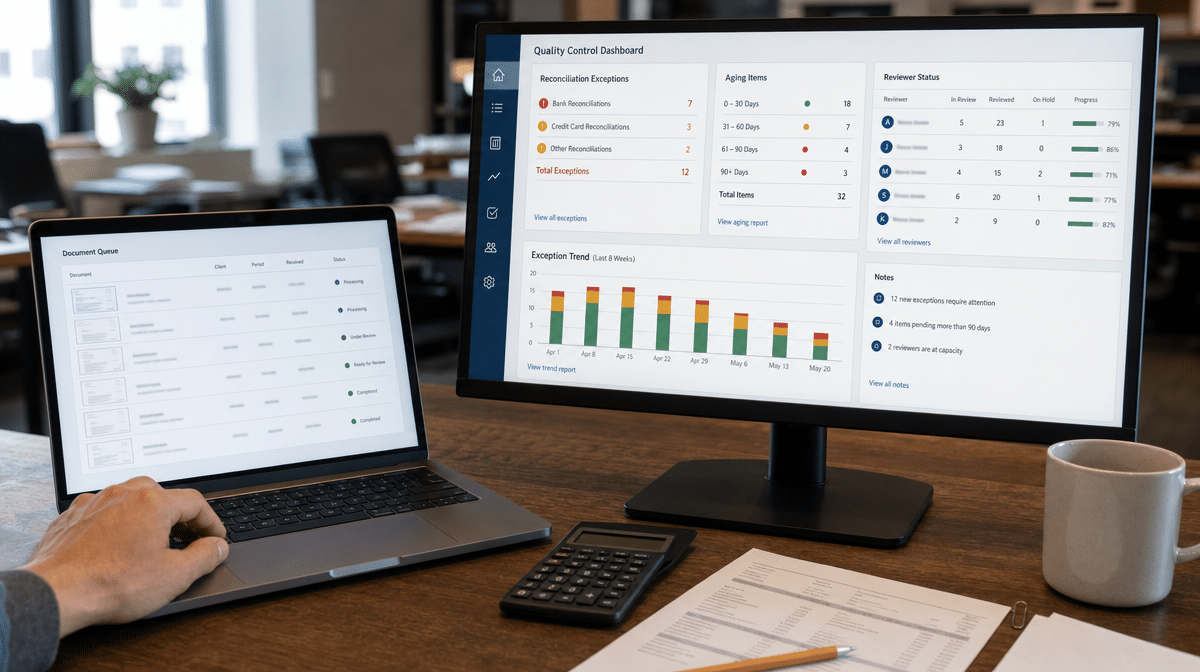
Use standard review checklists for reconciliations, transaction coding, journal entries, accounts payable, accounts receivable, and reporting packages. The checklist should confirm both numerical accuracy and compliance with the firm’s accounting policies.
- Unreconciled balances and stale reconciling items
- Unusual transactions or unsupported journal entries
- Duplicate, missing, or incorrectly dated transactions
- Changes to prior-period balances
- Items posted to suspense or uncategorized accounts
- Late source documents and assumptions made without approval
- Client questions that require the firm’s judgment
Classify errors by cause, not only by count. A one-time typo needs correction, while repeated miscoding may indicate weak instructions, insufficient training, or a system-control problem. Feedback should identify the rule, show the correct treatment, and update the procedure when needed.
The external provider can prepare the books, but the CPA firm’s reviewers apply the professional knowledge developed through CPA training and experience. Review intensity may decrease after reliable performance is demonstrated, but accountability does not transfer.
Step 6: Measure Results and Expand Carefully
Use a Balanced Performance Scorecard
Compare pilot results with the firm’s baseline. Cost savings alone are not enough. Measure whether the new model creates usable capacity without increasing risk, rework, or client frustration.
- Percentage of tasks completed by the due date
- First-pass acceptance rate
- Number and severity of review exceptions
- Average age of unresolved questions
- Internal review hours per client or close
- Total cost per completed bookkeeping cycle
- Security incidents, access violations, or policy exceptions
- Client complaints, missed commitments, and satisfaction signals
Review the scorecard with the provider on a fixed cadence. Separate service failures from client-caused delays, but do not hide either category. The firm needs a complete view of what prevents a timely close, including late documents, system downtime, unclear procedures, provider mistakes, and slow internal approvals.
Expand only when the pilot has met its standards for several cycles and the firm can explain why the process works. Add similar clients or adjacent tasks in small groups, then repeat the access, training, review, and measurement steps.
Outsourced bookkeeping can free a CPA firm to focus on review, relationships, tax, assurance, and advisory work. The benefit comes from disciplined process design. Clear responsibilities, secure access, careful onboarding, and visible quality measures turn outsourcing from an informal handoff into a controlled service-delivery system.
Frequently Asked Questions
What Bookkeeping Tasks Can a CPA Firm Outsource?
A CPA firm can outsource rules-based tasks such as transaction coding, reconciliations, accounts payable support, accounts receivable support, payroll data preparation, close schedules, and management-report preparation. The firm should retain final review, client advice, policy decisions, and work requiring professional judgment.
How Does a CPA Firm Keep Control of Outsourced Bookkeeping?
The firm keeps control through a detailed scope, responsibility matrix, role-based access, review checklists, approval limits, exception queues, and service metrics. The provider performs assigned production work, while the CPA firm remains accountable for the engagement.
What Should a CPA Firm Include in an Outsourcing Agreement?
The agreement should define tasks, deliverables, deadlines, pricing, confidentiality, data handling, access controls, subcontractor use, quality standards, incident notification, workpaper ownership, termination, and transition assistance.
How Should Outsourced Bookkeepers Access Client Systems Securely?
Use named accounts, multifactor authentication, least-privilege roles, secure document exchange, access logging, periodic permission reviews, and immediate removal when access is no longer required. Payment approval and other sensitive permissions should remain separated from bookkeeping preparation.
How Long Should an Outsourced Bookkeeping Pilot Run?
A pilot should cover enough complete bookkeeping cycles to test recurring deadlines, reconciliations, review effort, communication, and exception handling. Many firms can learn from two or three monthly cycles, but the appropriate length depends on volume, complexity, and the risks involved.