What Does Continuous Improvement Mean in Manufacturing?
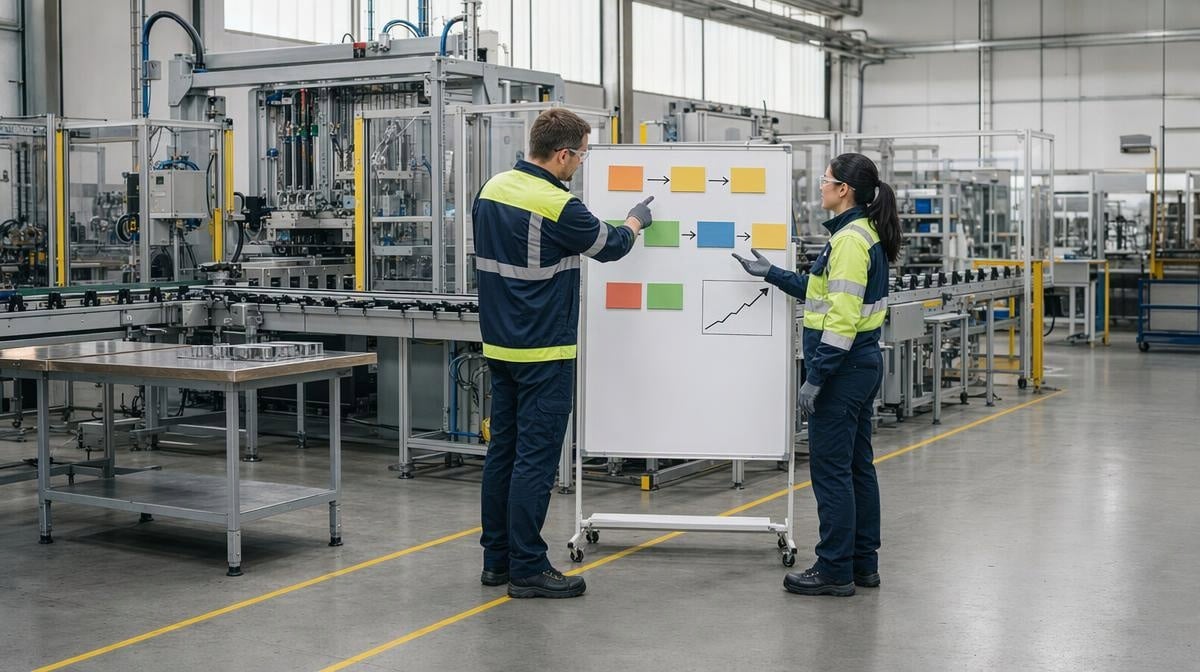
Continuous improvement in manufacturing means making small, measured changes to established production processes, checking the results, and standardizing what works. The goal is not constant change for its own sake. It is a repeatable way to reduce waste, solve problems, improve quality, and make production more reliable.
Business policies and procedures provide the baseline for consistent work. Continuous improvement builds on that baseline by involving employees, measuring performance, and refining accepted practices over time. Even successful manufacturing companies are constantly looking for ways to refine the production process. Manufacturers can use Kaizen, lean methods, agile manufacturing, improved levels of training and communication, and selected technology to improve one process at a time.
What Does Continuous Improvement Mean in Manufacturing?
Continuous improvement is the ongoing practice of progressively enhancing already accepted and proven manufacturing practices. It involves looking at a variety of ways to make operations more reliable instead of waiting for one large project. The Lean Enterprise Institute describes continuous improvement as small, incremental changes to processes, systems, and activities. In manufacturing, that may mean reducing a setup delay, clarifying an inspection step, improving material flow, or updating instructions after a team tests a better method.
Continuous Improvement in Manufacturing Enhances Production
Standard operating practices help employees perform work consistently, but a standard is not the end of improvement. It is the current best-known method and a reference point for the next test. Clear business policies and procedures make it easier to identify a gap, assign responsibility, measure a change, and update the process when the evidence supports it.
The ultimate aim is better performance without compromising safety or customer requirements. Results may include less waiting, fewer defects, shorter lead times, lower costs, or more predictable output. The relevant measure depends on the production process and the problem being addressed.
How Do Manufacturing Methodologies Support Continuous Improvement?
Manufacturing Methodologies Define Continuous Improvement
The Japanese management philosophy Kaizen is a common approach to continuous improvement. It centers around the concept that small, regular, positive changes generate improvements in a business process. It also encourages the people performing the work to identify problems and test practical solutions. The implementation depends on a repeatable method, not on change alone.
Lean manufacturing provides a related discipline. The National Institute of Standards and Technology describes lean manufacturing as a continuous improvement model that seeks to eliminate non-value-added activities. Lean teams examine the flow of materials and information, while Kaizen gives them a practical rhythm for making and evaluating incremental changes.
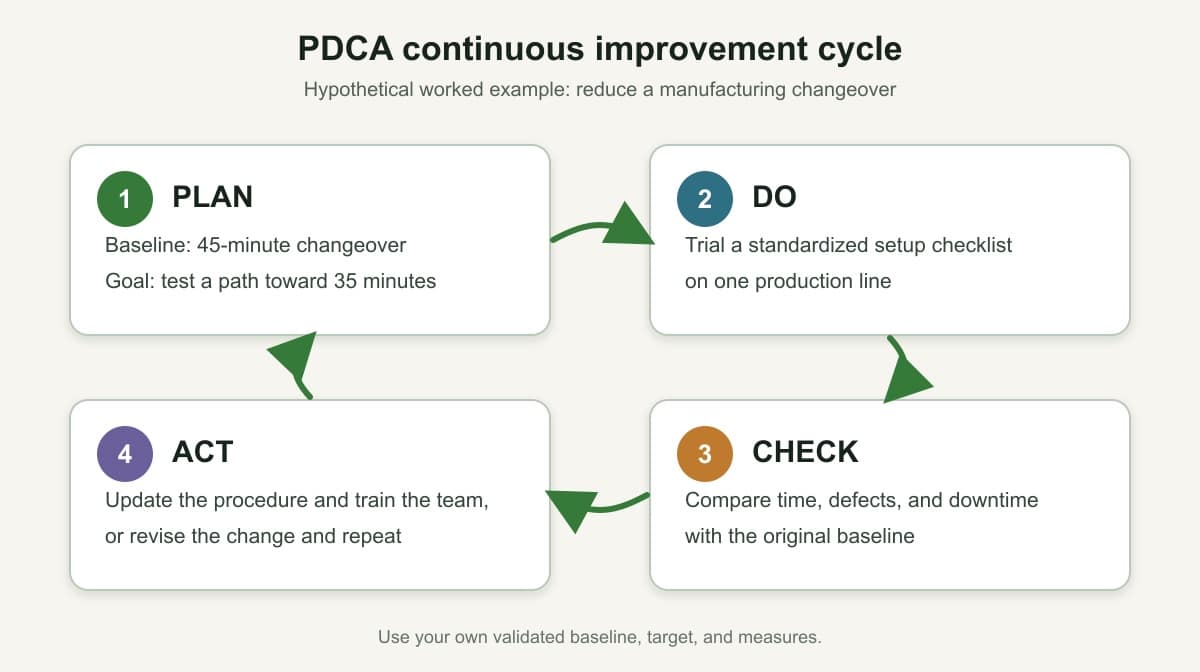
Hypothetical worked example: a production team records a 45-minute changeover as its baseline and sets a 35-minute test goal. The team trials a standardized setup checklist on one line, compares changeover time, defects, and downtime with the baseline, and then updates the procedure and trains employees if the change works. If it does not, the team revises the change and repeats the cycle.
How Does Agile Manufacturing Improve Adaptability?
Agile Manufacturing Increases Versatility
Lean and agile manufacturing are two distinct manufacturing concepts. Lean emphasizes value flow and the removal of waste. As its name suggests, the idea of agile manufacturing is centered on adaptability, flexible design, and the ability to reconfigure production in response to evolving customer demands or changing conditions. A NIST paper on smart manufacturing systems describes agile systems as flexible in design and reconfigurable so they can respond quickly. Agile manufacturers can adapt processes when the evidence supports a change.
For example, modular handling equipment may let a manufacturer adjust accumulation, direction, length, or width when a product mix changes. The equipment change alone is not continuous improvement. The improvement comes from defining the problem, testing the new configuration, measuring its effect on flow and quality, and incorporating the verified method into standard work.
How Does Communication Support Continuous Improvement?
Effective Communication Improves Productivity
In any business setting, effective communication throughout the workforce is key. Continuous improvement depends on workers knowing the current procedure, the expected result, and how to report a problem. The Occupational Safety and Health Administration tells employers to establish or update operating procedures and communicate them to workers. Although that guidance concerns workplace safety and health, the same operational discipline supports clear escalation and work followed consistently.
Dealing with machinery breakdowns on the factory floor or a lack of production materials is easier when roles are clearly outlined and understood. Employees can identify who stops the line, who evaluates the cause, who communicates the shortage, and who authorizes a restart. This reduces confusion, misunderstandings, and the same actions repeated unnecessarily by different workers.
Training should also make improvement part of the job rather than a separate event. NIST’s Training Within Industry program connects standardized instruction with small, incremental improvements proposed by the people doing the work. Accessible apps and digital tools designed for connecting coworkers can help workers share information immediately between themselves or easily access updated instructions from management, but the process for reviewing and approving changes still matters.
How Can Technology Support Continuous Improvement?
Increased Technology Leads to Greater Adaptability
As well as enabling clearer and more frequent communication, technology can support continuous improvement when it gives a team better information, a safer test environment, or faster access to approved instructions. From cloud computing to advanced robotics and artificial intelligence, technology may help manufacturers streamline selected operations, monitor equipment, identify issues with raw materials and supply chains, or speed analysis of production data. Each use still needs a defined problem, appropriate controls, and a measure of success.
More advanced use of technology includes digital twins. NIST defines manufacturing digital twins as synchronized virtual representations that can help manufacturers represent, diagnose, predict, and optimize operations. A virtual digital twin or digital model may be used to test a new factory layout and configuration before a physical change, but reliable data, validation, interoperability, and trustworthy models are necessary for sound decisions.
Technology does not replace the improvement method. A dashboard, sensor, robot, or model is useful only when employees can connect its information to a process, decide what action to test, and verify whether the result improves safety, quality, delivery, or cost.
Continuous Improvement in Manufacturing
Start with one process that matters. Establish a baseline, identify the gap, test a small change, and compare the result with the original measure. If the change works, update the procedure, communicate it, and train the people who use it. If it does not, record what happened and adjust the next test.
Whether manufacturers are enhancing communication with employees, upgrading and streamlining production equipment, or testing a factory layout, small but regular steps can strengthen company practices. Better results come from measured changes rather than complacency or technology alone. This approach helps manufacturers increase efficiency while supporting business performance and quality. For more ways to choose and test practical changes, review these process improvement ideas.