How Do You Successfully Launch a Digital Product in Multiple Markets?

Your digital product may not yet be completely finished, but you still need a strategy for getting it into the public’s hands. The fastest way to launch a product in multiple markets is to use one repeatable market-by-market gate, not to rush every region toward the same date. Start with a product launch plan that assigns owners for legal review, localization, customer support, launch operations, and measurement.
A successful product launch also requires materials, external collaborators, and decisions about what must be ready before release. Treat each market as a separate operating decision. A market can proceed when its critical fronts are covered, while another market can remain in remediation without delaying the entire digital product.
Important Considerations for Launching a Digital Product
Digital products can offer flexible distribution and broad market coverage with a relatively low barrier of entry. The advantages can be substantial, but only when the team is able to cover each market adequately and protect against legal problems. To successfully launch a connected product in multiple markets, decide what evidence makes each market ready, name an owner for every gap, and defer any market that cannot meet the critical requirements.
Invest in Legal Counselling for Each Region You Plan to Operate in
When you operate in multiple countries, the applicable rules can differ by location, customer, data flow, and business model. The GDPR can apply to a company outside the European Union when it offers goods or services to people in the EU or monitors their behavior there. That example shows why a general compliance article cannot replace international legal advice for each region.
Ask qualified counsel to identify the privacy and data collection laws, consumer terms, intellectual property issues, tax obligations, and required notices for every planned market. Record the decision, supporting evidence, owner, and renewal date. Legal counselling may require a significant investment in time and money, but it helps the team distinguish a manageable gap from a launch blocker.
Localisation is Well Worth Its Cost
Publishing only in English does not address every market’s needs. The W3C defines localization as adapting a product, application, or content for the language, culture, and other requirements of a target market. That work can include currency, dates, time formats, symbols, address formats, scripts, graphics, and legal requirements. It should also cover onboarding, error messages, help content, transactional email, and customer support.
Build internationalization into the product before country-specific localisation. Then use market research, local reviewers, and acceptance testing to check whether the personalised approach works in context. The U.S. International Trade Administration recommends using market research and analytics to define and refine international opportunities before localization work. This sequence prevents translation from being mistaken for market fit.
A professional translation agency like Global Voices can be one option, but no vendor should be treated as automatically suitable for every launch. Evaluate subject expertise, language coverage, review workflow, security controls, turnaround time, and responsibility for corrections. Regional agencies can also provide market-specific context when the internal team lacks it. The existing localization strategy guidance can help connect this work to the broader digital marketing plan.
Use a Multi-Market Launch Readiness Matrix
A readiness matrix turns broad advice into a decision. List the same critical areas for every market, assign an owner, and use plain-language statuses such as Ready, Needs Work, and Defer. The hypothetical example below shows how one market can proceed while another remains blocked by legal, payment, or support gaps.
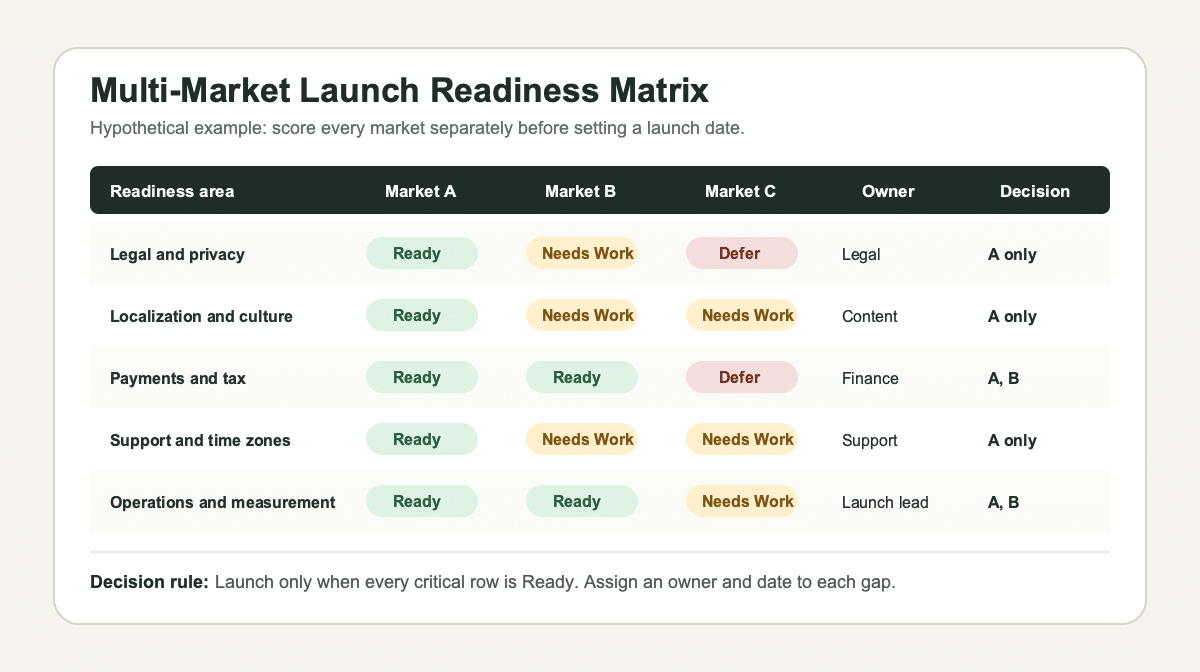
Use the matrix as a working scorecard, not as a substitute for evidence. A Ready status should point to the approved terms, completed test, assigned support schedule, or other proof behind the decision. If an area needs work, assign a specific owner and completion date. A short feasibility study can support the first screen before the team commits to full localization.
Outsourced Services Can Help You Cover All Markets Properly
Launching a digital product on the market is not the end of your work. Most digital products need ongoing support, incident handling, content updates, and customer communication. Multiple markets add language needs, cultural differences, and time zones. A support promise that works in one country may leave customers waiting in another.
Choose an in-house, partner, follow-the-sun, or hybrid model based on coverage, product knowledge, quality controls, escalation ownership, and cost. Outsourced customer support can extend regional coverage, but the internal product owner must still define service standards, review performance, and retain authority over sensitive cases. Outsourced services are a capacity option, not a universal requirement.
Considerations for Launching a Digital Product
Plan the launch as a sequence of gates rather than one global event. First select the market and confirm demand. Next complete legal, privacy, payment, and tax review. Then localize the product and customer journey, prepare support and escalation paths, and run a controlled release with defined measures. This order preserves momentum without treating every market as equally ready.
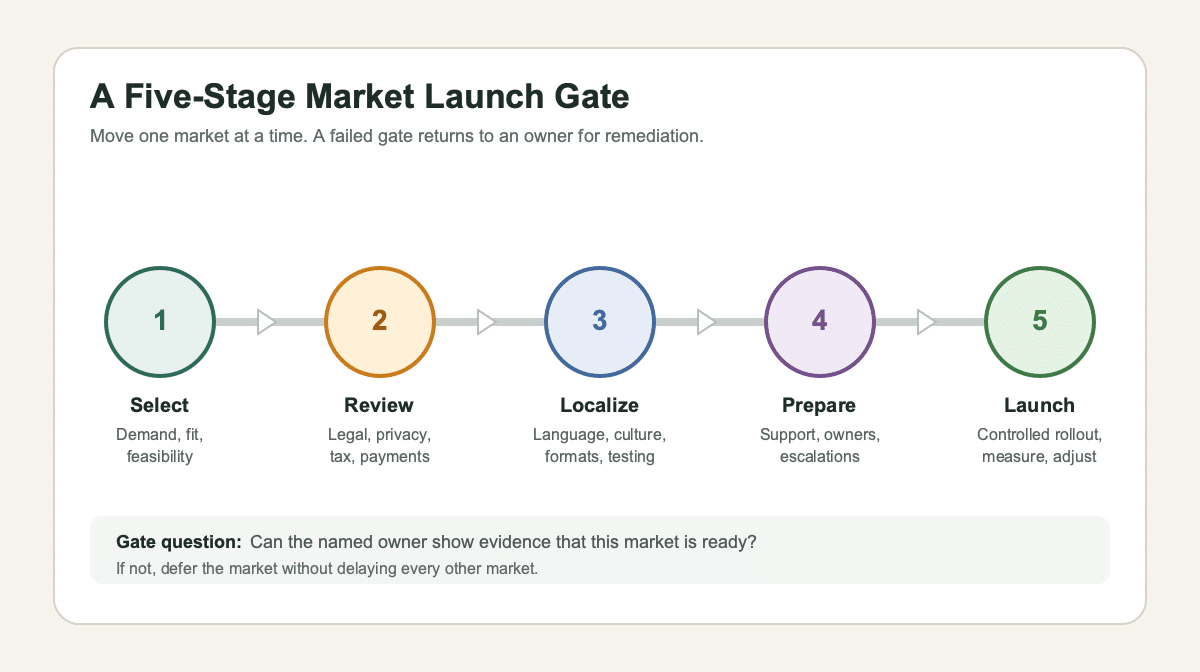
Before each gate closes, ask whether the named owner can show evidence that the market is ready. If not, defer that market and keep working the gap. After launch, review support demand, localization defects, conversion quality, refunds, incidents, and customer feedback. Continue following the qualified professionals hired to guide the company through different markets, and update the product launch plan as the evidence changes.
Frequently Asked Questions
What is the fastest way to launch a product in multiple markets?
Use one repeatable readiness gate for every market, assign an owner to each requirement, and launch only the markets that meet the critical legal, localization, support, and operational conditions.
What is the best way to launch a connected product in multiple markets?
Review data flows, privacy obligations, connectivity dependencies, local support, and incident ownership separately for each market before approving the launch date.
Should every market launch at the same time?
No. A staged launch lets the team proceed in ready markets, learn from controlled releases, and defer markets that still have legal, localization, payment, or support gaps.
When should customer support be localized?
Localize support before launch when customers need another language, local service hours, market-specific guidance, or a regional escalation path to use the product safely and successfully.
What should a market launch readiness matrix include?
Include legal and privacy review, localization and cultural review, payments and tax readiness, customer support and time-zone coverage, launch operations, measurement, an owner, evidence, and a launch decision.