How to Run a Successful Supply Chain Management Business

To run a successful supply chain management business, choose a narrow service scope, understand the client’s market, and create a dependable operating system for demand, purchase orders, inventory, warehousing, and order fulfillment. The business may provide planning, procurement, logistics coordination, or improvement services, but every promise should connect suppliers to customers through visible controls.
Start with one client segment and one operational problem. Then document how work moves from forecast to supplier order, receipt, storage, fulfillment, and review. This approach makes each step easier to sell, deliver, and measure.
How Do You Start a Business With a Supply Chain Management System?
Starting a supply chain management business can be challenging but not impossible. You need to understand your market, have the right skills, and set out to attract your first customer with a service you can deliver consistently.
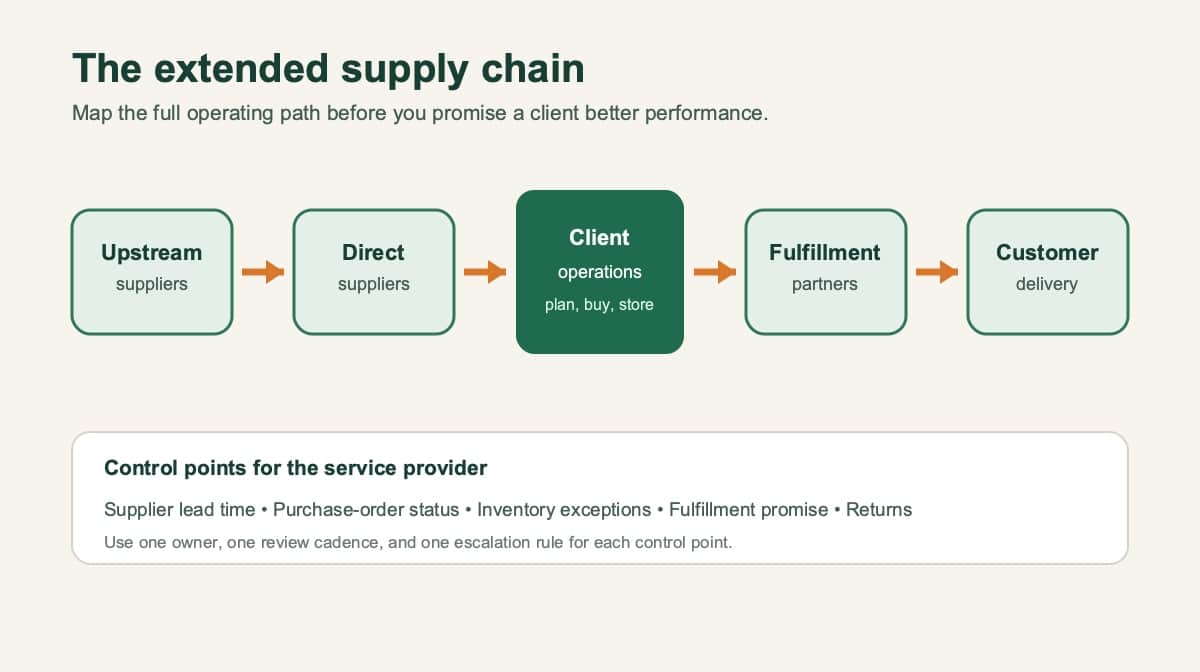
A supply chain management business helps a client coordinate the flow of products, services, information, and decisions from suppliers to customers. A Supply Chain Management System, or SCMS, is the combination of processes, responsibilities, data, and tools used to control that flow. The business is the service provider. The SCMS is the operating system used to deliver the service.
The supply chain is a series of events or processes involved in designing, producing, and distributing a product or service. Supply Chain Management Systems connect an interorganizational network of processes and structures so companies can handle the flow of goods from different suppliers to their customers. Whether you are an expert supply chain professional or a curious entrepreneur, the system should make that flow and its decision points visible.
This distinction matters because a new firm should not begin by buying software or promising end-to-end transformation. Begin by defining the client problem you will own. That might be supplier coordination, purchase-order tracking, inventory planning, warehouse selection, or ecommerce fulfillment. You can expand the scope after the first process is stable.
ASCM organizes the SCOR Digital Standard around seven primary management processes: Orchestrate, Plan, Order, Source, Transform, Fulfill, and Return. That framework is a useful reminder that supply chain management extends beyond shipping or inventory alone. Review the SCOR Digital Standard when defining the boundaries of your service.
What Are the Steps to Building Your Supply Chain Business?
Like any other business, a supply chain management firm requires capital, business judgment, industry knowledge, and the ability to execute. The strongest launch plan turns those broad requirements into a defined customer, a bounded service, and a repeatable operating method. Use the following sequence to build that method without erasing the practical steps that matter most.
1. Choose a Service Scope and Target Client
Decide whether you will advise, operate, or coordinate. An advisory engagement might map the supply chain and recommend controls. An operating engagement might manage purchase orders or inventory exceptions. A coordination engagement might connect a client with suppliers, carriers, warehouses, and third-party logistics providers.
Write a one-sentence scope that names the client, the process, the deliverable, and the boundary. For example: “We help regional ecommerce businesses track supplier orders and inventory exceptions, but the client retains purchasing approval.” A clear boundary protects working capital, prevents responsibility gaps, and gives the first customer a specific outcome to evaluate.
2. Understand the Market
The first step in market research is to identify a segment with a recurring supply chain problem. The SBA explains that market research helps you find customers and competitive analysis helps you make your business unique. Its guidance recommends examining demand, market size, location, saturation, and pricing before committing resources. Use the SBA market research and business planning guide to structure this work.
Conduct proper research into how the supply chain market works for the niche you intend to serve. Unless you are already well exposed to this niche, dig deeper into probable customers, common delays, inventory constraints, and buying patterns. Segment the market so you can determine which customers have a problem you can solve and the budget to support the service.
Interview prospective clients about missed supplier dates, stockouts, excess inventory, manual order tracking, warehouse costs, and customer complaints. Compare those problems with your actual skills in supply chain logistics, operations, and management. If the work requires expertise you do not have, narrow the offer or partner with a qualified specialist rather than learning on a client’s live operation.
To gain a competitive advantage, develop the technical skills required for logistics operations and management. Seek professional advice where necessary. A supply chain analyst can help with process design, while a finance expert can help assess working capital and avoid straining the business. Always check a prospective partner’s reputation, service quality, and ability to perform the work.
3. Understand Supply and Demand
Once you understand the market, establish how the client estimates demand and how suppliers respond. Do not promise a perfect forecast. Instead, define the inputs, the owner, the review cadence, and the exception threshold. Compare demand with supply for the products or services that create the most risk, then revise the forecast as new orders and constraints appear.
Once you have your first customers, start tracking how demand compares to supply for the various products. Use those metrics to forecast demand, inform critical decision-making, and keep business operations running smoothly from suppliers to customers. The figures will not always be exact, so document assumptions and review errors rather than presenting estimations as certain.
Your information system can be a shared worksheet, an existing enterprise system, or specialized software. The important requirement is a reliable record of forecast changes, supplier commitments, inventory on hand, and customer orders. The hypothetical control sheet below shows the minimum weekly view for a first client.
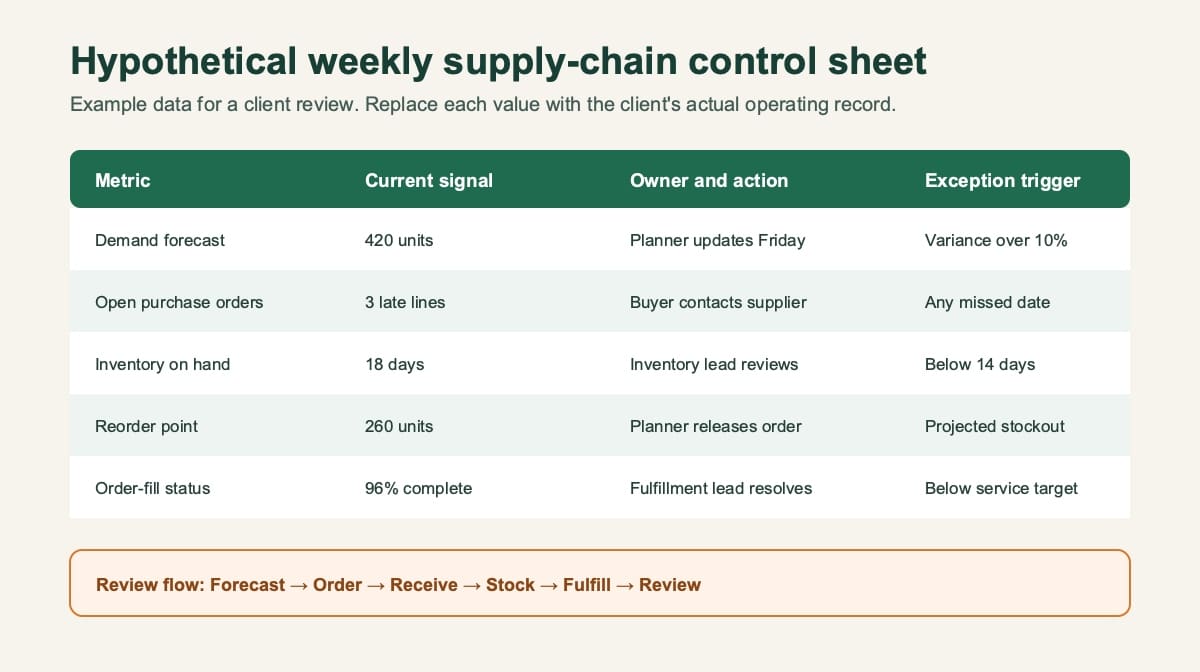
Hypothetical example: replace every value, owner, and trigger with the client’s actual operating data.
4. Track the Purchase Orders
On the supply end, your work is to make the status of each important order visible. Record the supplier, order date, promised date, quantity, confirmation status, shipping status, receipt status, and owner of the next action. When a promised date changes, update the demand and inventory view before the delay reaches the customer.
After placing orders with suppliers, track those orders to avoid delays and unnecessary inconveniences. The global supply chain is prone to challenges, so staying ahead requires an agreed response when a supplier misses a milestone. The order record should show what happened, who owns the next action, and how the change affects inventory and customer commitments.
Technology can reduce manual communication, but it does not replace clear responsibilities. Before adding automation, decide who confirms a purchase order, who follows up with the supplier, who approves a substitution, and who tells the client that an order is at risk. Make order tracking reliable before adopting advanced technologies.
5. Manage Your Inventory
Inventory management connects the demand plan with supplier lead times and customer service. Start with a small set of controls: inventory on hand, committed inventory, open purchase orders, expected demand, reorder point, and projected stockout date. Review exceptions instead of treating every item the same.
Study the buying cycle and document how the client decides when and how much to restock. Stocking out during peak seasons disappoints customers, while excess stock can strain the resource pool. Use supply chain analytics to inform critical decision-making, but require the underlying inventory records to reconcile. The goal is end-to-end visibility that supports a decision, not a dashboard full of unused figures. The Bizmanualz guides to inventory management and inventory procedures provide related operating context.
6. Understand the Warehousing Options
Warehousing decisions depend on order volume, product handling requirements, customer location, service targets, and working capital. Keeping all inventory in one place may simplify control, while distributed locations may reduce delivery time for a broad customer base. Compare those tradeoffs before recommending a warehouse or third-party logistics partner.
Managing the supply chain from suppliers to customers is a lot of work, and along the way a client may need to outsource some services. Warehousing is one such option, especially when the customer base is global or spread across the country. A competent and trustworthy partner should be evaluated against the actual products, locations, volumes, and service requirements.
Evaluate a third-party logistics provider using evidence that matches the client’s work: service coverage, capacity, system access, inventory accuracy, insurance, security, escalation practices, references, contract terms, and performance reporting. Certification can be relevant, but it should not replace operational due diligence. Decide which party owns inventory records, claims, customer communication, and exceptions before the first shipment.
7. Fulfill Orders and Measure the Service
Order fulfillment covers the handoff from an approved customer order through picking, packing, shipping, delivery, invoicing, and returns. Smaller companies may use third-party logistics providers for drop-shipping, pick and pack orders, warehousing, or fulfillment. Your service should show where each handoff occurs and who resolves a failure.
Fulfilling orders professionally helps create repeat business. A keen understanding of ecommerce supply chain logistics, from order management to shipping, is critical when that is the client’s chosen channel. Companies that are not well resourced to handle order fulfillment may partner with third-party logistics companies, but the decision should follow a cost, capability, and risk review.
Choose a small set of operating metrics that match the engagement. Examples include supplier on-time delivery, purchase-order confirmation time, inventory record accuracy, order-fill rate, and customer order cycle time. Record the starting point, review exceptions at a fixed cadence, and avoid claiming improvement until the client’s data supports it.
Is Your First Client Ready for a Controlled Launch?
Before you take responsibility for live supply chain activities, score the client across six readiness areas. A low score does not mean the client is a poor prospect. It means the first engagement should focus on discovery and documentation rather than operational promises.
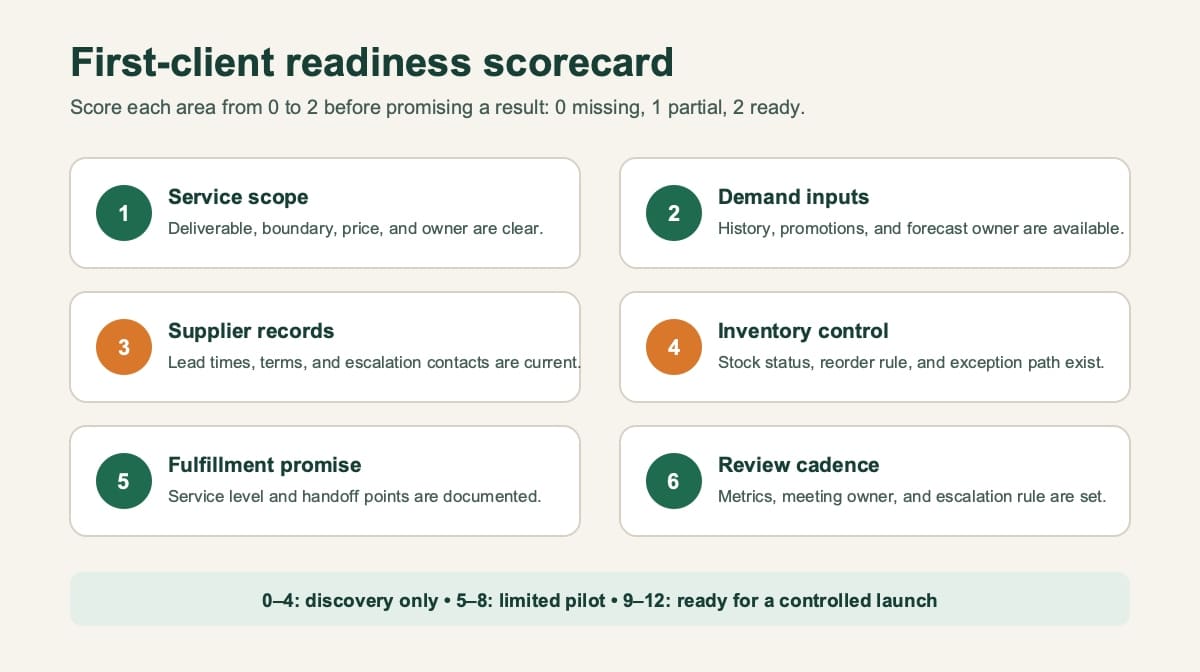
For each area, score 0 for missing, 1 for partial, or 2 for ready. A score from 0 to 4 supports discovery only. A score from 5 to 8 supports a limited pilot. A score from 9 to 12 supports a controlled launch, subject to the specific risks and contract.
How Do You Run a Successful Supply Chain Management Business?
Success comes from controlling scope and making operating decisions visible. Document the first-client workflow, assign owners, agree on exception thresholds, and review a short set of metrics. Start with one product, site, customer lane, or fulfillment process. Expand only after the pilot is stable.
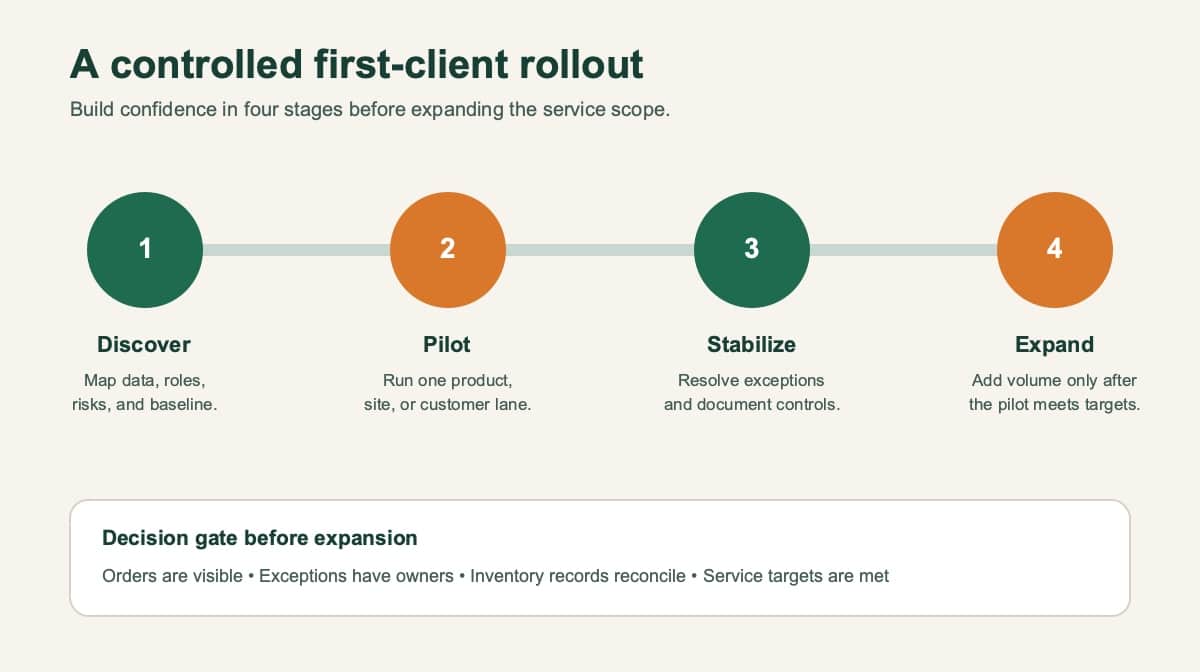
After you prove the method, you can explore adjacent opportunities such as an import-export business, additional supplier categories, or a broader ecommerce supply chain. The expansion should reuse the same disciplines: clear scope, verified data, purchase-order control, inventory visibility, documented warehousing decisions, and accountable order fulfillment.
Frequently Asked Questions
What services can a supply chain management business provide?
A supply chain management business can provide planning, supplier coordination, procurement support, purchase-order tracking, inventory analysis, warehouse evaluation, logistics coordination, fulfillment oversight, or process improvement. Begin with the services you can define and control reliably.
What is the difference between a supply chain management business and an SCMS?
The business is the organization that sells and delivers the service. The Supply Chain Management System, or SCMS, is the set of processes, responsibilities, data, and tools used to coordinate suppliers, operations, and customers.
Which metrics should a new supply chain business track?
Track only the measures tied to the service promise. Common starting points include supplier on-time delivery, purchase-order confirmation time, inventory record accuracy, order-fill rate, and customer order cycle time.
How should you evaluate a third-party logistics provider?
Evaluate service coverage, capacity, inventory controls, system access, security, insurance, references, escalation practices, contract terms, and performance reporting. Confirm who owns each record, decision, and customer communication before operations begin.
When should the business add supply chain software?
Add software when the process, owner, required data, and exception rules are clear. A shared worksheet may support a small pilot, while higher volume or more complex handoffs may justify specialized tools.
Original contributor: Thomas Glare. WordPress author attribution is unchanged.