How Do You Improve Workplace Safety?
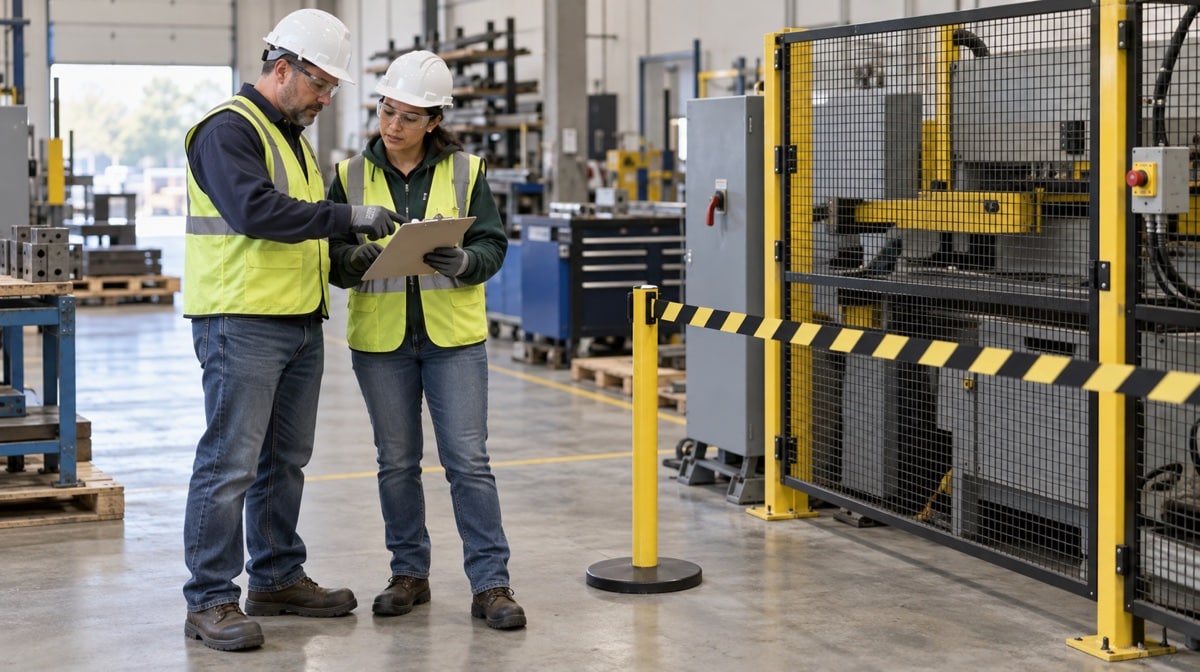
Regardless of the size of your company, its location, and industry, improving workplace safety starts with the same discipline: identify hazards, choose effective controls, assign responsibility, train the people affected, and check whether the controls work. This is crucial for the health and safety of your employees, their work performance, and their confidence in the organization. How do you improve workplace safety?
Begin with the work people actually perform, not a generic list of safety products. Review security risks, changing health conditions, equipment, protective workwear, emergency procedures, and reports from employees. Then prioritize the most serious risks and keep improving the plan as work, staffing, and equipment change.
Ways to Improve Workplace Safety
Workplace health and safety can save lives and keep your staff healthy, but it is not a one-time project. It is something you need to work on all the time and upgrade whenever a process, tool, material, or work area changes. OSHA recommends a proactive, ongoing process to identify and assess workplace hazards.
From new security features to new equipment and safety clothes, every proposed improvement should address a defined hazard. New purchases may be useful, but a clear method prevents the company from treating cameras, rules, or personal protective equipment as a complete safety program. The following smart tips move workplace safety to a higher level without losing sight of the people doing the work.
Assess Hazards and Choose Controls
Walk through routine and nonroutine work with employees. Review injuries, illnesses, close calls, maintenance records, emergency situations, and changes to workstations or equipment. Record each hazard, who may be exposed, the possible severity, and the likelihood of an incident. Fix obvious problems, such as blocked exits, damaged cords, poor housekeeping, or missing guards, as soon as they are found.
For hazards that need planning, select controls in a deliberate order. NIOSH places elimination, substitution, and engineering controls ahead of administrative controls and PPE. This means removing a hazard or isolating people from it is generally preferable to relying only on a rule, reminder, or item of protective equipment.
Give workers a real role in this process. OSHA notes that workers often know the most about potential hazards associated with their jobs. Provide a simple way to report hazards and near misses, respond promptly, and explain what changed. That feedback is often the fastest way to discover a control that looks fine on paper but does not work well in practice.
Install CCTV for a Defined Security Risk
Installing CCTV might sound like the oldest trick in the book, but it can support a security plan when the risk assessment identifies theft, unauthorized access, or another problem that video surveillance systems can help document. It can assist with knowing what is going on in your office space or at a controlled entrance and with reviewing something suspicious after it occurs. It does not make a workplace completely safe, prevent every crime, or replace lighting, access controls, reporting procedures, supervision, and emergency planning.
CCTV could end up being rather expensive, especially across spacious offices, so define the purpose, coverage, retention period, access rules, and response process before buying equipment. Check the privacy and employment rules that apply in your jurisdiction. Most importantly, make sure you have talked to your staff. Employees might feel violated because unexplained monitoring changes the workplace, so be transparent about CCTV, explain why it is being considered, and limit it to the defined risk.
Insist on Social Distancing When Risk Supports It
Getting through a life-threatening pandemic like COVID-19 forced many organizations to adapt to new life conditions and new working conditions. Adapting to those conditions also means considering how controls affect daily work. Promoting working remotely and insisting on social distancing were among the ways employers tried to keep everyone protected. Those measures also affected productivity, cost, communication, and staff motivation differently from one workplace to another.
The durable lesson is to choose infection controls for the actual exposure. NIOSH says improving building ventilation can reduce exposure to respiratory viruses and the spread of respiratory infections. Employers can also maintain equipment, support people who are ill in staying away from shared work areas, improve workplace ventilation, and use distancing, remote work, masks, or other measures when the setting and current guidance support them.
COVID-19 remains a useful example, but it should not turn one temporary measure into a permanent rule for every job. Use current public health guidance for the relevant setting, share reliable information with employees who want to be vaccinated, and keep the related COVID-19 prevention guidance in context. Keeping everyone safe also means avoiding measures that do not fit the exposure, so the goal is a proportionate response that helps avoid putting everyone in danger without creating unnecessary disruption.
Personal Protective Equipment (PPE)
Personal Protective Equipment (PPE) is important when hazards remain after stronger controls are used, or while those controls are being installed. Depending on the work, protective workwear may include protective shoes, vests, gloves, goggles, a hardhat, hearing protection, a face shield, or respiratory protection. With many different models available, selection must be based on the hazard, task, fit, and compatibility with other equipment, not on appearance or price alone.
Equipping your employees is only the beginning. Define when PPE is required, train employees to put it on, use it, remove it, inspect it, store it, and report damage. Replace worn or contaminated items and check that the equipment still provides the protection intended. Employers around the world face different rules for equipment and PPE. What applies in Australia or another country may differ, so confirm the requirements for each workplace and jurisdiction.
With limited exceptions, OSHA requires employers to pay for PPE used to comply with OSHA standards. Do not assume that employees should invest their own money in required equipment. When specialized standards apply, obtain competent safety or legal guidance and document the hazard assessment, selection, training, and maintenance process.
Keep Promoting Safety in the Future
Doing these things now can introduce meaningful safety and protection into your company, but it is not enough to stop after the first round of corrections. Keep promoting safety with a sustainable plan. Assign every open action to an owner, set a realistic completion date, provide the required resources, and define how the company will verify that the control works.
OSHA recommends assigning responsibility, setting completion dates, tracking progress, and verifying controls after implementation. Organize regular safety drills for relevant emergencies, keep educating your staff, keep investing in new protective equipment whenever the hazard assessment supports it, and keep finding new ways to strengthen the plan. Review incidents and close calls for new lessons instead of waiting for the next event.
Measure activity and results separately. Training completion and inspection frequency show whether the plan is being carried out, while recurring hazards, close-call patterns, equipment failures, and corrective-action closure show where the plan may need attention. Use workplace safety metrics to support decisions, not to discourage reporting or make a low number of reports look like proof that no hazards exist.
Workplace Safety Action Plan
Use this improvement loop for each priority hazard. Find the hazard, prioritize the risk, choose the strongest feasible control, train and equip the affected people, and verify the result. Worker input and incident or near-miss reporting should support every step.
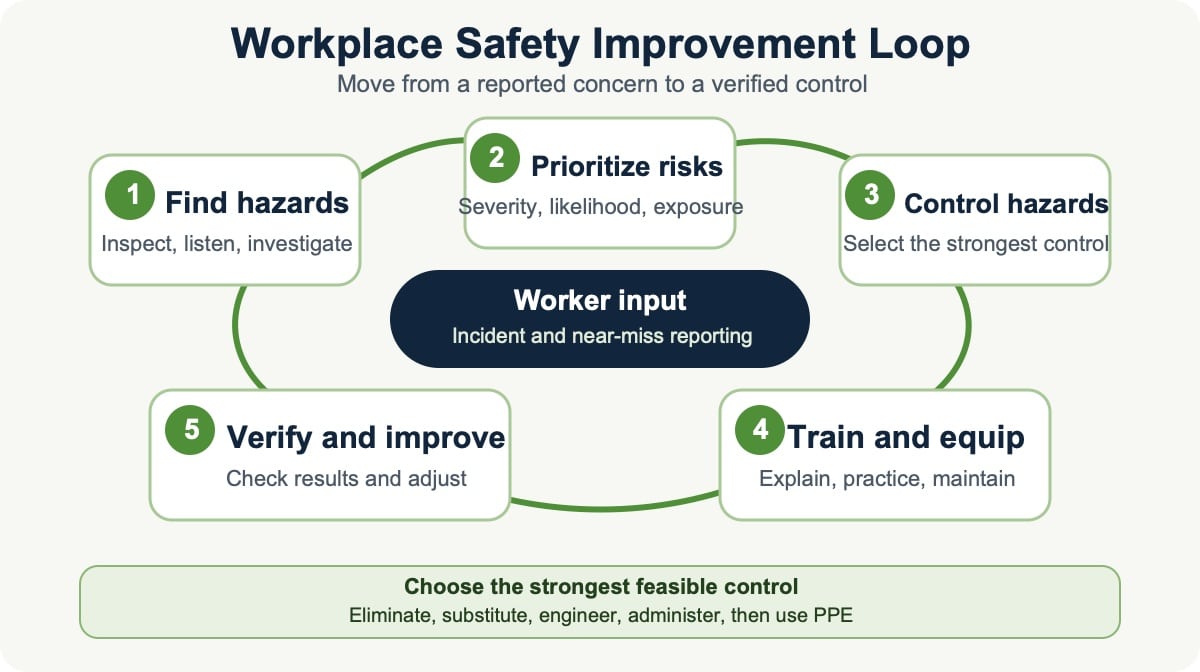
The strongest feasible control follows this order: eliminate the hazard, substitute something safer, use engineering controls, use administrative controls, and then use PPE. Several controls may be needed together. The aim is to reduce dependence on perfect human behavior when the hazard can be removed, isolated, or designed out.
Worked Example: Reduce Heavy-Lifting Risk
- Hazard and task: Employees lift heavy cartons from floor-level storage.
- People exposed: Receiving staff on both shifts.
- Selected control: Raise storage height and add a lift-assist device. Use a two-person lift as an interim control until installation.
- Owner and deadline: Assign the warehouse manager, with purchasing support, and record a completion date.
- Training and equipment: Demonstrate the lift-assist device and include it in the pre-use inspection.
- Verification: Observe the task after installation, ask workers for feedback, and review new reports or close calls.
Improve Workplace Safety
Workplace safety measures are most useful when they become part of normal operations. Start with one priority hazard, involve the people who perform the work, assign an owner, choose a control, and schedule a follow-up. Then repeat the process for the next risk instead of waiting for an incident to force action.
A documented workplace safety plan helps managers keep inspections, training, safety drills, equipment decisions, and corrective actions connected. It also makes it easier to show employees and visitors how concerns are reported and how the company keeps finding new ways to improve its safety potential.
Frequently Asked Questions
Where should a small business start improving workplace safety?
Start with a walk-through of routine and nonroutine work, ask employees about hazards and close calls, fix obvious dangers, and rank the remaining risks before choosing controls.
What are the five levels in the hierarchy of controls?
The five levels are elimination, substitution, engineering controls, administrative controls, and personal protective equipment, in that preferred order.
Is CCTV enough to improve workplace safety?
No. CCTV may support a defined security need, but it does not replace hazard controls, emergency planning, training, employee reporting, access controls, or clear response procedures.
Who pays for required PPE?
In the United States, employers generally pay for PPE required to comply with OSHA standards, although limited exceptions apply. Confirm the rule for the equipment and jurisdiction involved.
How often should a workplace safety plan be reviewed?
Review the plan after incidents, close calls, process or equipment changes, new hazards, and completed controls. Schedule periodic reviews so open actions and changing conditions do not get missed.