How Do You Manage an eCommerce Supply Chain?

Managing an eCommerce supply chain means controlling the complete path from checkout through inventory allocation, picking, packing, shipping, delivery, and returns. Start by mapping those handoffs, choose a fulfillment provider that fits your products and order volume, test the connection with real-world scenarios, and measure whether orders reach customers accurately and on time.
Supply chain processes are different for every industry, and another business’s approach may not work for your business model. Planning, research, and controlled experimentation are essential if you want to make your eCommerce business thrive without giving a warehouse or software vendor control over every operating decision.
Managing eCommerce Supply Chain: Do’s and Don’ts
A practical eCommerce supply chain is a control loop. The storefront captures an order, inventory is reserved, the fulfillment team picks and packs it, a carrier receives it, tracking returns to the customer, and any delivery or return exception updates inventory. Assign an owner and a measurable standard at every handoff.
Starting an eCommerce supply chain can be tricky and requires some experience before getting the hang of it. A defined loop helps you avoid easy-to-make mistakes while you put planning and research into developing your own supply chain.
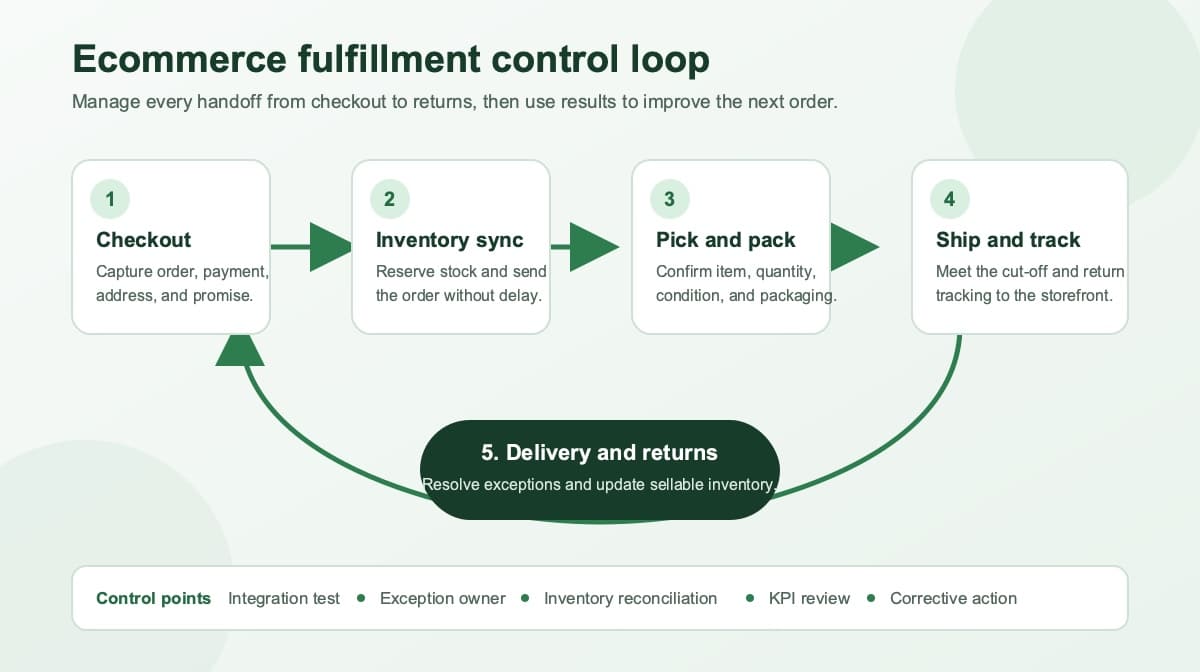
This order-to-delivery map also gives you a testing plan. Use it to identify where data can fail, who handles an exception, and which result you will review before increasing order volume.
What eCommerce Businesses Should Do
To stand out in eCommerce, become familiar with the supply chain vendor and the process behind its sales presentation. Confirm what happens to an ordinary order, a rush order, a damaged item, a stock discrepancy, and a return.
Tour the Warehouse
When you are storing inventory at another company’s warehouse, tour the facility before signing a contract when access is available. Review receiving controls, storage conditions, inventory security, picking methods, packaging stations, carrier handoffs, and the process for investigating a missing item.
You should not be barred from seeing the space when a visit is part of the provider’s normal due-diligence process. At the warehouse location, look for robots and other technology that speeds up shipments, but also verify that the operator is a reliable and dependable supplier. Ask how the facility handles power outages, natural disasters, theft, fire, system downtime, and other potential damages. The point is not to demand a perfect warehouse. It is to verify that the provider has named owners, documented fail-safes, and a way to communicate when normal service is interrupted.
Quantify Your Effectiveness
Create key performance indicators (KPIs) that represent customer outcomes and operating cost. Useful measures can include order accuracy, on-time shipment rate, order fulfillment cycle time, inventory accuracy, backorder rate, return rate, and fulfillment cost per order. The ASCM SCOR performance model groups supply-chain measures around reliability, responsiveness, agility, cost, and asset management, which is a stronger foundation than counting barcode scans alone.
KPIs are basic measures of performance, but they should not be limited to the number of times an event happens. Define each KPI before using it. State the numerator, denominator, time period, data source, owner, and action threshold. A provider can then explain a miss instead of debating how the number was calculated, and you can gauge outsourced fulfillment efficiency without confusing activity with results.
Integration Audit
Communication between your inventory management software and the warehouse should be tested, not assumed. Choose an ecommerce platform and fulfillment integrations that can exchange the order, inventory, shipment, cancellation, and return data your process needs.
Run an initial test with your team and theirs to ensure that a mock shipment can be properly executed, then repeat the test after a material integration change. Shopify’s official test-order guidance uses test orders to check inventory tracking, shipping calculations, notifications, and fulfillment flows. Your audit should also verify order import, stock allocation, pick and pack status, tracking updates, partial shipments, cancellations, returns, and the person responsible for each exception.
What eCommerce Businesses Should NOT Do
When launching an eCommerce business, do not let a supply chain vendor drive every decision. The provider can recommend an operating model, but you still own the customer promise, the product requirements, the acceptable risk, and the final choice.
Assume Fulfillment by Amazon Fits Every Product
Fulfillment by Amazon (FBA) can store inventory, pick and pack orders, ship products, process returns, and provide customer service. It may still be a poor fit for a product with unusual packaging, handling, margin, branding, or service requirements. Amazon’s current FBA packaging guidance says fragile items, ceramics, glass, and sharp products require product-specific preparation such as full bubble wrapping, so packaging responsibility must be confirmed before inventory is sent to a fulfillment center.
Specialized products can require packaging that goes far beyond a basic cardboard box. Compare eligibility, preparation work, storage, fulfillment fees, return handling, packaging control, and the channels you need to serve. Keep FBA as one named option, not as the default answer for every specialized product.
Sign a Long-term Contract Without an Exit Plan
A long-term contract is not automatically bad, and a month-to-month agreement is not automatically safe. Whether the provider can prove it is capable of providing reliable shipments matters more than a blanket rule against an annual contract. Compare minimum volume commitments, renewal language, termination rights, service levels, liability, insurance, data export, inventory return, and exit assistance. The term should match the evidence you have about the provider and the cost of changing providers later.
Skip a Trial Period
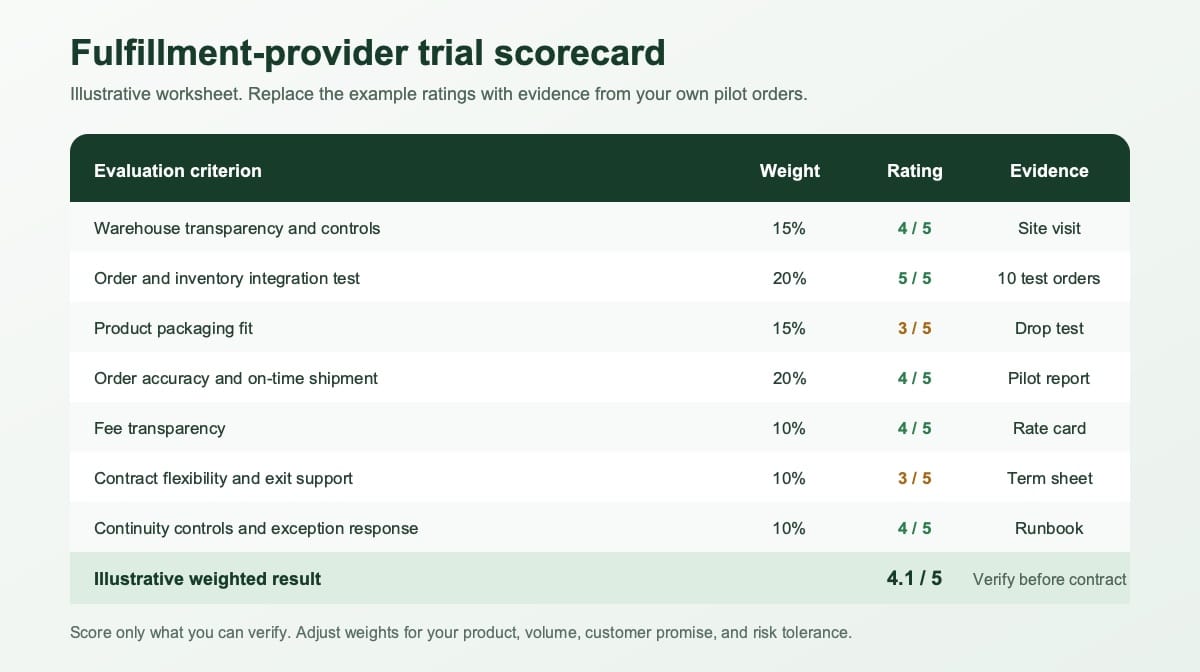
When the provider offers a pilot or limited-volume trial, take the opportunity to get to know its services in depth before entering a contract or committing more inventory. You can then decide whether the provider fits your business. Send representative products and include the cases most likely to expose weakness: a split shipment, an address correction, a cancellation, a fragile item, a return, and an out-of-stock exception.
Record the result instead of relying on impressions. The illustrative scorecard below gives warehouse transparency, integration results, packaging fit, order performance, fees, contract flexibility, continuity controls, and exception response an explicit weight. Replace every example rating with evidence from your own trial.
Ignore Hidden Fees
Ask for an itemized rate card and a sample invoice based on your actual order profile. Review receiving, storage, pick and pack, packaging materials, kitting, postage, returns, account minimums, integration or setup work, peak surcharges, aged inventory, disposal, and inventory-return charges.
Separate unavoidable pass-through costs from discretionary services and penalties. A low upfront cost can come with a catch, so request an explanation of the pricing structure. The headline price can still produce a high total fulfillment cost when your product mix, order volume, or return rate does not match the pricing model.
Manage an eCommerce Supply Chain
E-commerce is complex because many working parts and third parties have to collaborate to get an order delivered. Manage that complexity with a written process, one owner for each handoff, tested integrations, a small set of customer-centered KPIs, and regular reviews of exceptions and provider performance.
Make shipping promises only when your inventory and fulfillment process can support them. The FTC’s prompt-delivery guidance says online sellers need a reasonable basis for a stated shipping time and must notify customers about delays and offer the required cancellation or refund options when they cannot ship as promised.
Not every business needs the same model. A print-on-demand operation may use a provider such as Printful to print, pack, and ship items after an order arrives, while another business may own inventory and use a third-party warehouse. The correct system is the one that fits your product, preserves your customer promise, and gives you enough evidence and control to improve.
Frequently Asked Questions
What should you measure in ecommerce fulfillment?
Start with order accuracy, on-time shipment rate, order fulfillment cycle time, inventory accuracy, return rate, and fulfillment cost per order. Define each measure and assign an owner before comparing providers.
How do you test a fulfillment provider?
Use a pilot with representative products and test ordinary orders, partial shipments, cancellations, address changes, fragile-item packaging, returns, and inventory updates. Record the result against a scorecard instead of relying on a sales demonstration.
Should you tour a fulfillment warehouse?
Tour the warehouse before signing when access is available. Review receiving, storage, security, picking, packaging, carrier handoff, inventory controls, and the provider’s response to outages and other disruptions.
Is Fulfillment by Amazon right for every ecommerce business?
No. Evaluate product eligibility, preparation requirements, packaging control, fees, storage, returns, sales channels, and service needs. A specialized or fragile product may require a different process even when FBA is available.
What fees should you check in a fulfillment contract?
Check receiving, storage, pick and pack, packaging, kitting, postage, returns, minimums, setup, integrations, peak surcharges, aged inventory, disposal, termination, and inventory-return costs. Ask for a sample invoice based on your own order profile.