How Effective are Policies and Procedures?

Policies and procedures documentation can look complete and still fail in practice. If employees cannot find the current version, understand the purpose, see who approved it, or connect the procedure to a measurable result, the documentation is not working.
So how effective are policies and procedures? The answer depends on whether your documents can be managed, reviewed, distributed, used, and measured against common criteria. A strong procedure is not just written once; it is controlled, communicated, updated, and tested through daily management.
Does Your Policies and Procedures Documentation Work?
Well-written policies and procedures display common elements that make effective communication possible. They define what the procedure covers, who owns it, when it was released, what version is current, how it should be reviewed, and what evidence shows that people are using it.
The practical question is not whether the company has documents. The question is whether the documentation helps people perform the current activity consistently, meet compliance criteria, and improve the process over time.
Policies and Procedures Common Criteria
What should your policies and procedures documentation have in common? Effective procedures are reviewed for a consistent style and format to ensure usability. Industry best practices can be documented in auditable criteria and used to improve your policies and procedures documentation.
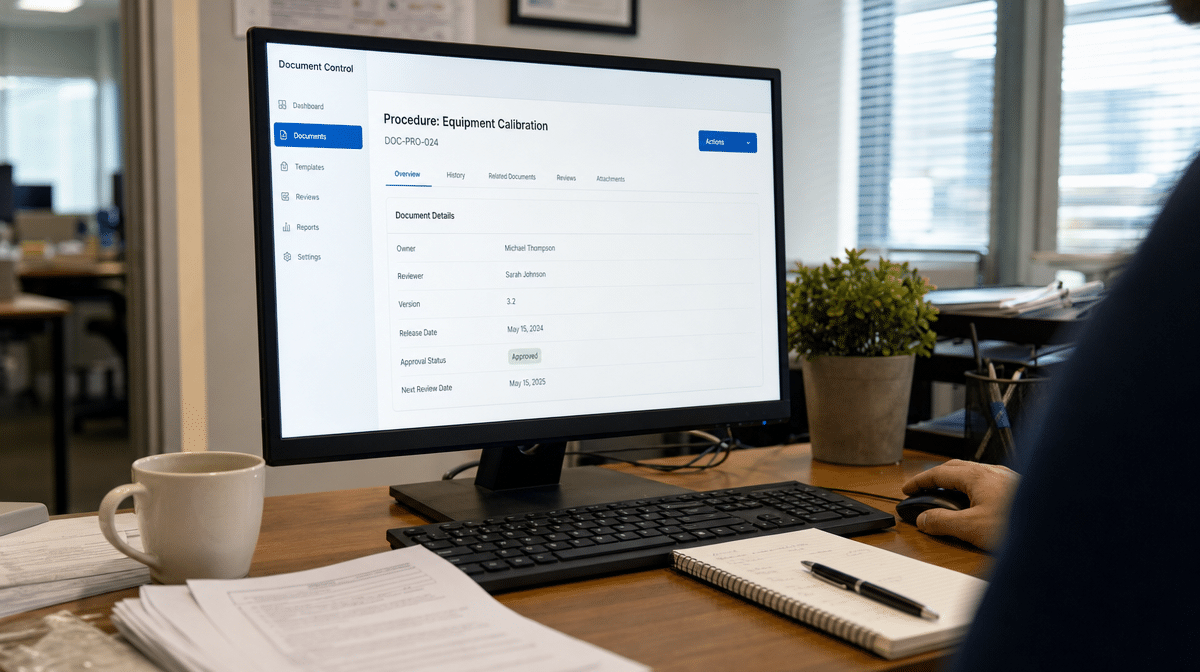
The first thing to check is document control. Your documents should contain a method for recording the author, reviewer, release date, and revision level or version number. Other helpful information includes the title, document number, compliance criteria, and dates for each event in the control history.
A documented control block gives reviewers a fast way to answer basic questions: Is this the current version? Who approved it? What changed since the last release? Is the document tied to a standard, regulation, customer requirement, or internal objective? The American Society for Quality’s blueprint for document control describes a discipline for managing procedures, work instructions, approvals, revisions, and access in a controlled system, which is exactly the role this block plays in business documentation.
Procedure Metadata
Metadata is data or information that describes the procedure, and it belongs at the start of the procedure. Procedure metadata includes purpose, scope, definitions, responsibilities, and references. This information can be stored in a policy and procedure template to communicate your common elements to everyone else.
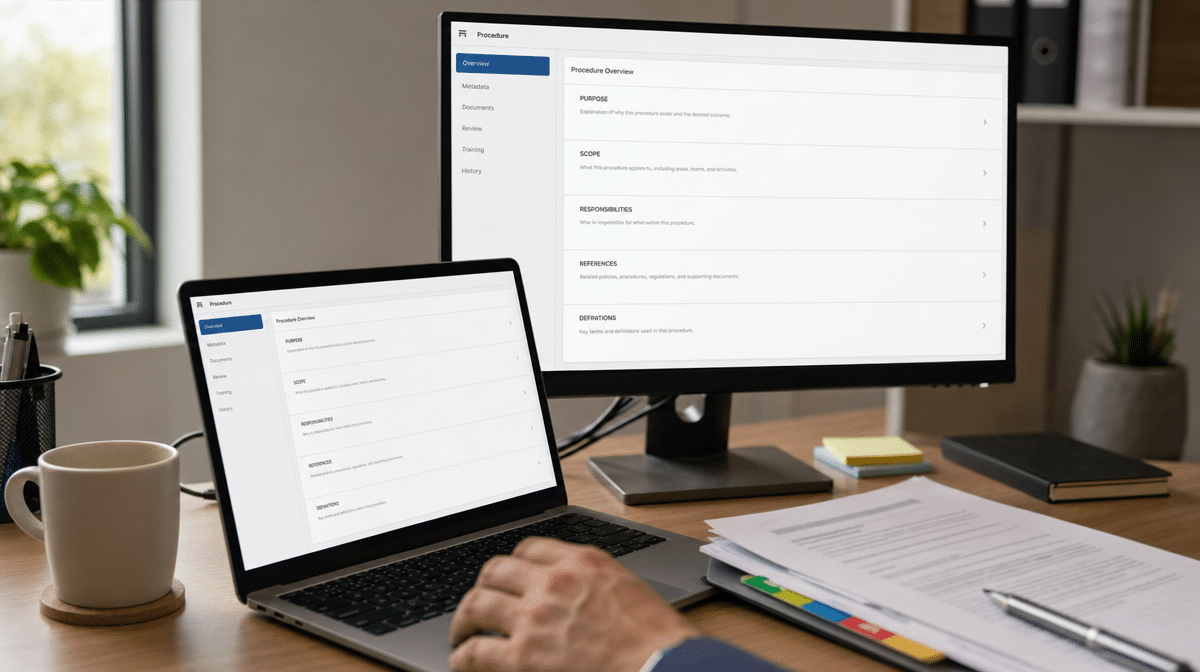
Purpose explains why the procedure exists. Scope explains where it starts and ends. Definitions make key terms consistent. Responsibilities show who does the work, who reviews it, and who approves changes. References connect the procedure to related policies, forms, records, standards, or legal requirements.
The procedure itself describes the actions and activities that answer the questions who, what, when, where, and why you wrote the procedure in the first place. When metadata is missing, the procedure may still describe work, but it is harder to audit, revise, train, and control.
Policies and Procedures Review Criteria
To ensure your procedures are effective, action oriented, and grammatically correct, set up common review criteria based on the 7 C’s. These criteria make review less subjective and give managers a repeatable way to improve policies and procedures documentation.

- Context. The text describes the current activity performed, not an idealized version of the activity from years ago.
- Consistency. References, terms, job titles, form names, and approval paths are used consistently to ensure consistent results.
- Completeness. Information is clear and logical without confusion, missing steps, or unexplained handoffs.
- Control. Actions have clear targets, criteria, or measures that are reviewed.
- Compliance. Conformance criteria are referenced, explained, or used where they affect the procedure.
- Correctness. Grammatical errors, spelling errors, broken references, and obsolete instructions have been removed.
- Clarity. Paragraphs are easy to read, understand, and follow.
A review process built around these criteria helps reviewers look beyond formatting. The goal is to confirm that the procedure reflects the real process, uses common language, contains the necessary control points, and gives employees enough information to perform the work correctly.
Procedure Distribution
Once your procedures are reviewed, they are ready for distribution. Your procedure deployment can be added to your review process too. Do your employees read your procedures or use them? How would you know?
One thing you can do is perform regular internal audits or assessments to see if your employees are using your procedures. Audit findings can show whether employees know where procedures are located, whether they understand the current version, and whether the actual work matches the documented process.
You can also use document management software for managing your policies and procedures files. Now users in all locations can access the same information at the same time over the internet. You can run reports that track compliance with required reading. Users are regularly notified when a new document version is released and made available. Only the current document version should be accessible by users in all of your locations.
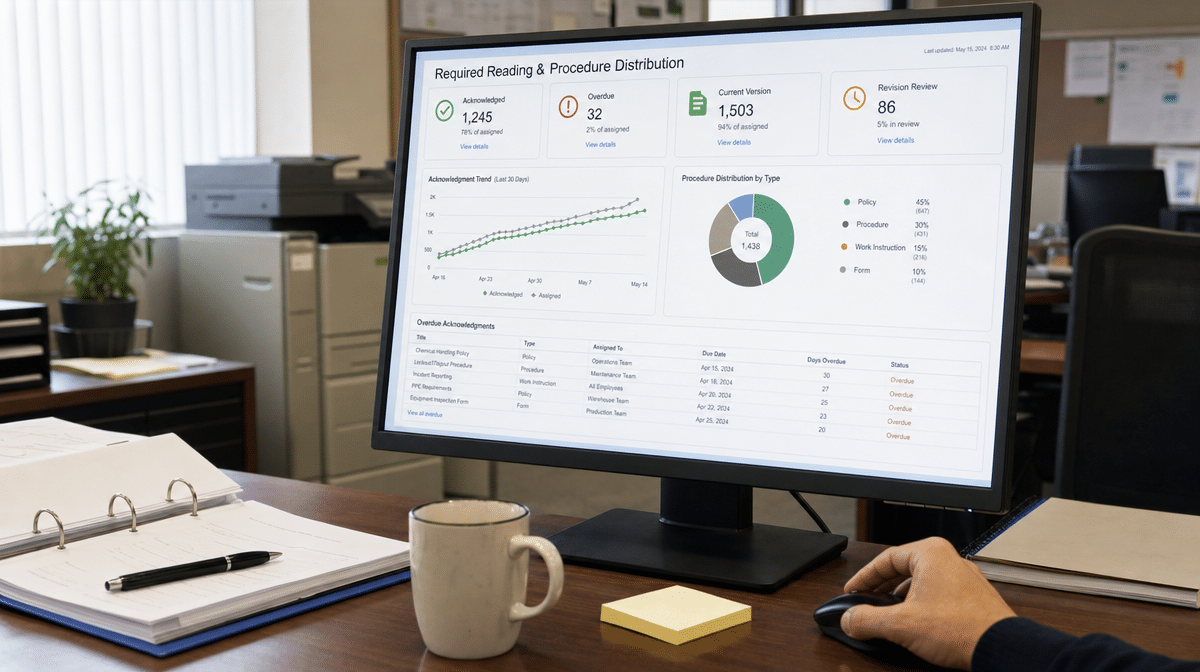
Another way to ensure employees use your procedures is to design in controls that include measures with targets that employees can strive for on a periodic basis. What gets measured gets managed. A well-defined process includes measures and targets used to control the process.
Data from individual processes can be collected into dashboards that are reviewed on a regular basis. Use the metrics as your daily management system to ensure you are getting the results you expect from your business.
Policies and Procedures Metrics
What metrics have we discussed? We started with consistency of industry standards using document control blocks. Next we looked at procedure metadata, review criteria, and procedure distribution. Each one of these can be measured, variance tracked, and developed into audit criteria to ensure procedures are effective.
Useful metrics can include the age of the current revision, the number of procedures past their review date, required reading completion, overdue acknowledgments, audit findings by department, exception counts, document-change cycle time, and the percentage of procedures with complete metadata. These are practical signals that show whether documentation is controlled and used.
Measuring your documentation against common elements provides a method for managing, reviewing, and communicating the effectiveness of your policies and procedures. To get the most value out of your policies and procedures documentation, you need to use it over and over again, updating it as needed. Now you are managing by procedures that you built.
To see procedure examples, download free policies and procedures from Bizmanualz.
Frequently Asked Questions
How Effective Are Policies and Procedures?
Policies and procedures are effective when employees can find the current version, understand the required actions, follow the documented controls, and produce measurable results. Effectiveness depends on use, review, distribution, and metrics, not just the existence of a written document.
What Should Policies and Procedures Documentation Include?
Policies and procedures documentation should include document control, purpose, scope, definitions, responsibilities, references, steps, approval history, release date, revision level, and compliance criteria. These common elements make the procedure easier to review, audit, update, and communicate.
How Do You Review Policies and Procedures?
You review policies and procedures by checking context, consistency, completeness, control, compliance, correctness, and clarity. A good review also confirms that the procedure reflects the current activity performed and that targets, criteria, or measures are clear.
How Do You Know If Employees Use Procedures?
You can use internal audits, assessments, required reading reports, version-control records, and operational metrics to see if employees use procedures. The evidence should show whether people accessed the current version, understood the instructions, and performed the process as documented.
What Metrics Show Procedure Effectiveness?
Procedure effectiveness metrics can include review-date compliance, revision age, overdue acknowledgments, audit findings, exception counts, required reading completion, and dashboard trends. These measures help managers communicate whether policies and procedures are working in daily operations.