How are New Technologies Influencing Training?
New technologies are influencing training by making learning easier to access, practice, update, and measure. Digital learning systems can connect remote and on-site employees with training manuals, workshops, quizzes, university courses, accredited programs, and internal knowledge centers. The technology is useful only when it helps an employee perform a real job task correctly.
The modern workplace organization continues to evolve with industry needs, technological progress, and employee requirements. This guide explains five durable ways technology influences workplace training, adds current guidance for AI-assisted learning, and gives you a decision matrix for choosing a method.
5 Ways Technology is Transforming Workplace Training in the New Normal
What began as the “new normal” is now a regular operating model for many companies. Employees may learn in an office, at home, in the field, or across several locations. Business leaders therefore need training that is available when the work happens and structured enough to produce consistent results.
Technology can make training and professional development more efficient and effective, but a platform is not a training strategy. Start with the task an employee must perform, the information they need, the practice they require, and the evidence that will show they can do the job right.
Digital Learning Makes Information Accessible
Digital learning makes quality information and training accessible to employees across locations and schedules. A learning management system, shared knowledge center, recorded demonstration, or mobile course can deliver procedures and educational material without requiring every employee to attend the same workshop at the same time.
AI-assisted tools add another option. They can help a training owner draft an outline, turn a policy into practice questions, summarize a long manual, or adapt an explanation for a learner. Treat that output as a draft. The NIST AI Risk Management Framework is voluntary guidance for managing AI risks, and NIST’s generative AI profile calls for appropriate human review, tracking, documentation, and management oversight. Do not paste confidential employee, customer, or company information into an unapproved tool.
Accessibility is part of information access. The W3C learning management system accessibility guidance says these tools should be usable by instructors and learners with disabilities and should help authors produce accessible content. Check keyboard access, captions, transcripts, alternative text, readable contrast, and mobile behavior before you roll out a course.
This gives business leaders an opportunity to make training manuals, workshops, and engaging online learning materials accessible to remote employees as well as people in the workplace. Over the long term, that access can support a passion for learning and development across the entire organization as employees keep evolving their skills and know-how.
Interactive Training Improves Onboarding
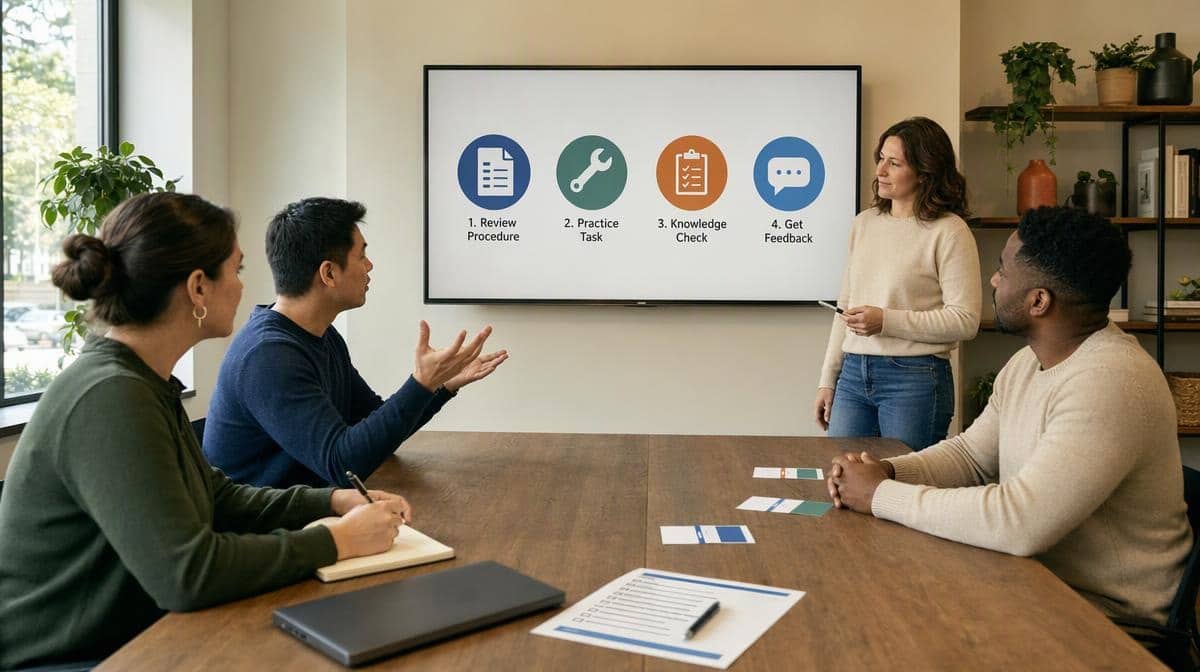
Bringing new employees into the company and empowering them to become proactive team members depends on more than giving them information. New employees need a safe way to practice decisions, receive feedback, and repeat the task before they perform it independently.
Interactive training can use branching scenarios, simulations, gamification, and quiz-based learning. A quiz can confirm recall. A scenario can show how someone applies a policy. A simulation can test a procedure without putting a customer, system, or piece of equipment at risk. Choose the format that resembles the real work, then observe performance instead of assuming that course completion equals competence.
Talent and expertise matter, but employees also need access to important information, educational material, workshops, and other important data during training and onboarding. Highly engaging training programs should help people become proactive team members, acquire new skills, and demonstrate those skills in the work itself. Gamification and quizzes can make practice more approachable, but enjoying the process is not the same as retaining knowledge.
Online Universities are Sharing a Wealth of Knowledge
The digital age has made information available from universities and other authoritative sources around the world. Employees can use online courses, lectures, microcredentials, and professional development units to build skills in management, marketing, human resources, information technology, security, and other fields.
Deakin University is one current example. Its official short courses include flexible online options and professional development. The official university page is a stronger source than a third-party study-notes marketplace for confirming what is available, how it is delivered, and whether a course or credential fits an employee advancement plan.
Online universities can share a wealth of knowledge through curriculums, learning materials, and lectures from teachers in their fields. Use official university sources to confirm whether study notes, short courses, or credentials are current, and whether employees can apply them to an advancement program.
Synchronous and Asynchronous Accredited Training Programs

Many associations and accredited training programs offer synchronous and asynchronous learning to companies and professionals. Synchronous sessions let employees ask questions, discuss examples, and receive live coaching. Asynchronous courses let people learn at their own pace and revisit a difficult lesson when they need it.
Choose the mode around the task. Use live instruction when discussion, observation, or immediate correction matters. Use self-paced learning for stable knowledge, preparation, and reference. A blended program can assign a short lesson before a workshop, use the workshop for practice, and require a supervisor observation afterward.
Check the accreditation, instructor qualifications, assessment method, renewal requirements, and whether the certificate is recognized in your industry. A polished course page is not proof that a credential is valid for a regulated role.
When associations, accredited institutions, industry mentors, or coaches provide the training, check their accreditations before enrollment. Confirm whether employees will receive valid certifications or diplomas, identify the relevant certifications in your industry, and conduct thorough research before choosing a provider. This protects the employee advancement program and helps people use their new skills to push the business forward.
Internal Knowledge Centers Boost Efficiency
An internal knowledge center, such as a company wiki, can make manuals, procedures, policies, workshops, and other important data available to new and veteran employees. It gives people a place to learn a process and a reference to use when they are stuck.
The knowledge center needs ownership. Assign someone to approve changes, show the effective date, archive obsolete material, control access, and connect each training lesson to the current procedure. Search is useful only when employees can trust the result. A simple, maintained source of truth is better than a large library of conflicting files.
Over the long run, an internal wiki can also support communication, collaboration, and efficiency because everyone refers to the same manuals and procedures. It should help employees advance their skills and find an answer when they are stuck, without presenting the knowledge center as a substitute for coaching or supervised practice.
How Should You Choose a Training Technology?
Choose technology after you define the training need and the proof of learning. The following decision matrix is a worked starting point. Replace the examples with your own procedure, risk level, learner needs, and systems.
| Training need | Suitable technology | Evidence of learning | Governance check |
|---|---|---|---|
| Learn a stable policy or procedure | Short self-paced lesson linked to the controlled document | Knowledge check plus acknowledgement of the current version | Owner, effective date, version history, and access control |
| Practice a judgment call | Branching scenario or facilitated discussion | Learner explains the decision and its consequences | Examples reflect approved policy and do not expose private data |
| Perform a physical or system task | Demonstration followed by simulation or supervised practice | Observation against a task checklist | Safe practice environment and qualified observer |
| Draft or adapt learning material with AI | Approved AI assistant used by the training owner | Human-reviewed lesson tested against the source procedure | Privacy, security, accuracy, bias, provenance, and change approval |
| Build recognized professional skills | Accredited course, university short course, or qualified live instructor | Assessment, credential, and observed application at work | Provider standing, credential validity, and renewal requirements |
Run a small pilot before a company-wide rollout. Include employees who use different devices and employees who need accessibility support. The WCAG 2 documents provide a stable technical reference for accessible web content. Compare completion data with a practical assessment, support requests, errors, and supervisor observations. Keep the technology only if it helps people perform the task more consistently.
New Technologies Influencing Training
Technology gives you more ways to develop and educate employees, but the basic discipline has not changed. Define the job task, provide accurate information, let people practice, give them feedback, and verify performance. Gamification, online university curriculums, industry experts, AI-assisted content, and internal knowledge centers can all support that cycle.
Connect each lesson to current documentation and make someone responsible for it. That is how digital technologies and training systems become part of daily operations instead of another library employees stop using. Continue with the Bizmanualz guide to quality education when you need to define the standards behind a training program.
Frequently Asked Questions
What is the best technology for workplace training?
The best technology is the simplest tool that supports the real job task, works for the employees who need it, and produces reliable evidence of learning. Start with the task and assessment, then choose the platform.
How can a company use AI in employee training?
A company can use an approved AI tool to draft outlines, practice questions, summaries, or alternative explanations. A qualified person should check every output against the source procedure and the company’s privacy, security, and approval rules before employees use it.
How do you know whether technology-based training worked?
Measure the behavior the training is meant to change. Use a knowledge check for recall, a scenario for judgment, and a supervised task checklist for performance. Course completion alone does not prove competence.