
procedures
Writing good standard operating procedures has a lot to do with how you use verbs. How can you make sure your procedures have verb power?
Read more
A policy sets direction by stating what an organization expects and why. A procedure turns that direction into repeatable steps that explain how, when, and by whom the work is done.
Read more
You need policies and procedures to communicate your goals; standardize behavior, processes, and results; train employees consistently; and identify what’s acceptable behavior and what’s not.
Read more
Where should you start when writing policies and procedures? Should policies come before procedures, or should it be the other way around?
Read more
Writing error-free procedures can be as easy as using these seven simple keys.
Read more
Don’t go into long explanations or try to dispense too much information. Complexity is an enemy of consistency and quality.
Read more
All policies and procedures manuals from Bizmanualz follow the Plan-Do-Check-Act (PDCA) cycle. The new procedure writing guide emphasizes this concept.
Read more
Careful organization of your policies and procedures manual will be vital to its readability and usefulness. Do you know how to correctly organize this?
Read more
Many get these terms mixed up: policy, business Process, Procedure, and Work Instruction. In truth, most people create work instructions and refer to them as procedures. Or they will write a procedure, which is really a process. Some think of these terms as interchangeable. What is a work instruction?
Read more
Best Manual Deals
-
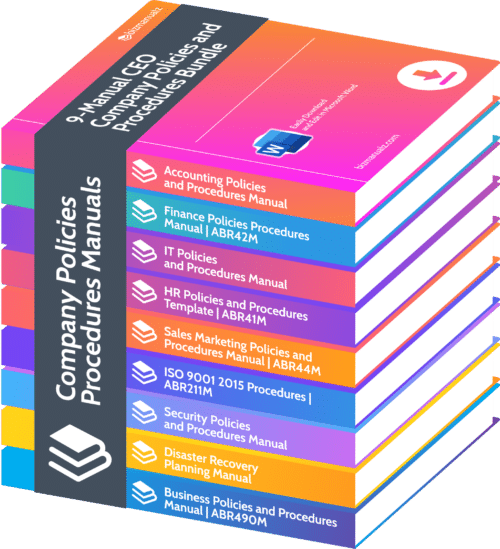 9-Manual CEO Company Policies and Procedures Bundle | Save 45%
$ 2,495.00
-
 ISO 22000 Food Safety Procedures Manual | ABR213M
Original price was: $ 395.00.$ 197.00Current price is: $ 197.00.
-
 ISO 22000 Seguridad de los Alimentos Procedimientos | ABR219M
Original price was: $ 395.00.$ 195.00Current price is: $ 195.00.
-
 ISO 9001 Quality Manual | ABR211MPM
$ 49.99
Business Manuals
-
 Finance Policies Procedures Manual | ABR42M
$ 495.00
-
 Accounting Policies and Procedures Manual | ABR31M
$ 495.00
-
 IT Policies and Procedures Template Manual | ABR34M Information Security Policy Manual
$ 495.00
-
 HR Policies and Procedures | ABR41M Employees Policy Examples
$ 495.00
-
 Sales Marketing Policies and Procedures Manual | ABR44M
$ 495.00
-
 ISO 9001 2015 Procedures | ABR211M
$ 495.00
-
 AS9100 Quality Procedures Manual Rev D | ABR217M Aerospace QMS
$ 395.00
-
 Security Policies and Procedures Manual | ABR32M
$ 395.00
-
 Disaster Recovery Planning Manual | ABR33M
$ 395.00
-
ISO 22000 Food Safety Procedures Manual | ABR213M
Original price was: $ 395.00.$ 197.00Current price is: $ 197.00.
-
9-Manual CEO Company Policies and Procedures Bundle | Save 45%
$ 2,495.00
-
ISO 22000 Food Safety Procedures Manual | ABR213M
Original price was: $ 395.00.$ 197.00Current price is: $ 197.00.
-
ISO 22000 Seguridad de los Alimentos Procedimientos | ABR219M
Original price was: $ 395.00.$ 195.00Current price is: $ 195.00.
-
ISO 9001 Quality Manual | ABR211MPM
$ 49.99
-
 How to Prevent Embezzlement Manual | ABR242DWD
Original price was: $ 49.99.$ 19.99Current price is: $ 19.99.