
How Will IFRS Convergence Impact You?

Accounting standards do not stop at the finance department. When the rules behind financial statements change, the impact can reach reporting systems, inventory procedures, loan covenants, management bonuses, training materials, and the way employees document routine work.
That is why IFRS convergence still matters, even though the United States did not make the full domestic switch once expected. The SEC explored incorporating International Financial Reporting Standards into the U.S. reporting system, and several convergence projects changed important parts of GAAP, but U.S. domestic issuers still report under U.S. GAAP. The convergence impact is practical: companies need to understand where GAAP and IFRS line up, where they still differ, and what those differences mean for policies and procedures.
What Is IFRS Convergence?
IFRS convergence is the long-running effort to reduce unnecessary differences between U.S. Generally Accepted Accounting Principles, or GAAP, and International Financial Reporting Standards, or IFRS. The International Accounting Standards Board develops IFRS Accounting Standards, while the Financial Accounting Standards Board develops U.S. GAAP for domestic companies.
The original public discussion around convergence sounded like a conversion project. The SEC developed a road map, the AICPA built IFRS education resources, and many companies expected a possible switch from GAAP to IFRS around 2014 or 2015. That full switch did not happen. The IFRS Foundation’s United States jurisdiction profile states that the SEC requires domestic issuers to apply U.S. GAAP, while foreign private issuers may use IFRS Accounting Standards as issued by the IASB.
Earlier discussions used more urgent language. The original plan was for U.S. companies to have made the switch from Generally Accepted Accounting Practices to IFRS by 2014, and when an official date hadn’t been set, some SEC materials and commentators treated 2015 as the earliest date for IFRS adoption. That timing belongs to the earlier IFRS adoption debate, not current policy. It explains why older coverage talked about adoption, implementation, conversion, and whether companies would follow suit.
Those short- and long-term convergence projects, plus ongoing guidance from the IASB, FASB, AICPA, SEC, and other organizations, made adoption look like a near-term task at the time. The behavior point still holds: people implement IFRS, and people don’t handle change well when rules are deeply ingrained. Some observers feared the United States would not leave well enough alone, while others assumed much of the world had already adopted IFRS and U.S. companies would eventually follow.
For management teams, the lesson is not that IFRS disappeared. It is that convergence became a continuing business-readiness issue instead of a single deadline. Multinationals, companies with foreign subsidiaries, private companies preparing for acquisition, and businesses working with international lenders or customers may still need to compare GAAP and IFRS reporting treatments.
What Are The Key IFRS And GAAP Differences?
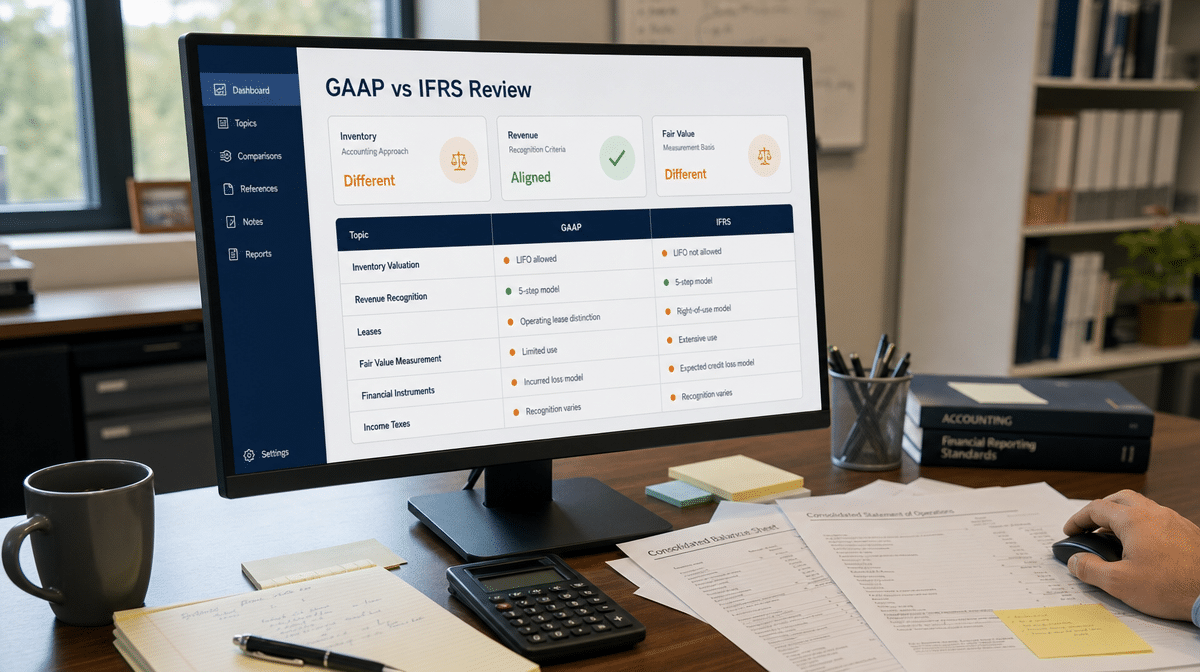
GAAP and IFRS share the same broad purpose: provide useful financial information. The differences are in the details, and those details matter because accounting policies drive journal entries, controls, approvals, system settings, training, and management reports.
Inventory valuation remains one of the clearest examples. IFRS does not permit the LIFO method, while U.S. GAAP allows it. A company that uses LIFO for inventory under GAAP may have tax, margin, and systems implications if it also needs IFRS reporting for an overseas parent, investor package, or acquisition process.
Property, plant, and equipment can also create differences. IFRS permits revaluation to fair value in certain circumstances, while U.S. GAAP generally relies on historical cost. That difference can affect asset registers, depreciation schedules, impairment reviews, capital expenditure controls, and the reports managers use to evaluate operating performance.
Revenue recognition is a more nuanced story. The old article treated revenue as a major area of difference because GAAP had extensive industry-specific guidance. Since then, the IASB and FASB issued a converged revenue recognition standard, creating a common five-step model under IFRS 15 and ASC 606. Even there, companies still need careful policies for contract review, performance obligations, variable consideration, and disclosure.
Compensation linked to GAAP financial metrics needs the same practical attention. Those metrics do not simply go away because IFRS exists. Instead, management should understand how different accounting treatments could change EBITDA, revenue timing, inventory costs, asset values, covenant calculations, or bonus plan triggers.
How Does GAAP And IFRS Convergence Impact Management?
The biggest IFRS impact is often operational. A financial reporting change can force updates to accounting policies, chart-of-accounts structure, ERP configuration, close calendars, approval matrices, reporting packages, board materials, lender reporting, and staff training.
Finance is the obvious starting point. A company may need to update its accounting policies and procedures manual, revise reconciliations, document new judgments, and strengthen review controls. The goal is not just to produce a different financial statement. The goal is to make sure the new reporting logic is repeatable and auditable.
Operations can be affected when accounting treatments depend on inventory, fixed assets, production costs, warranties, leases, or contract milestones. HR can be affected when compensation plans use GAAP-linked performance measures. A change in reporting can therefore reach finance policies and procedures, operations procedures, and HR policies and procedures.
The people side is easy to underestimate. GAAP is deeply ingrained in the American way of conducting business. Accountants, executives, managers, auditors, lenders, and employees build habits around familiar definitions. Ask yourself: when a performance metric changes, does everyone understand whether performance changed, or whether the measurement changed?
That is why procedures matter. If management treats convergence as an accounting-department issue only, the organization will miss the places where reporting assumptions turn into everyday decisions. If management treats it as a process and controls issue, the company can update training, documentation, reviews, and internal communication before confusion reaches the financial statements.
How Do Private Companies Use GAAP?
Private companies in the United States generally use U.S. GAAP when lenders, investors, owners, auditors, or contracts require it. Some private companies may use other accounting frameworks when those frameworks fit the purpose of the financial statements, but GAAP remains the common reference point for many U.S. reporting relationships.
That does not make IFRS irrelevant to private companies. A private company selling overseas, acquiring a foreign business, reporting to an international parent, preparing for outside investment, or working with cross-border customers may need IFRS awareness. Market forces can create reporting expectations even when federal law does not require a full IFRS conversion.
Small and medium-sized entities also have a dedicated IFRS framework. The IFRS for SMEs Accounting Standard was updated in February 2025, with the new edition effective for annual periods beginning on or after January 1, 2027. That does not automatically make it the right framework for a U.S. private company, but it does show that SME reporting remains part of the global IFRS conversation.
What Are The IASB And FASB Doing Now?
The IASB and FASB no longer need to be described as pushing toward a single near-term U.S. conversion date. Their relationship is better understood as a history of convergence projects, continuing comparability work, and separate standard-setting responsibilities.
The boards have already converged important areas, including revenue recognition. Other topics still differ. That means companies should avoid blanket statements such as “IFRS and GAAP are almost the same” or “IFRS will replace GAAP soon.” Both statements can lead to poor planning.
A practical approach is to maintain a GAAP-to-IFRS difference register for the areas that matter to the business. Inventory, fixed assets, leases, revenue, financial instruments, impairment, and disclosures are common starting points. For each area, management should identify the policy owner, system owner, control owner, training need, and reporting impact.
The future of American accountancy is not a simple story of abandoning GAAP. It is a story of operating in a global reporting environment while still meeting U.S. requirements. Companies that document policies, train employees, and keep controls aligned will be better prepared no matter how the standards evolve.
-
 9-Manual CEO Company Policies and Procedures Bundle | Save 45%
$ 2,495.00
9-Manual CEO Company Policies and Procedures Bundle | Save 45%
$ 2,495.00
-
 ISO 22000 Food Safety Procedures Manual | ABR213M
Original price was: $ 395.00.$ 197.00Current price is: $ 197.00.
ISO 22000 Food Safety Procedures Manual | ABR213M
Original price was: $ 395.00.$ 197.00Current price is: $ 197.00.
-
 ISO 22000 Seguridad de los Alimentos Procedimientos | ABR219M
Original price was: $ 395.00.$ 195.00Current price is: $ 195.00.
ISO 22000 Seguridad de los Alimentos Procedimientos | ABR219M
Original price was: $ 395.00.$ 195.00Current price is: $ 195.00.
-
 ISO 9001 Quality Manual | ABR211MPM
$ 49.99
ISO 9001 Quality Manual | ABR211MPM
$ 49.99
-
 How to Prevent Embezzlement Manual | ABR242DWD
Original price was: $ 49.99.$ 19.99Current price is: $ 19.99.
How to Prevent Embezzlement Manual | ABR242DWD
Original price was: $ 49.99.$ 19.99Current price is: $ 19.99.