What are Static and Dynamic Policy and Procedure Systems?

Can you really have compliance without control? A business procedure can exist on paper and still fail in deployment and usage. Documentation provides a requirement. Control also requires people to follow the procedure, observe the result, compare it with the expected result, and act on what they learn.
That is the practical difference between static and dynamic policy and procedure systems. A static system records how work should happen. A dynamic system connects that record to feedback, review, corrective action, and verified change. The policy stays controlled, but the system can respond when performance, risks, customers, suppliers, or regulations change.
Difference Between Static and Dynamic Systems
The original bridge analogy remains useful if the engineering terms are kept accurate. In engineering mechanics, statics concerns bodies in equilibrium, while dynamics examines motion and acceleration. University of Maryland engineering mechanics explains the distinction.
For the comparison, think about static control conditions as a snapshot with the forces in balance. An engineer may calculate stress, tension, torque, and other forces for that condition. Next comes dynamic analysis, which considers motion and forces that change over time. Automobiles move, and a suspension bridge sways in the wind. The changing conditions make the situation more complex, but feedback is a separate control concept rather than the definition of dynamics.
A solid bridge or building may be analyzed under a set of forces. A suspension bridge also responds over time as wind, traffic, and other conditions change. In the same way, a written procedure describes a planned condition, while the business process operates in changing conditions.
Static Systems
In this business analogy, a static system has no feedback connected to the document. The procedure is approved and stored, but nobody checks whether the process delivers the intended result. Without a performance signal, an owner cannot see drift, exceptions, or unintended workarounds. These can become ballistic processes with no control.
Dynamic Systems
Dynamic systems change over time, and feedback is one way to control them. Reinforcing, or positive, feedback can amplify a deviation. Balancing, or negative, feedback compares actual performance with a target and prompts a correction. NIST defines control as corrective action based on feedback. NIST’s engineering statistics glossary provides that definition.
Positive feedback loops amplify a signal and can cause a vicious cycle, whereas negative feedback loops can reduce deviation and help obtain control. In practice, that pushing back starts the feedback process only when information about the result returns to a decision maker who can act. The point is not that every change is destructive, but that unmanaged loops can move a process away from its target.
The wind can make a bridge oscillate, just as changing demand, staffing, systems, or suppliers can expose weakness in a process. The Federal Highway Administration documents that the Tacoma Narrows Bridge deck oscillated severely under relatively mild wind conditions before its collapse. The FHWA bridge report supports this example. The lesson is not that a business procedure is a bridge. It is that a system needs signals that reveal when actual behavior is moving away from its intended state.
Static and Dynamic Policy and Procedure Systems
When you design policies and procedures systems, decide what feedback the process will produce and who will respond to it. A policy without an operating loop may support awareness or checkbox compliance, but it cannot show whether the process is under control.
The dynamic nature of a business process should be considered before it is captured in a knowledge management system. The document needs an owner, a controlled revision method, evidence of deployment and usage, and a way to detect whether results match the requirement.
Policies and Procedures Are Not Static
Business policies and procedures involve people who provide feedback. Customers, suppliers, employees, and management all see different parts of the process. Plan how those observations enter the system, who evaluates them, and how an approved change reaches the people who do the work.
Dynamic Policies and Procedures Systems
Planning for feedback means using data, scoreboards, process reviews, process audits, management reviews, customer and supplier surveys, discussions, interviews, comments, and employee collaboration. Use control charts only where the data and process make them useful. The mechanism matters less than closing the loop from evidence to action.
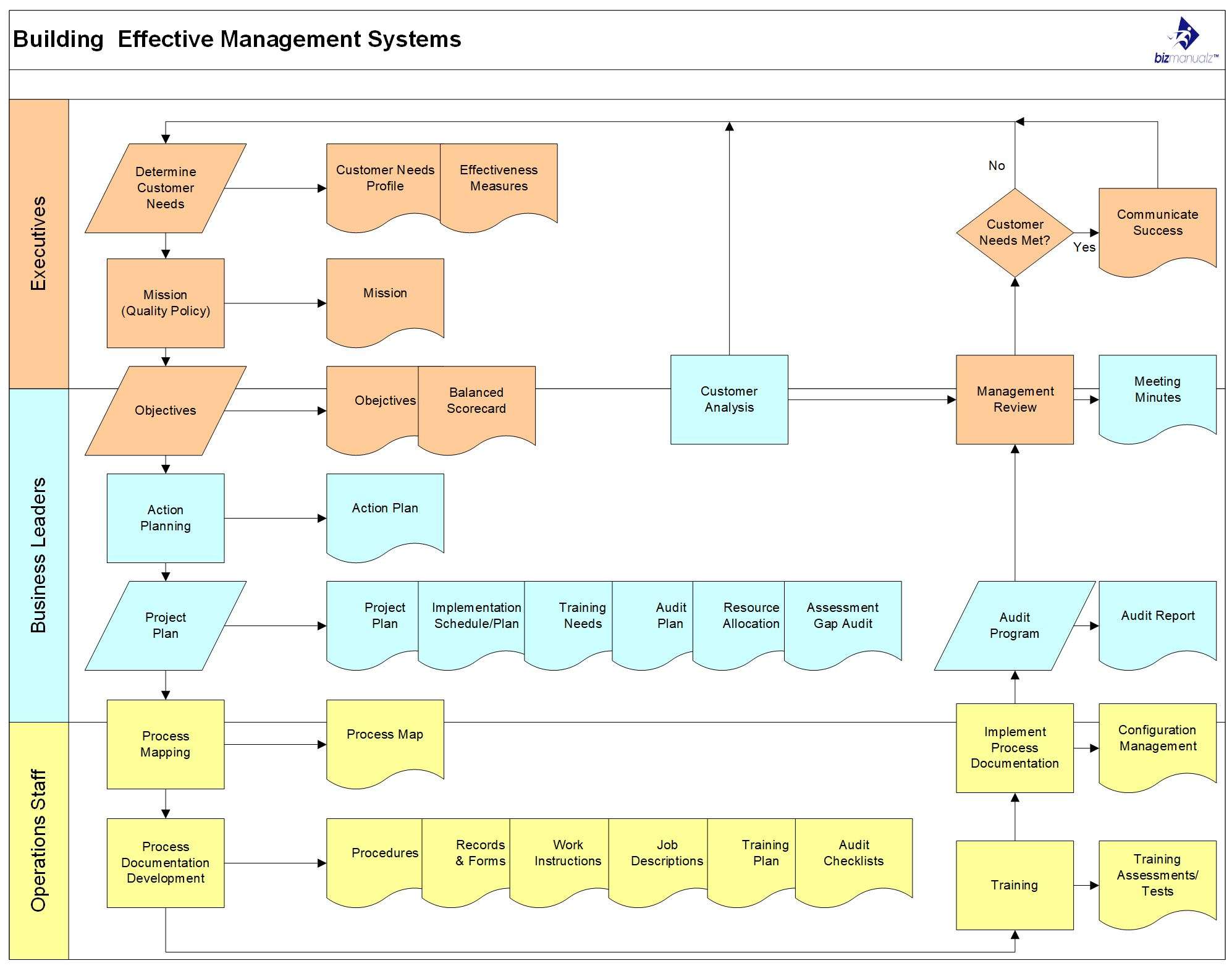
The process map shows the operating loop in context: planning and documentation lead to training and execution, audits and reviews produce evidence, and feedback informs approved improvements. The image is a guide to the sequence, not a claim that every organization needs the same workflow.
How Do You Test Whether a Procedure Provides Control?
Use this five-step policy-control review as a practical checklist:
- Define the expected result. State the policy objective, procedure output, owner, and acceptable condition.
- Collect evidence. Choose a useful signal such as an exception log, reconciliation, approval record, quality check, complaint, survey, or audit result.
- Compare actual with expected. Identify the variance and decide whether it is isolated, recurring, or caused by a change in the process environment.
- Assign corrective action. Name the owner, due date, affected document, training need, and approval path.
- Verify the change. Confirm that the revised procedure was deployed and that later evidence shows the intended result.
If any step is missing, the system may document compliance without providing reliable control. The checklist also prevents every complaint or exception from triggering an uncontrolled rewrite.
How Do Feedback Loops Strengthen Policy and Procedure Controls?
Standards and regulatory regimes use different language and apply to different organizations, so they should not be treated as one universal feedback rule. ISO explains that ISO 9001 includes monitoring, measurement, performance evaluation, and continual improvement. ISO’s explanation of ISO 9001 describes those elements.
For public-company internal control over financial reporting, the SEC’s Sarbanes-Oxley Section 404 guidance asks whether a control operates as designed, how it is applied, and whether it operates consistently. The SEC Section 404 guide supports this operating-effectiveness test, and the Bizmanualz guide to SOX accounting policies and procedures provides related implementation context.
In drug manufacturing, FDA current good manufacturing practice guidance says operating procedures should consistently produce a quality product. FDA production and process controls guidance supports that scoped example. ISO 9001, Sarbanes-Oxley, and GMPs are not interchangeable, but each shows why documentation must connect to implementation and evidence.
The next time you are writing effective procedures, ask where feedback enters, who owns the response, and how the organization verifies the correction. That is how a policy document becomes part of an effective internal control system. You can also download free policies and procedures to examine a practical starting structure.
Frequently Asked Questions
Can documented policies provide control by themselves?
No. A document states the expected method, but control also needs deployment, evidence, comparison with the expected result, corrective action, and follow-up.
What makes a policy and procedure system dynamic?
A dynamic system captures operational feedback, assigns ownership for review, controls approved revisions, communicates changes, and verifies that the change improved the result.
How often should procedures be reviewed?
Set a risk-based review schedule and also trigger review when evidence shows drift, an exception repeats, a process changes, or a relevant requirement changes.