How Do You Conduct eCommerce Market Research?

For an entrepreneur, market analysis is a way to find answers to what and how to sell. Effective ecommerce market research starts with a business decision, then combines evidence about demand, customers, competitors, prices, sales channels, and outside conditions. It can help you choose what to test without pretending that research can remove every risk.
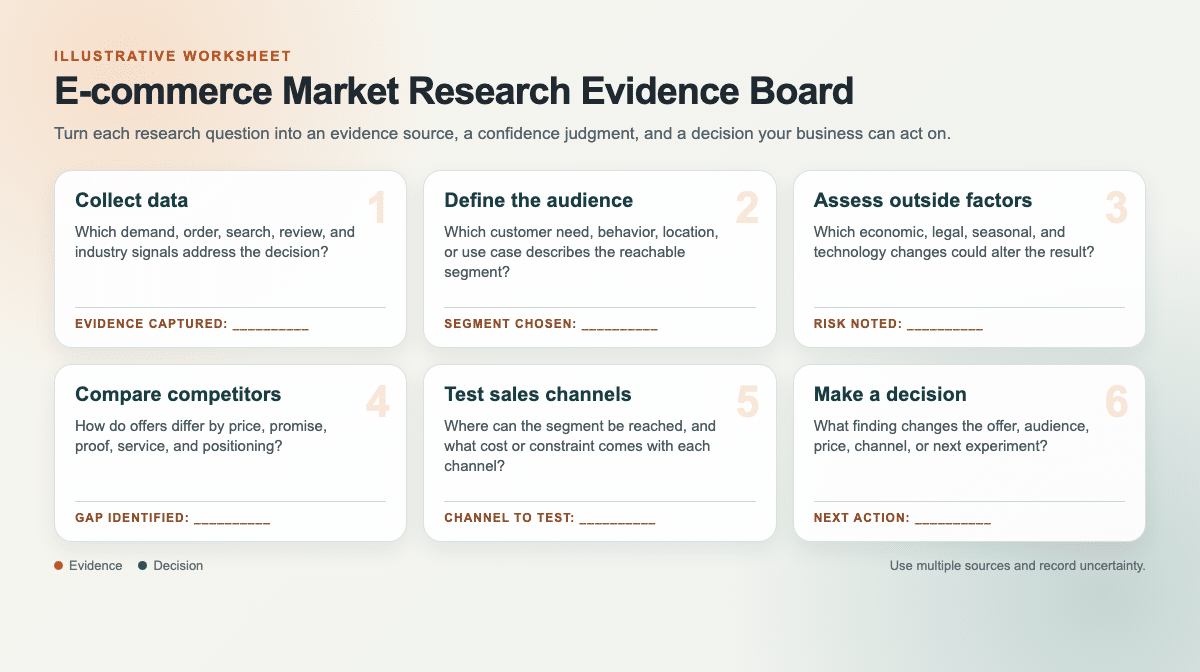
Begin with a short list of questions and turn each question into a source, finding, confidence level, and next action. The six-step process below preserves that discipline while showing how to use first-party store data, direct customer research, public market information, and competitive market research together.
How to Conduct Ecommerce Market Research like a Pro
Marketing research of the ecommerce market allows you to assess the prospects for creating a new business startup, learn how to stand out in ecommerce, or adjust the development strategy of an existing one. A useful study does not begin by collecting everything available. It begins by stating the decision you need to make and the evidence that would change that decision.
Why Research the Ecommerce Market?
Goal setting is the first stage of useful marketing research. If the range of tasks is defined correctly, you avoid collecting and processing unnecessary information. The subject of research can be one of the structural components of the market. The U.S. Small Business Administration recommends examining demand, market size, location, market saturation, pricing, and the competitive landscape when planning a business. Use those questions to narrow the study to the choice in front of you, not to produce a report that nobody will use. Review the SBA market research guidance.
- Free niches. Assess competition in segments and search for an unoccupied or underserved need before introducing a new business or offer.
- Market condition. Review the current economic situation, industry structure, seasonality, and any change that could affect demand.
- Similar offers. Count comparable offers in the selected segment and compare their promises, proof, sales volume signals, and service model.
- The target audience. Study customer behavior, product requirements, use cases, location, purchase frequency, and value to the business.
- Competitors. Identify the strengths and weaknesses of competing companies and their products, including indirect alternatives.
- Prices. Compare pricing in the industry and the cost of similar offers from competitors, including economy, mid-market, and premium positioning.
To determine the direction of your marketing research, make a list of questions to which you want to find answers. The to-do list can serve as a prototype for a plan from which further research will be built. Give each question an owner, a deadline, a source, and a decision rule.
Types of Ecommerce Market Research
The most useful classification separates existing-source research from direct customer research. Existing sources can describe industries, economic trends, geography, and public behavior. Direct research, including surveys, questionnaires, focus groups, and in-depth interviews, can answer questions specific to your offer and buying experience. The SBA distinguishes these two approaches and notes that they serve different purposes. See the SBA methods.
Marketing analysis is aimed at studying a specific market segment. The subject of study is data about a particular product, its target audience, product price, and competitors’ offers. Use both quantitative evidence, such as orders and conversion events, and qualitative evidence, such as interview themes and the reasons behind abandoned purchases. The results can help you build or update development strategies, explore new revenue streams, and improve product performance without promising any particular outcome.
Complex research includes the study of all segments and industries of the market. A broad study can help when a specific line of business has not yet been chosen, but it should still end in a focused decision. Search for promising niches, evaluate development trends and purchasing power, and study ecommerce experience requirements before selecting a segment for deeper research.
Sources of Information for E-Commerce Markets
Use public, permissioned, and first-party information rather than trying to bypass a site’s security controls. Start with your store’s product views, add-to-cart activity, checkout starts, purchases, refunds, support questions, and repeat orders. Google Analytics documents ecommerce events and explains that event and item parameters provide context for customer interactions. Review Google’s ecommerce measurement guidance.
Combine that evidence with traditional polls, questionnaires, interviews, social networks, thematic forums, other internet resources, customer-service records, marketplace listings, and competitor offers. Read reviews across several sources and do not rely on star ratings alone, because reviews and ratings can be fake or misleading. See the Federal Trade Commission’s review guidance.
For a location-dependent market, Census Business Builder provides selected demographic and economic data, interactive maps, comparisons, and downloadable reports for a chosen geography and type of business. It is aggregate context, not proof that an individual customer will buy. Open Census Business Builder.
Google Trends can compare relative search interest across time and location, but it is normalized search interest, not a scientific poll, absolute search volume, or direct proof of demand. Use it as one signal among customer, competitor, sales, and industry evidence. Read how Google Trends data works.
Key Steps to Research E-Commerce Markets
Each marketing research project for ecommerce markets is carried out according to an individual plan because it aims to solve the problems of a specific business and help an ecommerce business thrive. However, the fundamental analysis steps are the same for most processes.
- Collect data. Collect information about the state of the market for a period that matches the decision, seasonality, and purchase cycle. Compare recent evidence with a longer baseline when that comparison is meaningful. Record the source, date, limitation, and whether each item is a fact, estimate, or observation.
- Define the target audience. Identify the category of buyers who may bring the company the most value. Buyers are often divided into groups according to general characteristics such as age, gender, social status, and income level, but an ecommerce study should also compare need, use case, location, behavior, purchase frequency, order value, and business type. Use first-party order data to understand current buyers and public data to estimate the reachable market.
- Study external factors. The market is influenced not only by buyers and sellers but also by outside participants. External factors such as legislative changes, economic processes, technological development, seasonal patterns, and various fashion trends can alter the result. A PEST analysis can help organize those factors.
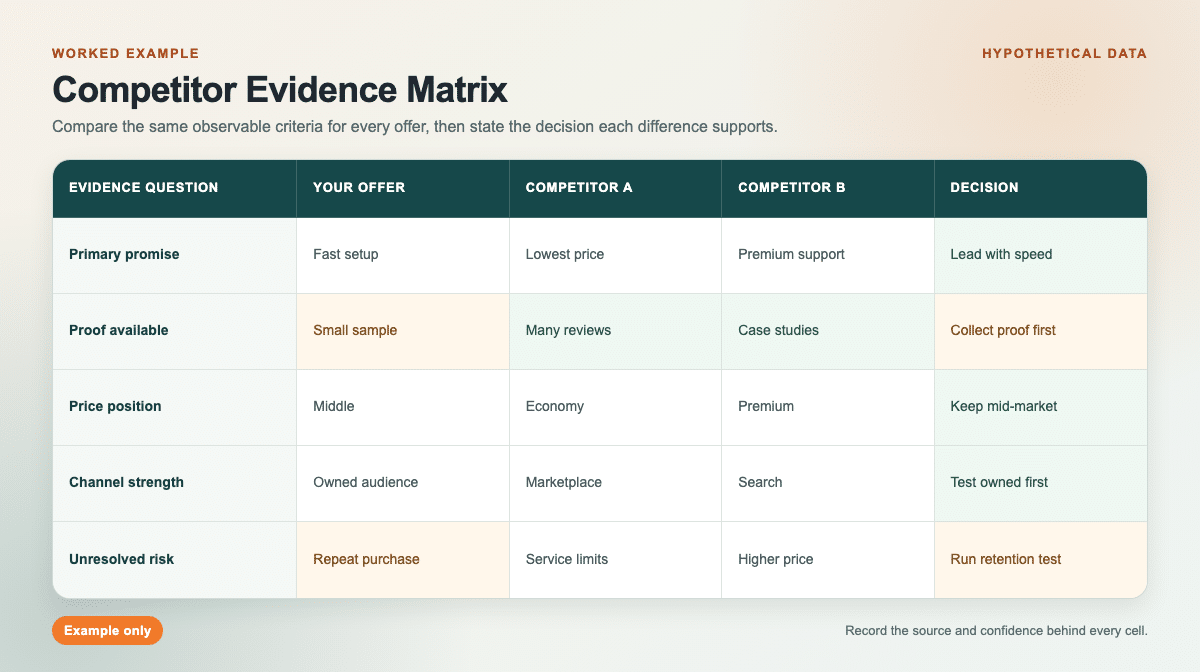
- Get acquainted with competitors. Study the advantages and disadvantages of direct and indirect rivals. Compare pricing, product range, delivery, returns, customer proof, service, and positioning. Ask whether each competitor markets the offer as economy, mid-market, or luxury. A SWOT analysis can turn those observations into a structured comparison.
- Look for sales channels. How and to whom you will sell goods and services is one of the essential issues when organizing a business. Marketing research can identify distribution channels through which goods move from the supplier to the consumer. Compare those channels by audience fit, reach, fees, control, fulfillment requirements, data access, and the cost of running a small test.
- Draw a conclusion. When all the data is collected and structured, analyze the results against the original decision. State what you know, what remains uncertain, and what low-cost test would reduce the most important uncertainty.
Use an Ecommerce Market Research Scorecard
Use the same fields for every question so that interesting facts do not crowd out decision-relevant evidence. The matrix above is hypothetical. It shows how one seller might compare the primary promise, proof, price position, channel strength, and unresolved risk before selecting a test.
| Research question | Source and method | Evidence or metric | Finding | Confidence | Decision |
|---|---|---|---|---|---|
| Which audience has the strongest need? | Customer interviews plus order history | Repeated problem, order value, repeat rate | Record the segment and supporting evidence | High, medium, or low | Choose a segment or collect more evidence |
| Where is the clearest competitive gap? | Offer, price, review, service, and returns comparison | Observable difference and customer importance | State the gap without assuming it creates demand | High, medium, or low | Design a small positioning test |
| Which channel should be tested first? | Audience evidence plus channel economics | Reach, fee, control, conversion, and fulfillment load | Record the most important tradeoff | High, medium, or low | Run a time-boxed channel test |
Conduct eCommerce Market Research
Marketing research of the ecommerce market requires time and disciplined analysis. Organize the collection and analysis around a specific decision, use several information channels, and separate observed facts from assumptions. Ecommerce technology changes how customers discover, compare, and buy, so repeat the parts of the study that depend on current behavior.
There are no analytical methods that will protect a company from failure. The practical goal is to reduce uncertainty: choose one audience, offer, price, or channel hypothesis, define what evidence would support or reject it, run the smallest useful test, and update the scorecard with the result.
Frequently Asked Questions
What Is the Difference Between Primary and Secondary Ecommerce Research?
Primary research collects evidence directly from customers or prospects through interviews, surveys, tests, and observations. Secondary research uses existing sources such as government data, industry reports, search-interest data, reviews, and competitor information.
How Much Ecommerce Market Research Is Enough?
You have enough for the next step when multiple credible sources address the important uncertainty and you can define a limited, reversible test. If one source drives the entire conclusion or key assumptions remain untested, collect more evidence.
How Often Should Ecommerce Market Research Be Updated?
Update the evidence when a major competitor, regulation, technology, customer behavior, price, or sales channel changes. Also set a review interval that matches your purchase cycle and the speed of change in the category.
Can You Conduct Ecommerce Market Research Before Launch?
Yes. Before launch, combine public market and competitor data with customer interviews, concept tests, waitlist behavior, prototype feedback, or small paid experiments. Label each result as observed evidence or an estimate.
Which Ecommerce Metrics Should Be Compared?
Compare metrics that match the decision, such as product views, add-to-cart activity, checkout starts, purchases, refunds, repeat orders, acquisition cost, contribution margin, and fulfillment load. Define each metric consistently before comparing periods, segments, or channels.