5 Ways to Make Your Writing Clearer

Clear business writing is not judged by whether everyone likes its style. It is judged by whether the reader understands the message and can act on it. Effective writing gets the job done simply and plainly, while ideas about “good writing” often depend on personal opinion.
You can make your writing clearer by defining its purpose, understanding the audience, favoring active voice, choosing simple language, and reviewing the finished work carefully. These five methods apply to procedures, emails, memos, presentations, reports, and other business documents.
What Makes Writing Clearer?
Clear writing communicates one intended meaning without making the reader stop and decode the sentence. It uses a logical order, familiar words, direct verbs, and enough detail for the reader to understand what happens next. The National Archives’ plain-language principles reinforce the same practical approach: know the audience, put the main message first, use active voice, choose everyday words, and proofread the result.
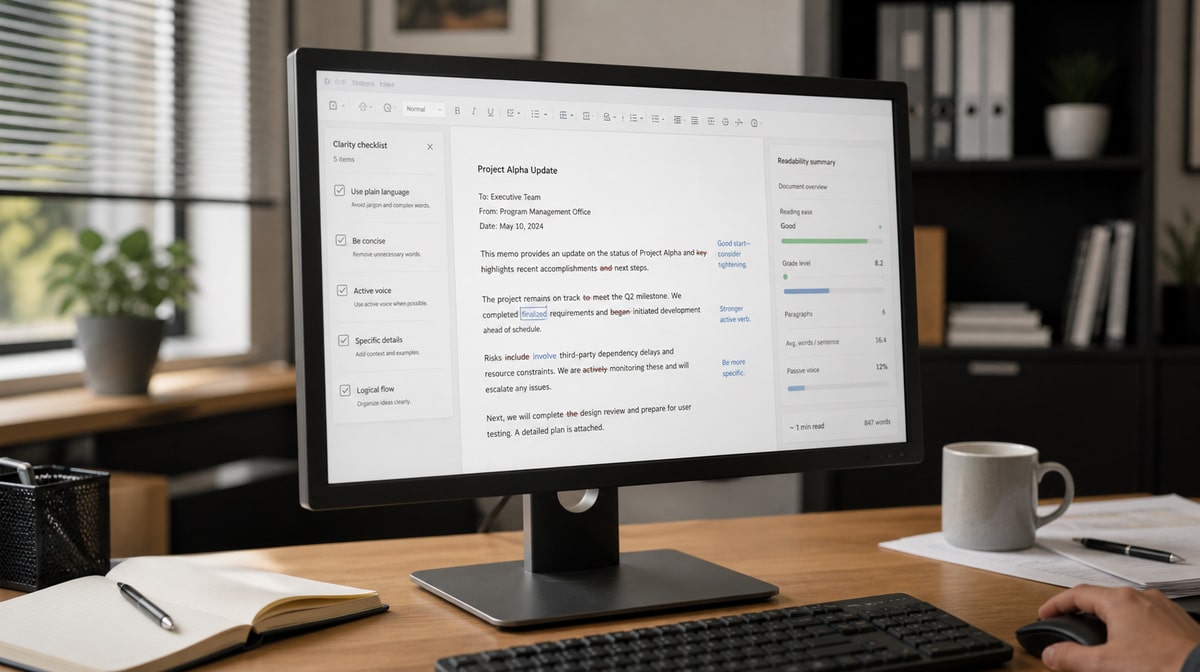
Everyone has an opinion on what it takes to be a good writer. Clarity is less subjective. When readers can identify the main point, follow the explanation, and take the correct action, the writing is effective. The following five ways preserve that practical standard.
A useful test is to give the document to someone who did not help write it. Ask that person to explain the main message and describe the next action. If the explanation changes from reader to reader, the draft probably needs a clearer purpose, stronger organization, or more precise wording.
Have a Purpose in Mind
Why are you writing: to educate, inform, impress, entertain, request a decision, or direct an action? Having a purpose in mind helps you focus the tone, style, message, and level of detail. If a document tries to do everything at once, the main point usually disappears.
For an email or memo, use the first paragraph to state what the reader needs to know and what response is required. For a procedure, begin with the purpose and expected outcome before moving into steps. You can still sound thoughtful and professional, but you should never sacrifice clarity to impress the reader.
Purpose also sets the boundary of the document. A status update should not become a complete project history, and a work instruction should not absorb every policy behind the task. Include the context needed for the reader’s decision, then link or refer to supporting material when deeper background is necessary.
Know Your Audience
Knowing your audience helps you make informed choices about context, vocabulary, and examples. Writers sometimes act as if they are writing for themselves, then wonder why other people do not understand the result. Identify the needs of the customer or colleague you are writing to, and ask questions when those needs are unclear.

Jargon and buzzwords may be efficient when you are writing for colleagues or a boss who shares the same technical background. The same language can confuse the general public or a new employee. The CDC Clear Communication Index recommends using words the intended audience uses and placing the main message where readers can find it quickly.
Context matters as much as vocabulary. If you are preparing a presentation, you need to know whether humor fits the audience and setting. If readers have little time, put the conclusion or requested action first, then provide supporting detail. Knowing your audience allows you to organize the message around their decisions rather than your drafting process.
Do not guess at audience needs when you can observe them. Review the questions customers ask, the mistakes new employees make, and the points where a procedure requires repeated explanation. Short interviews or usability checks reveal which terms need definitions and which steps need examples.
Use Active Voice
Active voice usually makes responsibility and sequence easier to see. In an active sentence, the subject performs an act: “The supervisor approves the request.” In passive voice, the subject receives the effects of the action: “The request is approved by the supervisor.” The active version names the actor immediately and uses fewer words.
Passive voice is not always wrong. Use it when the action matters more than the actor, when the actor is unknown, or when naming the actor would distract from the instruction. Prefer active voice when the reader must know who is responsible. If a procedure contains many vague passive sentences, strengthen it by adding verb power and naming the role that performs each step.
In procedures, start steps with a specific action verb whenever possible: verify, record, approve, compare, or notify. Avoid vague openings such as “it should be noted” or “there are.” Direct verbs make the sequence easier to scan and help reviewers identify missing responsibilities.
Simple Is the Best
Simple writing uses the shortest familiar wording that preserves the necessary meaning. You do not need flowery adjectives or inflated phrases to sound credible. Short sentences and paragraphs help readers keep their place, while precise and descriptive words reduce interpretation. For example, “use” is usually clearer than “utilize,” and “before” is clearer than “prior to.”
Simplicity does not mean removing essential detail or making the subject sound childish. It means organizing complexity so the reader can absorb it. Define specialized terms, break long instructions into steps, and keep each paragraph focused on one point. These habits also make business writing easier to read without weakening its substance.
Headings, lists, tables, and white space can support simple language, but they cannot rescue a confused message. Draft the logic first. Then use formatting to show relationships, sequence, exceptions, and emphasis. A reader should be able to scan the page and still understand how the parts fit together.
Read and Proofread
Never publish important work without reviewing it. One misspelled word may not destroy a useful document, but repeated errors, missing steps, or incorrect punctuation can make instructions look unreliable and create expensive misunderstandings. Whenever possible, ask another person to proofread and edit the piece before release.

Reviewing your own work is difficult for three familiar reasons:
- You are familiar with your writing, so your mind supplies the intended flow and message even when words are missing.
- You may avoid criticizing a sentence that took time to create, especially when it expresses an idea you value.
- After drafting a long piece, you may be too exhausted to reread it several times with full attention.
An independent reader does not share those blind spots. Ask that person to mark anything confusing, not merely spelling mistakes. If a second reader is not available, use the focused self-editing methods below.
Proofread from more than one direction. Read normally for flow, examine headings and lists by themselves for structure, and review critical numbers or names against the source. Some writers also read sentences from the end of the document toward the beginning so the story’s momentum does not hide surface errors.
How Should You Review and Edit Your Own Work?
You will sometimes need to review and edit your own work. A reliable process separates drafting from evaluation and divides the review into manageable passes. That makes it easier to see what is actually on the page instead of what you remember intending to write.

Give It Time
If time is on your side, set the draft aside and allow your mind to forget some of its message and flow. Review it after one or two days. The distance helps you notice missing connections, awkward wording, and assumptions that were invisible while the ideas were fresh.
When a deadline does not allow a full day, take a shorter break and change the review format. Print the document, read it on another device, or read it aloud. A different context can interrupt familiarity and make mistakes easier to spot.
Choose What to Focus On
Proofreading is easier when each pass has one purpose. Start with the document’s structure and confirm that the sections appear in a logical order. Then review sentence structure, spelling, word choice, and punctuation in separate passes. This sequence prevents small surface corrections from distracting you from a missing step or weak argument.
Use a repeatable checklist or a policies and procedures style guide when several people create documents for the same organization. A shared standard makes capitalization, terminology, numbering, and formatting easier to verify.
Track which version you reviewed and record major changes. Version control prevents an approved correction from disappearing when two people edit different copies. It also gives the final approver a clean way to compare the revised document with the prior version.
Spot the Common Errors
Keep a personal list of mistakes you make often, such as “your” instead of “you’re” or “its” instead of “it’s.” Double-check words you are unsure of rather than trusting memory. If the document includes facts, figures, citations, direct quotes, and proper names, verify each item against the original source.
Source checking is separate from copyediting. A perfectly punctuated claim can still be wrong. Use reliable primary material where possible, record enough information to find it again, and follow a consistent research process for evidence that supports a business decision.
Watch for internal errors as well. A heading may promise five steps while the body contains four, a table may use a different term than the procedure, or a cross-reference may point to an old section. These mistakes are easy to miss because each sentence can look correct on its own.
Avoid Repetition
Look for sentences or phrases that repeat the same point without adding meaning. Deliberate repetition can be a factor that influences learning, especially when a critical warning or required action must stand out. Accidental repetition, however, slows the reader and hides the main message.
Do not replace every repeated word with a different synonym. Consistent terms are important in procedures, contracts, and technical writing because a new word may imply a new meaning. Remove duplicate ideas, vary sentence structure when it helps, and keep the clearest term whenever precision matters more than variety.
Which Methods Keep Writing Clear Over Time?
There are many tricks in business writing, but clarity is a skill developed through practice and consistency. Define the purpose before drafting, organize the message for the audience, use direct verbs, simplify without stripping necessary detail, and review the result through focused passes.
Clear documents also need maintenance. Revisit procedures when responsibilities, systems, or requirements change. Ask real readers where they hesitate or make mistakes, then revise the language and sequence. A document is effective when people can use it correctly, not merely when it looks polished.
Frequently Asked Questions
What Makes Writing Clearer?
Clear writing presents one main meaning in a logical order, uses familiar and precise words, names responsible actors when needed, and gives readers enough information to take the correct action.
Why Should You Define Your Purpose Before Writing?
A defined purpose helps you choose the right tone, detail, structure, and requested action. It also keeps an email, memo, presentation, report, or procedure from trying to accomplish too many unrelated goals.
How Does Knowing Your Audience Improve Clarity?
Knowing the audience helps you select suitable vocabulary, examples, context, and depth. Technical jargon may work for experienced colleagues but confuse new employees or the general public.
When Is Passive Voice Appropriate?
Passive voice is appropriate when the action matters more than the actor, the actor is unknown, or naming the actor would distract from the instruction. Use active voice when responsibility and sequence must be explicit.
What Is the Best Way to Proofread Your Own Work?
Set the draft aside when possible, then review it in separate passes for structure, sentence clarity, spelling, word choice, punctuation, and source accuracy. Reading aloud or changing the format can also expose errors hidden by familiarity.