How Do You Optimize Your Inventory Management and Increase Efficiency?

Inventory management looks simple until the shelves, website orders, supplier lead times, and cash flow all start telling different stories. A retailer can have plenty of product and still miss orders if the wrong items are in stock, in the wrong location, or invisible to the people making purchasing decisions.
So how do you optimize your inventory management and increase efficiency? Start by treating inventory as an operating system, not just a stock count. The goal is to keep enough goods available to fulfill demand, avoid tying up cash in slow-moving items, and make replenishment decisions before shortages become customer problems.
What Is Inventory Management?
Inventory management is the activity of tracking, controlling, and replenishing the products and materials a business keeps in stock. It covers what is on hand, where it is stored, how quickly it moves, when to reorder, and how goods flow from suppliers to customers.
For a brick and mortar store, an ecommerce business, or a company with both channels, inventory management connects sales, purchasing, warehousing, transportation, and finance. If one part of that chain is late or inaccurate, the problem usually spreads: stockouts create lost sales, excess stock consumes cash, and obsolete inventory takes up space that could be used for faster-moving products.
The point is not to chase a perfect forecast. The point is to build a repeatable system that gives you early warning, clear ownership, and enough flexibility to react when demand, suppliers, or transportation plans change.
Ways To Optimize Your Inventory Management And Increase Efficiency
Inventory problems often look like warehouse problems, but the cause may be upstream. A weak demand forecast, unclear purchasing procedure, delayed supplier communication, or manual data entry error can all show up later as missing stock, rushed shipping, or customer disappointment.
Use the following practices to improve control without overcomplicating the process. Each one reinforces the same operating principle: inventory should move according to customer demand, documented procedures, and current data.
Predict Demand
One of the essential aspects of managing inventory is understanding demand. Predicting exactly how fast products will sell is difficult, but a useful estimate is still better than waiting until shelves are empty or warehouse space is full.
Start with the information your business already has: prior year sales, current growth rate, confirmed orders, subscriptions, contracts, upcoming promotions, and seasonal patterns. Then compare those signals against market trends and supplier lead times. A forecast should not be a one-time spreadsheet. It should be reviewed often enough that purchasing decisions reflect what is actually happening.
NIST’s guidance for small manufacturers emphasizes supply chain situational awareness, including customer demand, market outputs, and supplier inputs. That same discipline applies to retailers and ecommerce companies: you cannot optimize inventory if you only look at what is already sitting on the shelf.
To make demand planning practical, decide which items deserve the closest attention. Fast-moving, high-margin, or hard-to-replace products should usually receive tighter reorder points and more frequent review. Slow-moving goods may need smaller purchase quantities, markdown plans, or discontinued status before they become obsolete.
As an example, compare sales from the previous year with your sales today, determine guaranteed sales from subscriptions or contracts, monitor your current growth rate, check upcoming promotions, and decide whether seasonal hype will change order timing. Those activities give you a rough estimate of demand before additional expenses, loss of money, or loss of customers appear elsewhere in the supply chain.
Use Reorder Points And Safety Stock
A reorder point tells you when to buy more. Safety stock gives you a buffer for demand spikes, supplier delays, transportation problems, or temporary quality issues. Together, they turn inventory replenishment from guesswork into a repeatable decision.
At a basic level, your reorder point should account for average demand during supplier lead time, plus a reasonable safety stock amount. If a product sells 10 units a day and the supplier normally takes 14 days, ordering only when you reach 20 units is already too late. You would likely need enough stock to cover the lead time plus a buffer.
Review these levels whenever demand changes, suppliers become less reliable, or the cost of holding inventory changes. A reorder point that worked last year can be wrong after a promotion, a new sales channel, or a supplier change.
Leverage Technology
The size and scope of your inventory can make manual management expensive, slow, and error-prone. The more orders, locations, suppliers, and product variations you handle, the harder it becomes to rely on spreadsheets alone.
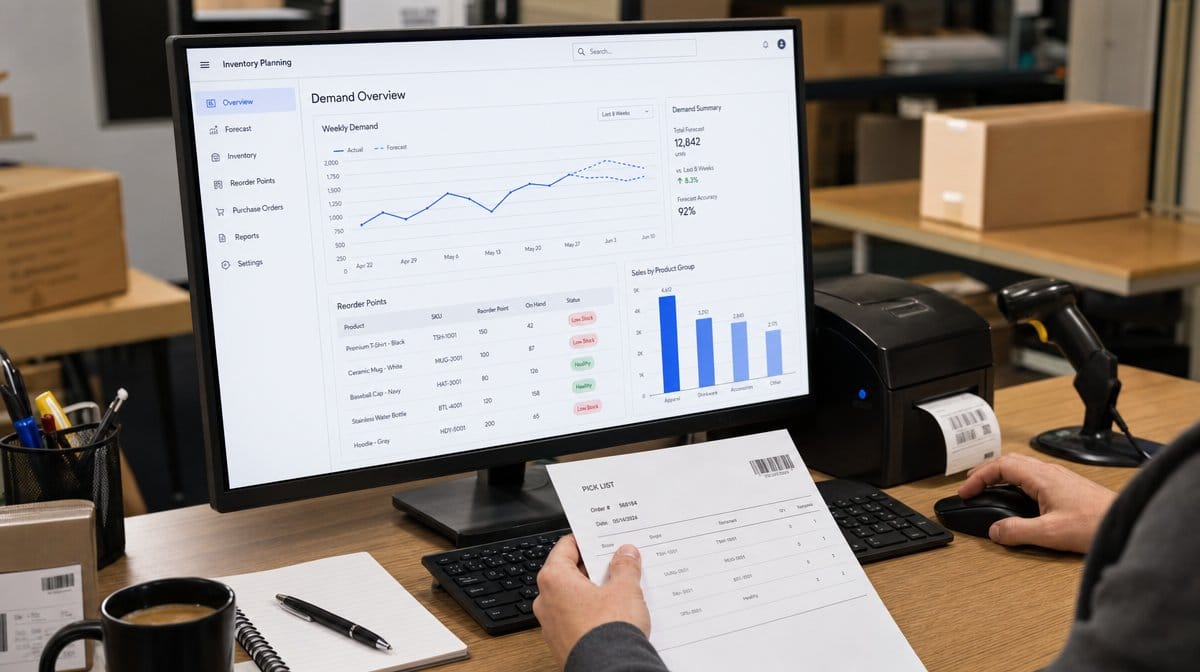
A reliable warehouse management system can help with receiving, put-away, order picking, labeling, packing, cycle counts, and transportation handoffs. It can also reduce the amount of time employees spend entering the same data into multiple systems.
Technology is most useful when it supports a clear inventory management procedure. If the procedure is unclear, software may only automate the confusion. Define who updates inventory records, who approves purchases, when counts are performed, how exceptions are handled, and what happens when stock levels fall below the reorder point.
Automation can also improve inventory control by reducing manual tasks such as data entry, invoice matching, stock alerts, and routine reporting. The benefit is not only speed. Better visibility helps managers make purchasing decisions before inventory becomes old, obsolete, or unavailable when customers need it.
Apply Lean Inventory Practices
Lean inventory practices focus on reducing waste while preserving the ability to serve customers. That does not mean cutting stock blindly. It means understanding which inventory supports demand and which inventory exists because of habit, fear, poor forecasting, or unclear purchasing rules.
A Lean Kanban system can help reduce excess inventory by tying replenishment to actual consumption. Instead of buying more because a calendar says it is time, teams replenish when stock reaches a visible trigger point. This keeps attention on customer demand rather than production or purchasing convenience.
Lean systems still need judgment. NIST notes that many manufacturers learned the limits of strict just-in-time thinking when supply chains became unstable. The practical answer is balance: reduce waste where demand is predictable, but maintain strategic buffers where disruption would stop production or disappoint customers.
Ensure Good Relationships
Meaningful relationships are essential in the business world, and not only with customers. Good relationships with suppliers, manufacturers, employees, warehouse teams, drivers, and third-party logistics partners can directly affect how efficiently inventory moves.
For instance, you may need to return an item to make room for another, restock faster than usual, adjust a delivery window, or respond to a manufacturing issue. Those adjustments happen faster when the people involved know the process, trust the communication, and understand the business priority.
Build those relationships into your operating rhythm. Share forecasts with important suppliers. Give warehouse employees a way to flag recurring errors. Review delivery performance with carriers. When a problem appears, a good relationship gives you more options than a purchase order number and a voicemail.

Outsource Inventory Management When It Makes Sense
A lot of businesses cannot handle logistics on their own. Sometimes the issue is cost. Sometimes it is warehouse space, staffing, technology, shipping expertise, or the complexity of serving multiple sales channels. In those cases, outsourcing part of the process may be more efficient than trying to build everything internally.
A third-party logistics provider can manage warehousing, picking, packing, shipping, returns, and sometimes inventory reporting. That can free the business to focus on product selection, sales, customer service, and supplier management.
Outsourcing does not remove responsibility. You still need documented service levels, inventory accuracy targets, reporting expectations, exception procedures, and regular performance reviews. If those controls are missing, outsourced inventory can become just as opaque as poorly managed internal inventory.
How Do You Know Inventory Management Is Improving?
Inventory efficiency should show up in measurable operating results. Useful indicators include stockout frequency, inventory turnover, order accuracy, carrying cost, obsolete stock, supplier lead time variance, order cycle time, and customer complaints tied to availability.
Do not track every possible metric with equal intensity. Pick the few that reveal whether inventory is helping or hurting the business. A retailer with frequent stockouts may focus first on availability and reorder points. A business with too much cash tied up in old goods may focus first on turnover and obsolete inventory.
Whatever you measure, connect the metric to a decision. If low-stock alerts do not trigger a purchasing action, they are noise. If inventory reports do not change order quantities, supplier conversations, or warehouse procedures, they are paperwork.
Optimize Your Inventory Management And Increase Efficiency
Managing inventory can be challenging because it touches nearly every part of the business. The success of a retailer, ecommerce company, distributor, or manufacturer depends on how efficiently goods are stocked, tracked, replenished, and delivered to customers.
To optimize your inventory management, start with demand, document the procedure, use technology where it reduces manual work, build stronger supplier relationships, and consider outsourcing when logistics complexity outgrows your internal capacity. Better inventory management is not only about having more stock. It is about having the right stock, in the right place, with the right process behind it.
Frequently Asked Questions
What Is Inventory Management?
Inventory management is the process of tracking, controlling, and replenishing the goods a business keeps in stock. It helps the business meet customer demand without carrying unnecessary excess inventory.
How Do You Optimize Inventory Management?
You optimize inventory management by forecasting demand, setting reorder points, maintaining safety stock, documenting procedures, using appropriate technology, and reviewing supplier performance regularly.
Why Is Demand Forecasting Important For Inventory?
Demand forecasting helps a business prepare for expected sales before customers place orders. It reduces stockouts, excess purchases, rushed shipping, and obsolete inventory.
When Should A Business Use Inventory Management Software?
A business should consider inventory management software when manual tracking creates errors, slows fulfillment, hides stock levels, or makes it difficult to coordinate purchasing, warehousing, and sales.
Can Outsourcing Inventory Management Improve Efficiency?
Outsourcing can improve efficiency when a qualified logistics partner can manage warehousing, fulfillment, returns, or shipping better than the business can internally. The business still needs clear controls, reporting, and service expectations.