How to Become an Effective Business Leader in a Crisis

Real leadership is easiest to recognize when a business has fewer good options and every decision affects employees, customers, and cash flow. Effective business leaders earn followership by pairing vision with judgment, clear communication, and disciplined action.
Some people naturally gravitate toward these quality individuals, while others recognize their leadership through experience. What does it take to build the qualities of an effective business leader and use them when a crisis narrows the room to maneuver?
What Is Effective Business Leadership?
Effective business leadership is the ability to create a positive future vision, turn that vision into a practical strategy, and help people act together to achieve it. A title gives someone authority. Leadership earns commitment by connecting organizational purpose to the decisions, details, and behavior employees see every day.
Effective business leader characteristics reinforce one another. Vision without competence becomes wishful thinking. Strategy without communication creates confusion. Decisiveness without principles can move an organization quickly in the wrong direction.
This is why leadership is more than supervision. Managers create schedules, allocate work, monitor controls, and keep recurring processes stable. Leaders also define the purpose behind that work, decide what must change, and help people cross the uncertainty between the present system and a better one. A capable executive must often do both jobs, but authority alone does not produce followership.
The practical test appears in the operating rhythm. Do employees know the vision, the current priorities, the measures that matter, and who can make a decision? Can they raise a problem without waiting for a crisis meeting? Effective leadership makes those answers visible before pressure exposes the gaps.

Which Characteristics Make a Business Leader Effective?
First, effective business leaders exhibit a combination of qualities and leadership characteristics that make people want to follow them. These qualities are not a checklist to perform once. They are connected habits that guide how a leader sets direction, makes decisions, and responds under pressure.
Leaders Are Visionary
Leaders are able to create a vision of a positive future. A credible vision begins the process of getting buy-in from the team because it explains where the organization is going and why the destination matters.
Leaders Are Strategic
An effective business leader understands how to capitalize on the assets of the organization with a solid management strategy. The leader turns the shared vision into choices about customers, people, resources, priorities, and the work that must happen next.
Leaders Are Competent
Leaders know their business. They know the market and they know their customers. This enables them to set a vision and strategy based on knowing rather than guessing, because leaders value organizational learning and test assumptions against operating facts.
Leaders Understand the Details
An effective business leader notices the details that can be strung together to make the strategy work. Leaders do not need to control every task, but they pay attention to critical handoffs, dependencies, risks, and measures so important details do not fall through the cracks during implementation.
Leaders Are Good Communicators
Leadership requires communicating the strategy in order to accomplish the vision. A leader must explain priorities, listen to concerns, repeat what matters, and make difficult decisions understandable. Clear communication helps leaders get buy-in to ensure results.

Leaders Are Passionate
In order to lead others, one must truly believe in and care about the strategy and vision. Nobody wants to follow a half-hearted leader. Passion becomes useful when it produces steady attention, energy, and belief without crowding out evidence or dissent.
Leaders Are Assertive
A leader must overcome obstacles and objections when trying to lead. Maintaining a position sometimes requires sticking to your beliefs and convincing others to support the strategy. Assertiveness is most credible when the leader can explain the principle, evidence, and tradeoff behind the decision.
Leaders Are Dedicated
Leading means making a commitment to the cause. An effective business leader leads by example and is the first to act on the strategy they are espousing. Employees compare stated priorities with the leader’s calendar, attention, and behavior.
Leaders Are Adaptive
Continuous improvement applies to leaders as well as processes. A good leader knows when to accommodate others to achieve a greater good, when new evidence requires a change, and when the original purpose still matters even though the plan must adapt.
Leaders Are Decisive
Making decisions is what a leader does. Decisions may not always be liked, but leaders make them anyway to keep the organization moving forward. They state what was decided, who owns the next action, and when the decision will be reviewed.
Where Do These Leadership Qualities Come From?
The military service academies purposely educate and groom individuals to be leaders by instilling discipline, self-sacrifice, an unshakable work ethic, and the need to plan for the best while preparing for the worst. They do not have a perfect track record, and outstanding leaders throughout history have developed without military service.
The broader lesson is that leaders can be developed through education, training, experience, feedback, and repeated responsibility. Military leadership doctrine similarly emphasizes competence, character, training, and the ability to understand and direct in complex conditions. Business leadership develops when organizations give people real problems to solve and hold them accountable for both results and conduct.

What Does Effective Leadership Look Like in a Crisis?
Imagine yourself, the CEO, in the place of the officer in charge. Your organization is the castle, outpost, or fortress under siege. You can fight or surrender, and retreat may not be an option. The metaphor is severe, but it captures the pressure of a business crisis: limited time, incomplete information, constrained resources, and consequences for a small group that depends on your judgment.
Leaders understand the difference between crisis management and risk management. Risk management prepares for possible events. Crisis management coordinates decisions and resources after disruption demands an immediate response. Preparedness creates the communications, continuity, training, and decision habits employees need when operations are disrupted.
How Can You Be a Leader During a Crisis?
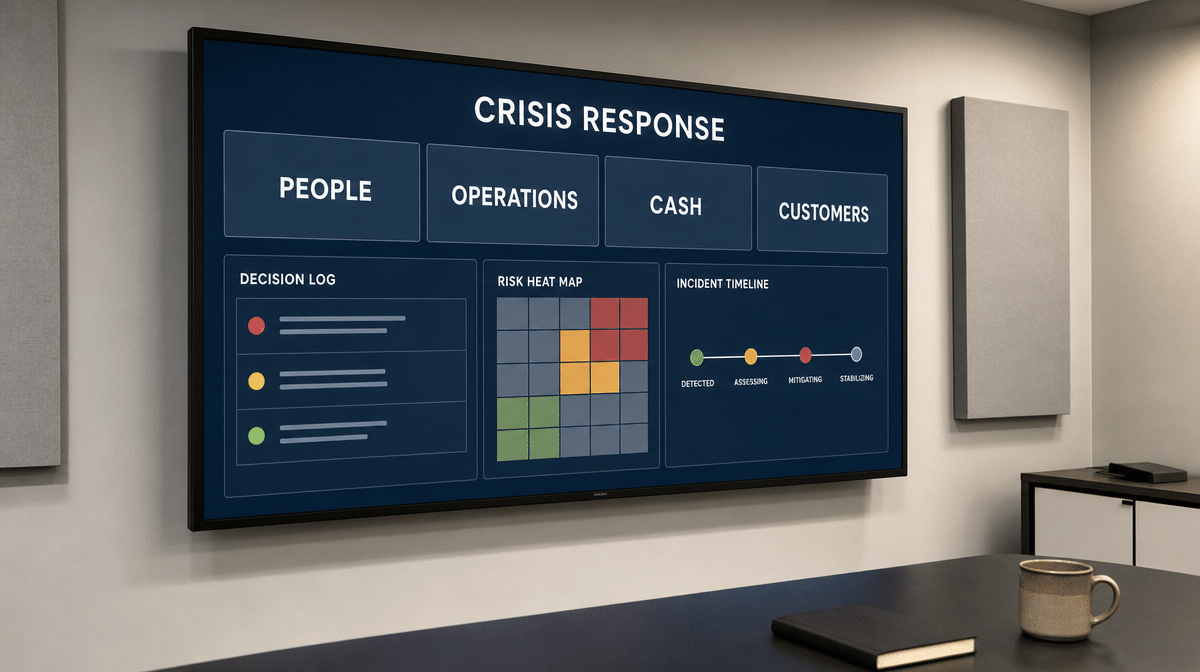
Your company might not be literally under siege, but when times are tough, good leadership in crisis follows a disciplined sequence. The following ten actions establish clear ownership and turn decisions into coordinated execution.
1. Leaders Are More Than Bosses
Get out in front of your employees. If you do not demonstrate leadership capability, who will follow you? Visibility does not mean pretending to have every answer. It means accepting responsibility, setting a cadence, and remaining present when people need direction.
2. Leaders Stand on Principles
There is the expedient thing to do and there is the right thing to do. If you believe in yourself, your product, and your employees, you will protect the principles that make trust possible. State which values are nonnegotiable before pressure makes them convenient to ignore.
3. Leaders Maintain Employee Morale
Morale grows from credible hope, useful work, and evidence of progress. A leader should acknowledge the difficulty, define what the team can control, and show how each completed action improves the organization’s options.
4. Leaders Build a Circle of Command
Leaders are social, and they understand that they are leading teams. They know who employees look up to and make those individuals part of a leadership Circle of Command, or C of C. Do not lock yourself into one hierarchy when informal leaders hold critical knowledge and trust. FEMA’s command-and-coordination guidance likewise emphasizes senior decision-making, resource allocation, and communication across the response structure.
5. Leaders Determine Their Options
Use the fuller circle of command to determine the available options. Invite contrary evidence, identify assumptions, and explain why you prefer option X. The purpose is not consensus on every choice. It is a decision informed by the people closest to the work.
6. Leaders Understand Their Resources
Realistically assess your resources, strengths, and weaknesses. Include people, time, cash, customer commitments, suppliers, systems, and decision rights. A plan that assumes unavailable capacity is not a plan.

7. Leaders Plan Ahead
Leaders have action plans for both the best-case and worst-case scenarios. They prepare for the unexpected with a plan that names triggers, owners, deadlines, communications, and fallback actions. The SBA’s business emergency-preparedness guidance recommends assessing risk, creating a response plan, and practicing it with staff. A short plan that people can execute is more useful than a perfect plan nobody can find.
8. Leaders Execute a Plan
Now that you have a plan, the next step is to go through with it and realize the intended result. Convert decisions into named actions, track them visibly, remove blockers, and close the loop. Leadership becomes real through execution.
9. Leaders Provide Employees Choices
Leaders set clear expectations and give employees an informed choice about taking a stand with the team. People should understand the plan, the standards, the sacrifices required, and the support available. Clarity is more durable than coercion.
10. Leaders Review and Adapt
A crisis changes as new information arrives. Review decisions at a defined cadence, compare results with assumptions, and adapt without losing sight of the vision and principles. Effective leaders distinguish between persistence in purpose and attachment to a plan that no longer fits the facts.
Can Effective Business Leader Traits Be Learned?

Is there such a thing as innovative leadership quality? People can be trained to manage, and leaders can also be developed. There is no easily reproducible process or easy-to-follow recipe because leadership combines character, competence, judgment, context, and the willingness to act.
Development requires repeated practice. Give emerging leaders responsibility for real outcomes, teach them to connect vision and strategy, review their decisions, and provide direct feedback on communication, details, principles, and execution. Continuous improvement applies to leadership capability just as it applies to business processes.
Anyone can play a leader when things are going well. Leadership in crisis determines who the true leaders are because pressure exposes whether vision, strategy, competence, communication, dedication, adaptability, and decisiveness work together when the organization needs them most.
Frequently Asked Questions
What Is Effective Business Leadership?
Effective business leadership is the ability to create a credible vision, turn it into strategy, and help people act together to achieve it. It combines character, competence, communication, judgment, and execution.
What Qualities Make a Business Leader Effective?
Effective leaders are visionary, strategic, competent, detail-aware, communicative, passionate, assertive, dedicated, adaptive, and decisive. The qualities work together rather than as isolated traits.
How Should a Leader Respond During a Crisis?
A leader should accept responsibility, stand on principles, maintain morale, consult a circle of command, determine options, assess resources, plan, execute, clarify expectations, and adapt as facts change.
What Is the Difference Between a Leader and a Manager?
Managers coordinate work through authority, systems, and controls. Leaders earn followership by setting direction, explaining purpose, making decisions, and modeling the behavior needed to move the organization forward.
Can Effective Leadership Be Learned?
Leadership can be developed through education, training, experience, feedback, and responsibility for real outcomes. There is no single recipe because effective judgment depends on character, competence, and context.