
What are Processes and Procedures?
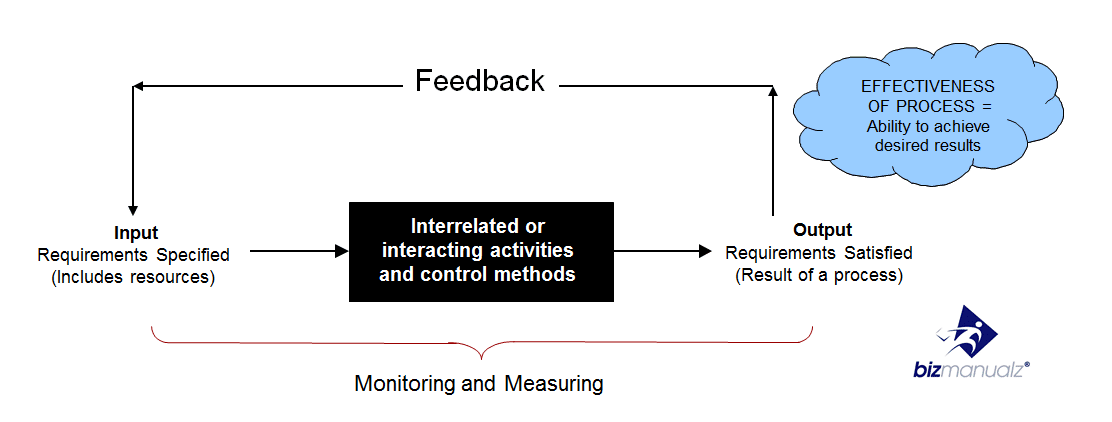
“Why do we have processes and procedures?” Frequently people struggle to give a clear and meaningful response to such an obvious question. But first, probably one of the most important questions to ask before starting or updating a system of policies and procedures is, what are processes and procedures?
Processes and Procedures
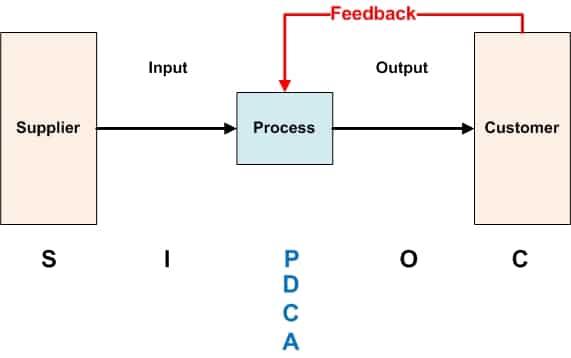
A process or procedure is a standard way of performing a task. What’s the difference between processes and procedures? A process is a series of steps taken to transform an input into an output. A procedure is the documentation of those steps used to communicate the process to others (i.e. for training, managing, or process improvement). Besides having inputs and outputs, controlled processes must have feedback in order for the process to exhibit control. Also, inputs come from somewhere called the supplier and outputs go to somewhere called customers (sse SIPOC diagram). Controlled processes are needed for consistent, stable, and reliable products and services to their customers. The are often referred to as Standard Operating Procedures or SOP for short.
Why Do We Have Processes and Procedures?
There are page-long lists of why policies and procedures are necessary, but, of course, such long lists lose meaning and value. By the time you read to the bottom, you don’t remember what was at the top of the list. Plus, such long lists have too much overlap and repetition. A simple approach may be more useful. The purpose for creating an internal control system through defining and documenting processes with well-written procedures boils down to a few very basic reasons:
- Compliance
- Operational Needs
- Managing Risks
- Continuous Improvement
New Release of “How to Write a Policies and Procedures Manual” is now available.
Policies & Procedures Improve Compliance
Complying with laws and regulations should be the most basic function of an organization. Even the smallest of organizations must comply with tax laws and with state and local regulations (i.e. zoning, licensing), while some organization must cope with a myriad of federal and state laws and regulations. Other compliance issues may deal with quality standards like ISO 9001, ISO 22000, or UL.
While procedures themselves may not demonstrate compliance, well-defined and documented processes (i.e. procedures, training materials) along with records that demonstrate process capability can make evident an effective internal control system and compliance to regulations and standards.
Let’s face it; if your organization is having trouble in performing the rudimentary function of obeying laws and regulations, then it is likely struggling even more at being effective and successful in fulfilling its core missions. If compliance is an issue in your organization, then creating well-defined processes documented by procedures in order to meet your legal and regulatory requirements should be a high priority.
 Ensure Operational Needs Are Met through Policies and Procedures

What is really important in your business? What is fundamental for its success? Are practices associated with them being steered by top management? How much visibility and transparency is there into the effectiveness of these key processes?
This brings us to the next important role of procedures; to ensure processes fundamental to the organization’s success are properly guided by management, are performed in a consistent way that meets the organizations needs, and that important related information and data are captured and communicated.
For example, if regularly introducing new and improved products is essential to the success of your business, shouldn’t you be in control of your sales and marketing cycle that captures customer requirements and desires so they can be translated into your product design? Shouldn’t there be well-documented design review and product launch processes?
Drive Improvement and Internal Control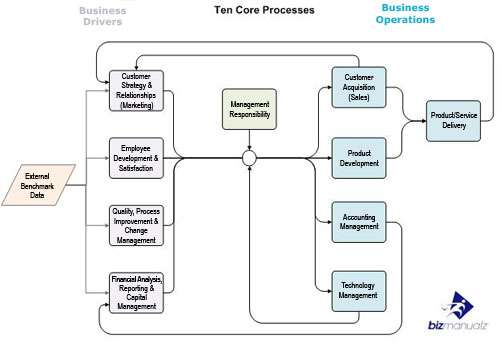
Reviewing data for process effectiveness is one form of internal control and should be an integral part of any business process. Are your objectives being achieved? Are the objectives meaningful and reflect the processes’ importance and risk? Using internal controls, the necessary corrections can be identified and implemented as a result of the review. Your procedures describe your process and its internal controls.
Your Policies and Procedures help your organization by providing employees with a handy reference to daily business operations, common company activities, or routine organizational tasks. New personnel will find your operations manual useful for getting trained and up to speed, fast on such things as internal controls. After all, with standard operating procedures in place, training is faster and interruptions are reduced.
Improvement occurs when we compare the prior condition to the current condition. Improvement is always a question of “as compared to what?” By documenting your business processes with procedures, you will have a foundation for improvement. A record of the standard work that was performed at a point in time.
What is more important than control, training and improvement? Procedures are important for controlling processes, documenting the standard work that was performed at a point in time. And training workers on the business process.
Use standard operating procedure templates that save time, guide you through common best practices and provide a format that you populate with your own company differences. Download Download free policies and procedures to start saving time writing your own procedures.


Processes (and procedures) are necessary, that’s true. It’s unfortunate that quite often they can have a bad reputation and can be considered restrictive. My colleague recently wrote an article on how to fix that: https://www.stxnext.com/blog/why-does-your-company-need-processes-guide-for-managers/
[…] Segundo Bizmanualz, “processos servem para alcançar conformidade, necessidades operacionais, gestão de riscos e desenvolvimento.” Com tanto escopo, diversos métodos e modelos de negócios foram criados para auxiliar na criação de processos e estratégias. Objetivos SMART, Círculo Dourado, Processo OGSM são só alguns. Há também milhares de ferramentas com a mesma finalidade: […]