
How to Implement Lean Thinking

Interest in Lean Thinking continues to grow. Many people have attended Lean training to learn the tools used to implement lean. But one question remains for many — how or where do you start to implement lean thinking?
What is Lean Thinking?
In order to implement lean thinking, we first need to understand what lean is and what it is not. It is not a set of tools, a set of procedures to follow, or a series of logical steps. Lean is a thought process, a culture, or belief system. So the most important thing that we must work on is how to change the thinking in your organization so that lean happens. First we need to identify our goals. For this we use position goals.
Instead of looking at how to change a situation from the outside we examine it from the inside to discover its potential energy and find the energy flows. In other words we need to determine the natural forces of flow or the starting point of the situation and then use this flow to achieve the results we desire.
Metrics Change Behavior
One example of this is your company metrics. Your metrics drive your culture, which drives individual behaviors. Change the metrics in your organization and you will change people’s behavior. To implement lean thinking, the position goal is to change the metrics.
Constraints Balance Flow
Another example uses your constraints. Using the Theory of Constraints we identify, exploit, and elevate the constraint to flow while subordinating all else to that constraint. By focusing on the constraint we can balance the flows within an organization and eliminate the harmful side effects (waste) that are occurring. This part of learning to implement lean thinking involves identifying, exploiting, and elevating the constraint while subordinating all else to that constraint.
First Improvement Event
Another example is a successful process improvement event. We will start out narrow, from a single point in the system, then move to the whole system flow before moving on to create a competitive supply chain advantage and make a value chain.
The first event must be successful if we want to grow the improvements, change peoples thinking, and get more people involved. The first event must have a respectable Return on Investment (ROI), alleviate a constraint and be completed fast (in days). It should be simple enough and noticeable to everyone. The position goal is to hold an improvement event.
We now have three position goals: (1) change the metrics, (2) use your constraints, and (3) hold an improvement event . What’s next? Yes we have to determine the metrics, find the constraints, and hold an event but how/where do we start?
First Pass Assessment
With our goals in place, we need to perform a first pass assessment where we are looking for examples of waste. We want to document the metrics used and important facts like cycle times, inventory turns, operational effectiveness measures and customer demand. We will follow the order flow (from customer order to customer delivery), draw a Value Stream Map (VSM), identify the constraints to flow, look for customer value and understand the supply chain issues. This first pass takes about a day or so, or more for larger supply chains.
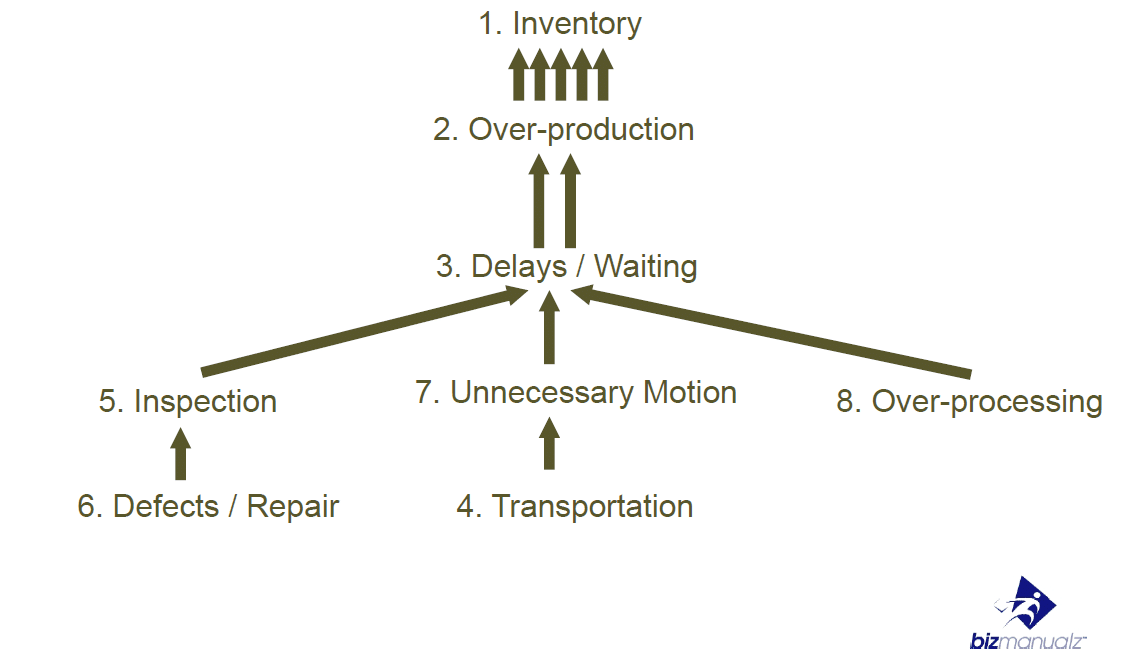
Lean Wastes
Visible Waste
The first pass assessment provides a lot of information fast. Don’t worry about collecting all of the data right away if it is not readily available. We will collect more detailed data later on in the next pass. The idea is to get a “big picture” view and to understand the scope of the operations. You will notice a lot of visible waste. Look for the eight wastes and try to understand why they build up (the potential energy flows). Note all process interfaces and customer touch points and their waste production, introduction, or handling (automation or institutionalizing). If you find one of the lean wastes, then the others are certainly near by and can be found too.
With a first pass assessment complete, you are already working towards your position goals and learning to implement lean thinking. You are beginning to understand your metrics, flows, and constraints to flow. This should give you some ideas as to what your first event should be. The Value Stream Map documents what you saw, so you can communicate it to others. Use it to build your case for the next step (next week) — a more detailed analysis of the metrics, flows, and constraints.
When we start with the right goals, we are working towards the right answers. The result is to end up with the right solution to the right problem. If you understand the flows inside your organization then you are half-way to thinking lean. The other half is to understand how to use those flows to achieve your goals. That is the power of position goals and lean together.


Your explanation to kick start by doing an assessment is well done……this process helps to evaluate…..What is happening? What is the problem you are trying to notice in the work flow?
Good job