««Blog Home

Top 10 Business Problems Solved by Policies and Procedures

Postedby Chris Anderson on 07-06-2010

Policies and procedures provide the framework and direction for addressing many common business problems your organization might face.  Let’s look at the top ten business problems solved by Policies and Procedures.

1. Accounts Receivable procedures to reduce accounts receivable (A/R) aging and ensure even cash flow.  Every company needs Strategies for Writing Accounts Receivable Procedures.  Your accounts receivable process is the heart of your cash cycle.  Salespeople can find plenty of customers but without cash-paying customers, you can’t pay your bills, which is part of your Strategies for Writing Accounts Payable Procedures.

2. Sales procedures to standardize sales pipeline management and ensure a consistent sales pipeline.  Sales procedures allow you to take control of the sales and marketing cycle.  Developing measurements, sales assignments, and target markets are all important elements of your sales process.

3. Disaster Recovery procedures will assist in an orderly and timely response to emergencies your company may face, as well as control the inevitable chaos that occurs.  Every company needs to effectively respond to disasters or emergencies in a timely manner; if not, they could be out of business.  In recent months, we’ve had ample opportunity to learn the lessons of the Gulf oil disaster, such as “having a disaster recovery plan before the need arises”.

4. Human Resources procedures ensure non-discriminatory practices; specifically, well-defined employee hiring and termination practices will help you avoid costly litigation.  Human resources procedures address diverse topics such as recruiting, hiring, training, retention, termination, and — most importantly –complying with local, state, Federal, and even international employment laws.

5. Quality procedures (nonconformance, corrective action, and auditing) improve product and process quality.  The ISO 9001 quality standard addresses quality control, quality assurance, and quality management practices.  Learning how to meet quality standards with ISO 9001 will help your organization reduce costly rework and overtime, thereby improving quality, satisfying customers, and contributing to your competitive advantages.

6. Customer communications procedures, like collecting data from customer feedback and complaint handling for process improvement.  ”Poor customer communication” is the root cause of much customer dissatisfaction.  If you know what your target customer wants, your business has all the information it needs to satisfy the customer. Implementing communication procedures will help you act on your customers’ wants, improving sales.

7. Shipping and receiving procedures are needed to track materials purchased and sold.  Most of shipping and receiving revolves around inventory or assets, which requires processes for handling, inventory management, asset acquisition, and asset disposition.  Specific supplier requirements — and the policies and procedures that flow from them — ensure that you receive what you want, when you want it, in the quantity you want, and with quality built in.

8. Management procedures can improve poor meetings, poor internal communications, and poor reporting.  Management is really about communication — that’s why improving internal communication benefits the whole company.  One of the best ways to improve communications is to develop, document, implement, and monitor a procedure for communications.

Also, it’s important that management shows its commitment to the highest standards, whether those standards have to do with internal processes or processes that directly involve your customers.

9. You also need compliance procedures to ensure your company conforms to the requirements of various regulations, statutes, and standards.  This is where policies and procedures can help your organization.  Compliance is one of the primary problems solved with policies and procedures.

10. Accounting procedures ensure that you fulfill your fiduciary responsibility to your shareholders.  Accounting is a process to track transactions of items, cash, and information.  Accounting procedures help to ensure consistency, reliability, and accuracy of those transactions, which (in turn) helps to build trust in your financial statements.  What Are the Top Ten Accounting Policies and Procedures?

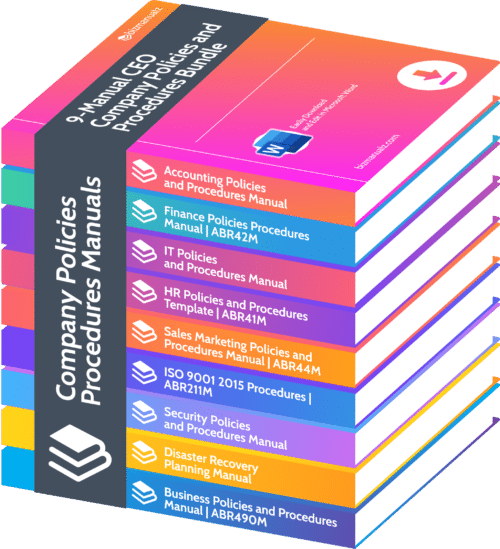
Prewritten policies and procedures from Bizmanualz help solve many of these common business problems.  The Top Ten Core Business Policies and Procedures you will need can be found in the Bizmanualz CEO Company Policies Procedures Manuals bundle.

Top 10 Business Problems Solved by Policies and Procedures

  1. Accounts Receivable procedures, to reduce A/R aging and ensure even cash flow.
  2. Sales procedures, to standardize sales pipeline management to ensure consistent sales.
  3. Disaster Recovery procedures, to control the response to chaos in an emergency.
  4. Human Resources procedures, to ensure non-discriminatory employee hiring and termination.
  5. Quality procedures, to improve quality.
  6. Customer communications procedures, to collect data from feedback and complaint handling for process improvement.
  7. Shipping and receiving procedures, to track materials purchased and sold.
  8. Management procedures to improve poor meetings, communications, and reporting.
  9. Compliance procedures to conform to regulations, standards, and laws.
  10. Accounting procedures, to fulfill your fiduciary responsibility to your shareholders.

What do you think? How quickly could your most urgent problems be solved by implementing effective policies and procedures?

What Is The Purpose of SOX Policies and Procedures?

Postedby Chris Anderson on 11-09-2009

In Sarbanes-Oxley compliance your SOX policies and procedures have the same purpose as with ISO 9001 policies and procedures, to provide a foundation for improvement.  Sarbanes-Oxley is not a quality standard so why the need for improvement?

First, Sarbanes-Oxley (SOX Section 302 and 404) requires that your financial reports contain accurate information from controlled accounting and financial processes.  Second, signing executives have to report on the effectiveness of the company’s internal controls and disclose any significant deficiencies in the design or operation of those internal controls that could affect the company’s financial reports.

ISO 9001 uses terms like effectiveness and deficiencies too.  Only the focus is on continuously improving effectiveness and identifying non-conformances that do not conform to planned arrangements.   Sounds pretty similar to SOX compliance.

SOX Policies and Procedures Provide a Baseline for Improvement

SOX policies and procedures are used to build consistency, communicate SOX internal controls, and provide a baseline for SOX improvement.  This is done by indentifying a target performance (policy) and communicating a series of actions (procedure) to achieve the target. Risks are areas for mistakes, fraud, or abuse.  Internal controls are responses to mitigate indentified risks to the policy and procedure. 

For example, an accounts receivable policy might be timely invoice collection.  Your procedure consists of the steps to ensure a timely invoice collection.  Risks include an accounts receivable clerk taking cash, misapplying collections, or not collecting at all.  Internal controls could include: segregation of duties, cash application controls, bad debt reserves, credit policy, credit approval process, and so on.  Each control counters one or more identified risk to the accounts receivable procedure. 

But let’s say we missed a few risks, now what?  If it is determined to be a significant deficiency then you would disclose the risks that you missed and work on improving them.  With SOX policies and procedures like this, you are Sarbanes-Oxley compliant.  You have reported on the effectiveness of your controls and disclosed known deficiencies, just like with ISO 9001.  Sarbanes-Oxley compliance and ISO 9001 conformance are pretty similar in their implementation.

Bizmanualz Accounting Policies Procedures Manuals serve as a model, or framework, for your own SOX policies and procedures.  Save time with the CFO Accounting Policies and Procedures Manuals set, which contains 239 procedures you can use to address Sarbanes-Oxley compliance with the ten accounting cycles.

Best Deal - Save 62%!
Contact Us